

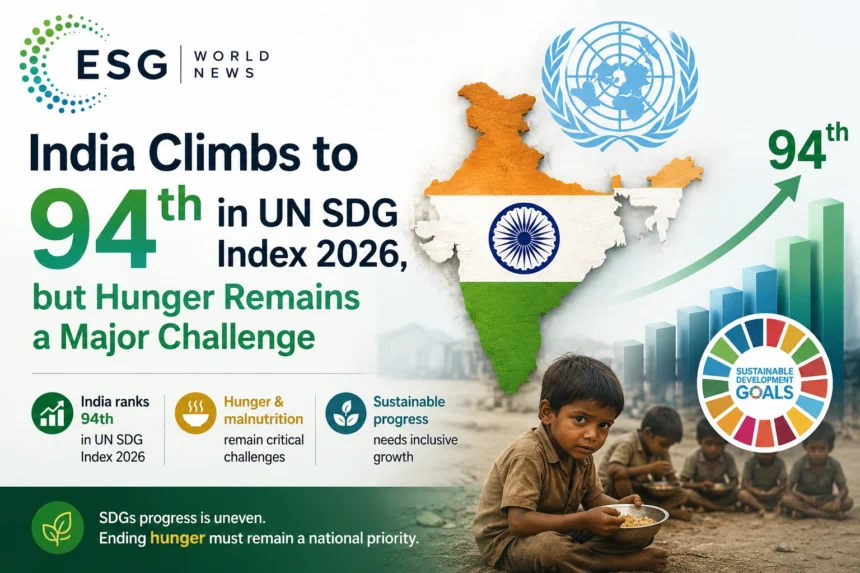
India has recorded its highest-ever rank in the UN Sustainable Development Goals (SDG) Index, climbing to 94th place among 167 countries in the 2026 edition. With an overall score of 68.3 out of 100, the country improved from 99th place in 2025, marking its strongest SDG performance since the global goals were adopted in 2015.
- Hunger remains India’s biggest development challenge
- Child stunting remains high
- Child wasting is worsening
- Undernourishment is rising again
- Obesity is also increasing
- Health, climate and governance remain weak spots
- Health indicators show slow or negative movement
- Carbon emissions continue to increase
- Press freedom and governance indicators remain under strain
- Why India’s SDG progress matters globally
- Conclusion
The rise in ranking shows that India has made steady gains over the past decade. Since 2015, the country has moved up 18 places, making it one of the strongest performers in terms of improvement among major economies. The broader regional trend also points to rapid progress in East and South Asia, where several countries have advanced in SDG implementation.
However, India’s improved global standing does not mean its development challenges are over. The country still ranks behind Bhutan, the Maldives, Nepal and Sri Lanka within South Asia. More importantly, the latest assessment shows India continues to face serious obstacles across a majority of the 17 global goals.
India still faces major SDG challenges
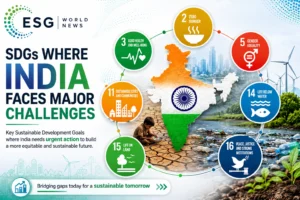
Despite its better ranking, India is still struggling on 13 of the 17 Sustainable Development Goals. Of these, 7 goals are classified as major challenges:
- SDG 2 – Zero Hunger
- SDG 3 – Good Health and Well-being
- SDG 5 – Gender Equality
- SDG 11 – Sustainable Cities and Communities
- SDG 14 – Life Below Water
- SDG 15 – Life on Land
- SDG 16 – Peace, Justice and Strong Institutions
India also faces significant challenges in another 6 goals:
- SDG 6 – Clean Water and Sanitation
- SDG 7 – Affordable and Clean Energy
- SDG 8 – Decent Work and Economic Growth
- SDG 9 – Industry, Innovation and Infrastructure
- SDG 12 – Responsible Consumption and Production
- SDG 17 – Partnerships for the Goals
This means that while India is moving forward overall, progress remains uneven and far from sufficient to meet the 2030 sustainable development targets.
India is not on track to meet the 2030 SDGs
The 2026 assessment suggests India is not on track to fully achieve the SDGs by 2030. Only 33.3 per cent of its targets are expected to be met on time. Progress on 42.7 per cent of targets has been limited, while 24 per cent have actually worsened.
These figures highlight a central reality: an improved ranking does not automatically translate into deep structural progress across nutrition, healthcare, climate resilience, and public institutions.
Hunger remains India’s biggest development challenge
Among all the SDGs, Zero Hunger (SDG 2) remains one of India’s most urgent concerns. The latest findings show that progress on hunger and nutrition is either slow or stalled, even as the country improves in other sectors.
Out of the 9 indicators tracked under SDG 2, 4 remain in the significant or major challenge category. The only indicator currently on track is cereal yield, which reached 3.6 tonnes per hectare in 2023.
But the broader nutrition picture remains troubling.
Child stunting remains high
India has reduced child stunting over time, but the level remains high. The share of children under five who were stunted stood at 35.5 per cent in 2020, down from 37.9 per cent in 2015. More recent NFHS-6 estimates place stunting at 29.3 per cent, showing improvement but also underlining that nearly one in three children under five still suffers from stunting.
Child wasting is worsening
A more serious concern is child wasting, which reflects acute undernutrition. The prevalence increased from 16.9 per cent in 2017 to 18.7 per cent in 2020. NFHS-6 estimates suggest a further rise to 19 per cent, indicating that the trend is moving in the wrong direction.
Undernourishment is rising again
India had earlier reduced undernourishment from 12.1 per cent in 2015 to 10.5 per cent in 2018, but the proportion rose again to 12 per cent in 2023. This suggests the country has lost momentum on one of the most basic indicators of food security.
Obesity is also increasing
India’s nutrition challenge is no longer limited to undernutrition. Adult obesity has also increased, rising from 4.91 per cent in 2015 to 7.27 per cent in the latest available estimate. This points to a growing double burden of malnutrition, where undernutrition and obesity exist side by side.
Health, climate and governance remain weak spots
India’s SDG performance also reveals continuing pressure in public health, climate action, and institutional governance.
Health indicators show slow or negative movement
Under SDG 3, half of the 14 monitored indicators are either stagnating or deteriorating. One example is the death rate linked to air pollution, which rose to 132 deaths per 100,000 population in 2023, up slightly from 131.72 in 2019.
Another key concern is non-communicable disease mortality. The death rate from heart disease, cancer, diabetes and chronic respiratory disease among adults aged 30 to 70 increased from 22.6 per cent in 2015 to 23.6 per cent in 2021.
Carbon emissions continue to increase
Under SDG 13 on climate action, India’s per capita carbon dioxide emissions from fossil fuel combustion and cement production rose from 1.69 tonnes in 2015 to 2.21 tonnes in 2023. This is the highest recorded level for the country since the SDGs were adopted.
Press freedom and governance indicators remain under strain
India also faces major concerns under SDG 16, particularly on governance-related indicators such as the Corruption Perceptions Index and Press Freedom Index. The press freedom score has shown a steep decline, falling from 59.51 in 2015 to 31.96 in 2026, a drop of more than 27 points.
Why India’s SDG progress matters globally
India’s SDG performance matters well beyond its borders. As the world’s most populous country, its development trajectory has a significant influence on global progress toward the 2030 agenda.
Worldwide, none of the 17 Sustainable Development Goals is currently on track to be fully achieved by 2030. Global progress remains especially weak on sustainable cities, food systems, biodiversity, oceans, and peace and justice. These are also areas where India continues to face major or significant barriers.
At the same time, India has posted notable gains in electricity access under SDG 7 and mobile broadband and internet use under SDG 9. These improvements show that progress is possible when policy, infrastructure, and scale come together effectively.
Conclusion
India’s rise to 94th place in the 2026 UN SDG Index is an important milestone and reflects genuine development gains over the past decade. But the country remains far from meeting the SDGs by 2030.
The biggest warning signs come from hunger, child nutrition, health outcomes, carbon emissions, and governance indicators. If India wants to convert ranking gains into meaningful human development, the next phase of progress will need to focus less on incremental improvement and more on solving persistent structural problems.
For India, the challenge is no longer just climbing the table. It is ensuring that growth translates into better nutrition, healthier lives, stronger institutions, and a more sustainable future.