

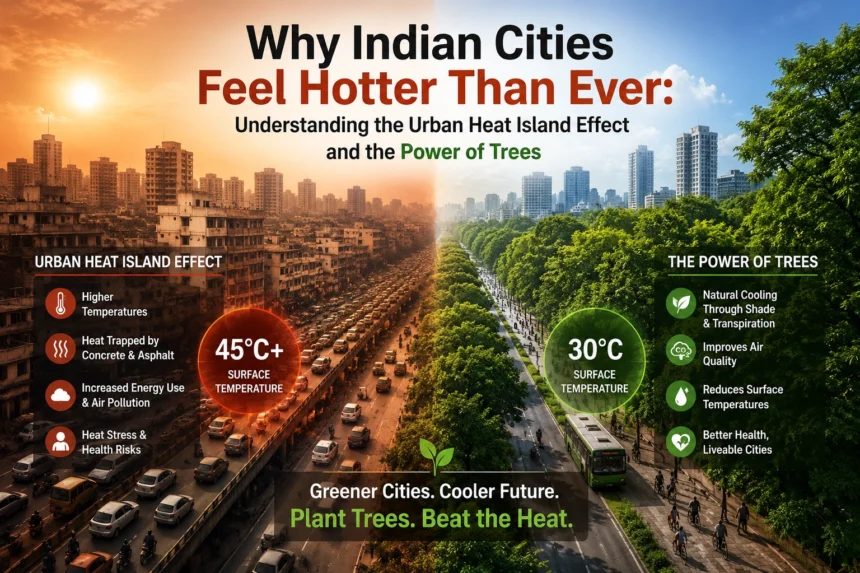
India is witnessing longer, more intense heatwaves than ever before. From Delhi and Jaipur to Hyderabad and Bengaluru, temperatures are regularly crossing 45°C during summer months. Yet, within the same city, some neighborhoods can feel dramatically cooler than others.
- Why Some Areas Feel Hotter Than Others
- The Growing Urban Heat Problem in India
- Why Urban Heat Is More Dangerous Than Many Realize
- The Economic Cost of Hotter Cities
- How Trees Can Cool Indian Cities
- 1. Natural Shade
- 2. Evapotranspiration
- 3. Reduced Surface Temperatures
- 4. Improved Air Quality
- 5. Lower Energy Consumption
- India’s Tree Cover Challenge
- Beyond Trees: Building Climate-Resilient Cities
- Cool Roofs
- Permeable Pavements
- Green Buildings
- Water Bodies and Blue Infrastructure
- Climate-Smart Urban Planning
- Why Urban Heat Matters for India’s Future
- The Bottom Line
The reason is a phenomenon known as the Urban Heat Island (UHI) Effect — a growing challenge that is impacting public health, energy consumption, infrastructure planning, and climate resilience across India’s rapidly urbanising cities.
As India continues its journey toward becoming a $5 trillion economy, understanding and addressing urban heat islands could become one of the country’s most important sustainability priorities.
Why Some Areas Feel Hotter Than Others
Have you ever noticed how a tree-lined residential street feels significantly cooler than a nearby commercial district filled with concrete buildings and asphalt roads?
The difference comes down to how surfaces interact with sunlight.
Trees and vegetation naturally cool the environment through:
- Shade generation
- Evapotranspiration (release of water vapour)
- Reduced surface heating
- Improved air circulation
Concrete, asphalt, glass and steel behave differently. These materials absorb large amounts of solar energy during the day and slowly release heat back into the atmosphere long after sunset.
Studies show that road surfaces and rooftops can become 27°C to 50°C hotter than surrounding air temperatures, turning dense urban zones into giant heat reservoirs.

The Growing Urban Heat Problem in India
India is urbanising at an unprecedented pace.
According to government estimates, over 600 million Indians are expected to live in urban areas by 2036, up from around 460 million today.
As cities expand, green spaces are increasingly being replaced by:
- Roads
- Parking lots
- Commercial complexes
- Residential developments
- Industrial infrastructure
This rapid transformation is intensifying urban heat island effects across major cities.
Recent studies have found temperature differences of 2°C to 8°C between heavily built-up urban areas and surrounding greener zones in several Indian cities.
During heatwave conditions, the gap can become even larger.
Why Urban Heat Is More Dangerous Than Many Realize
Heat is among the deadliest climate-related hazards globally.
In India, extreme heat has already become a significant public health concern.
According to the India Meteorological Department (IMD), several parts of northern and central India experienced prolonged heatwave conditions during recent summers, with temperatures crossing 48°C in some regions.
Urban heat islands amplify these risks by:
- Increasing heat stress
- Raising dehydration risks
- Triggering heatstroke incidents
- Worsening respiratory conditions
- Increasing cardiovascular health problems
The impact is especially severe for:
- Elderly citizens
- Outdoor workers
- Children
- Low-income communities
- Residents in densely populated urban settlements
Research globally suggests mortality rates can rise by approximately 2% for every 1°C increase above critical temperature thresholds.
The Economic Cost of Hotter Cities
Urban heat does not only affect health—it also affects economic productivity.
Higher temperatures lead to:
- Increased electricity demand
- Greater air-conditioning use
- Higher energy bills
- Reduced labour productivity
- Increased infrastructure maintenance costs
Experts estimate cooling demand can increase by 5% to 15% during extreme heat events.
For a country like India, where electricity demand is already rising rapidly due to economic growth and digitalisation, urban heat could place additional pressure on power grids and energy infrastructure.
How Trees Can Cool Indian Cities
One of the most effective and affordable solutions already exists: urban trees.
Trees provide multiple cooling benefits simultaneously.
1. Natural Shade
Tree canopies block direct sunlight from reaching roads, buildings, and pedestrians.
2. Evapotranspiration
Trees release water vapour, naturally cooling surrounding air similar to how perspiration cools the human body.
3. Reduced Surface Temperatures
Shaded surfaces remain significantly cooler than exposed concrete and asphalt.
4. Improved Air Quality
Trees absorb pollutants and particulate matter, improving urban air quality.
5. Lower Energy Consumption
Buildings surrounded by trees require less air conditioning, reducing electricity demand.
Studies from cities around the world show that urban trees can lower local temperatures by:
- 1°C to 3°C across neighborhoods
- Up to 12°C at pedestrian level under dense canopy conditions
India’s Tree Cover Challenge
Many Indian cities fall far below recommended urban green-cover levels.
Urban planners increasingly support the 30% tree canopy benchmark, which has emerged globally as an effective target for reducing heat stress.
However, several rapidly growing Indian cities continue to face:
- Shrinking green spaces
- Tree removal for infrastructure projects
- Limited urban forest planning
- Insufficient maintenance of existing trees
As cities expand, balancing development with urban greening will become critical.
Beyond Trees: Building Climate-Resilient Cities
While trees remain one of the most powerful tools against urban heat, they are not a standalone solution.
Experts recommend combining urban forests with:
Cool Roofs
Reflective roofing materials that reduce heat absorption.
Permeable Pavements
Materials that absorb less heat than conventional asphalt.
Green Buildings
Structures designed to improve energy efficiency and reduce cooling demand.
Water Bodies and Blue Infrastructure
Lakes, ponds and water features help moderate local temperatures.
Climate-Smart Urban Planning
Designing neighborhoods with adequate green spaces, ventilation corridors and shaded pedestrian pathways.
Why Urban Heat Matters for India’s Future
India is among the countries most vulnerable to climate change impacts.
As heatwaves become more frequent and severe, the urban heat island effect could significantly affect:
- Public health outcomes
- Economic productivity
- Energy security
- Water demand
- Quality of life
The challenge is particularly urgent because India’s urban population is expected to grow by more than 200 million people over the next decade.
The choices made today regarding city planning, green infrastructure and climate adaptation will determine whether future Indian cities become more livable—or more vulnerable.
The Bottom Line
The urban heat island effect is not merely an environmental issue—it is a public health, economic and infrastructure challenge.
While concrete and asphalt continue to dominate urban landscapes, increasing tree canopy, protecting green spaces and adopting climate-resilient urban design can significantly reduce temperatures and improve quality of life.
As India builds the cities of the future, the solution may be surprisingly simple: more trees, smarter planning, and a stronger commitment to urban sustainability.
Because in the battle against rising urban heat, nature remains one of the most effective technologies available.