

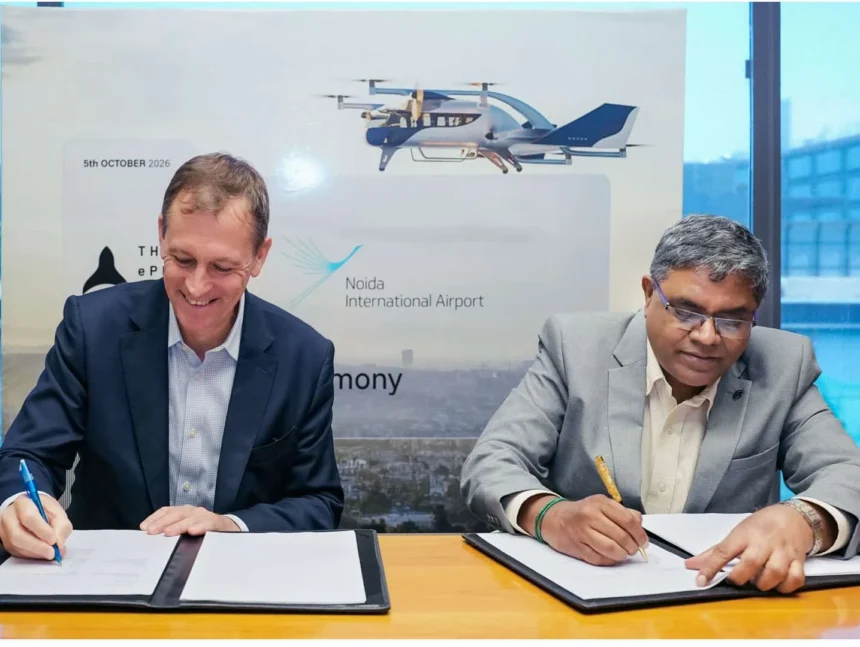
October 8, 2026, Noida, Uttar Pradesh, India – The ePlane Company has partnered with Noida International Airport to develop the infrastructure, operating procedures and technology systems required to support advanced air mobility (AAM) services in the Delhi-NCR region.
The partnership is expected to support the future deployment of the ePlane Company’s e200X electric vertical take-off and landing (eVTOL) aircraft for airport-to-airport connectivity, intra-city transportation and emergency air ambulance services.
The agreement was formalised through a Memorandum of Understanding (MoU) between Ubifly Technologies, which operates as The ePlane Company, and Noida International Airport.
Building Infrastructure for eVTOL Operations
Under the partnership, the two organisations will work together to establish the infrastructure and operational framework needed for electric air mobility.
The scope includes developing:
- Regulatory Standard Operating Procedures (SOPs)
- Vertiport infrastructure and management systems
- Charging infrastructure
- eVTOL operational processes
- Airspace integration frameworks
- AI-assisted fleet scheduling
- Safety and emergency operating procedures
The collaboration comes after the public unveiling of the full-scale e200X PT-01 prototype. Ground testing of the aircraft is currently underway, while infrastructure and airspace integration activities are being developed in parallel.
Noida Airport to Support e200X Trials
As part of the MoU, Noida International Airport will allocate space within its premises for proof-of-concept trials, vertiports and charging stations.
The airport will also work on adapting its operating procedures to accommodate future eVTOL operations.
The ePlane Company, meanwhile, will pursue the necessary regulatory clearances from the Directorate General of Civil Aviation (DGCA) and the Bureau of Civil Aviation Security (BCAS). The company will also continue aircraft prototyping and flight-testing activities for the e200X.
Regulators and Air Traffic Control to Be Involved
The partnership is expected to involve coordination with regulators, Air Traffic Control authorities and state governments to establish appropriate safety standards and operating procedures for advanced air mobility.
Another important component will be the development of a Vertiport Management System, designed to support the efficient operation of electric aircraft at dedicated take-off and landing facilities.
The organisations also plan to explore AI-enabled fleet scheduling and integration with smart-city systems, potentially creating a connected ecosystem for future urban air mobility operations.
Drone Trials Before Piloted e200X Flights
The ePlane Company plans to use drone-based trials to validate operational models before moving toward piloted e200X flights.
This phased approach is intended to allow aircraft development, airport infrastructure and operational procedures to progress together while providing an opportunity to test systems before full-scale piloted operations begin.
The collaboration is ultimately aimed at developing the infrastructure needed for zero-emission air transportation and emergency air mobility services across Delhi-NCR.
Advanced Air Mobility Could Strengthen Delhi-NCR Connectivity
Noida International Airport said integrating advanced air mobility into its airport ecosystem aligns with its broader plans for multi-modal connectivity.
For The ePlane Company, the partnership provides an opportunity to develop not only the aircraft but also the ground infrastructure, airport procedures and operational systems required to make eVTOL services commercially viable.
As electric aviation technology develops, infrastructure such as vertiports, charging stations, fleet-management platforms and airspace coordination systems will become increasingly important to the deployment of advanced air mobility.
The partnership between The ePlane Company and Noida International Airport represents an early step toward creating that ecosystem in the Delhi-NCR region.
Paddy Stubble Burning 2026: Madhya Pradesh Records Highest Incidents as Punjab Sees Seven-Year Low