

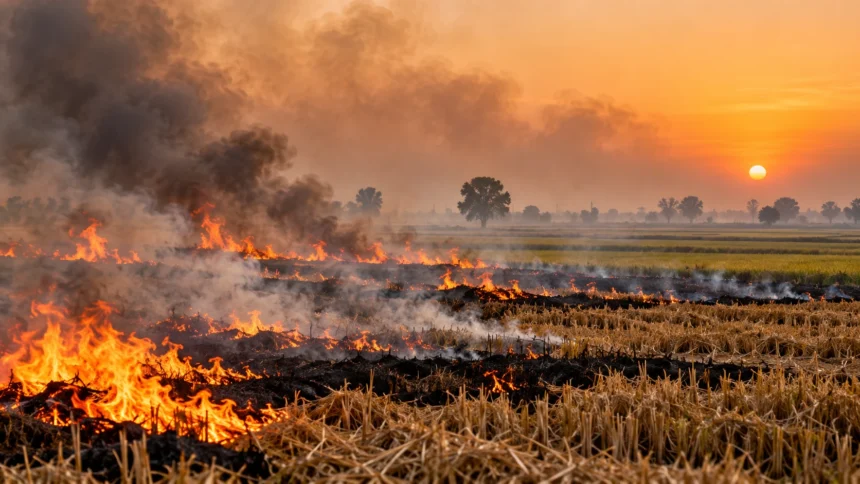
7 October 2026 | India – Paddy stubble burning incidents are being reported across Punjab, Haryana, Uttar Pradesh, Rajasthan, Madhya Pradesh, Delhi and Uttarakhand, with satellite-based monitoring indicating a shifting pattern of crop-residue fires across northern and central India.
- Madhya Pradesh accounts for the highest number of incidents
- 33 incidents detected on October 6
- Punjab records lowest seven-year figure for this period
- Madhya Pradesh sees a contrasting trend
- How the pattern changed in 2025
- Why is stubble burning increasing in Madhya Pradesh?
- Satellite monitoring provides an important warning system
- The ESG and climate challenge
According to a bulletin issued on October 6, 2026, by the Consortium for Research on Agroecosystem Monitoring and Modelling from Space (CREAMS) of the Indian Agricultural Research Institute (IARI), 287 crop-residue burning incidents were detected across the seven states between September 15 and October 6, 2026.
Madhya Pradesh accounts for the highest number of incidents
Of the 287 incidents recorded during the period, the state-wise distribution was:
- Madhya Pradesh: 118
- Punjab: 88
- Uttar Pradesh: 65
- Rajasthan: 10
- Haryana: 4
- Delhi: 1
- Uttarakhand: 1
Madhya Pradesh therefore accounted for more than 41% of the incidents recorded across the seven states during the monitoring period.
The CREAMS bulletin noted that cloud cover over eastern-southeastern Madhya Pradesh and Uttar Pradesh, along with dense clouds in the higher reaches of Uttarakhand, affected the detection of some crop-residue burning incidents.
CREAMS monitors active fires linked to crop-residue burning using satellite remote sensing technology, providing data through regular bulletins and dashboards.
33 incidents detected on October 6
Satellite observations recorded 33 crop-residue burning incidents on October 6 alone.
Madhya Pradesh accounted for 24 incidents, or approximately 73% of the day’s total.
The remaining incidents were recorded in:
- Punjab: 4
- Uttar Pradesh: 2
- Rajasthan: 3
- Haryana: 0
- Delhi: 0
- Uttarakhand: 0
The data highlights the growing importance of Madhya Pradesh in India’s current stubble-burning pattern.
Punjab records lowest seven-year figure for this period
Punjab, which has historically been closely associated with the stubble-burning problem, recorded 88 incidents between September 15 and October 6.
According to the CREAMS data cited in the bulletin, this is the lowest number recorded in Punjab during the same period over the past seven years.
Another notable trend is that Punjab has not recorded double-digit daily incidents on any day during the current season so far.
Haryana has also experienced a significant decline in incidents compared with the previous year.
Madhya Pradesh sees a contrasting trend
Madhya Pradesh presents a markedly different picture.
The state has recorded 118 incidents so far, the highest number recorded during the September 15–October 6 period in the state’s available seven-year comparison.
Daily incidents have reached double digits on five days this season.
The data also indicates that crop-residue burning is increasing in Madhya Pradesh, Uttar Pradesh and Rajasthan, even as incidents decline in Punjab and Haryana.
How the pattern changed in 2025
The shift becomes more evident when compared with last year’s data.
Between September 15 and November 30, 2025, a total of 33,028 stubble-burning incidents were recorded across Punjab, Haryana, Uttar Pradesh, Delhi, Rajasthan and Madhya Pradesh.
Madhya Pradesh accounted for 17,067 incidents, representing more than half of the total recorded across the six states.
The 2025 state-wise figures were:
| State | Stubble-burning incidents |
|---|---|
| Madhya Pradesh | 17,067 |
| Uttar Pradesh | 7,290 |
| Punjab | 5,114 |
| Rajasthan | 2,890 |
| Haryana | 662 |
| Delhi | 5 |
| Total | 33,028 |
These figures show that stubble burning is no longer concentrated primarily in Punjab and Haryana, with Madhya Pradesh emerging as a major contributor.
Why is stubble burning increasing in Madhya Pradesh?
Experts cited in the source material have linked the increase in Madhya Pradesh to changing agricultural patterns and climate-related pressures.
Farmers in parts of the state are increasingly shifting toward paddy cultivation, replacing crops such as soybean and black gram.
Changing weather conditions are creating additional challenges for some traditional Kharif crops, making paddy a more attractive option for some farmers.
After harvesting paddy, however, large quantities of residue remain in fields. Burning the residue provides farmers with a quick method of clearing fields for the next crop cycle.
This combination of changing cropping patterns, extreme weather conditions and the need for rapid field preparation is contributing to the growing incidence of crop-residue burning in parts of Madhya Pradesh, according to experts cited in the source.
Satellite monitoring provides an important warning system
The CREAMS monitoring system uses satellite observations to identify active fires associated with crop-residue burning.
Such satellite-based monitoring is important because it provides authorities with relatively rapid information about where burning is occurring and how patterns are changing during the agricultural season.
However, the October 6 bulletin also highlights an important limitation: cloud cover can prevent or reduce the detection of active fires.
Therefore, satellite-detected figures should be understood as monitored incidents rather than necessarily representing every instance of residue burning.
The ESG and climate challenge
Paddy stubble burning has implications beyond agricultural waste management.
Open burning of crop residue can contribute to air pollution and greenhouse gas emissions, while also representing a lost opportunity to convert agricultural waste into useful resources.
The latest data suggests that India’s crop-residue challenge is evolving geographically. While Punjab and Haryana appear to be showing progress, increasing incidents in Madhya Pradesh, Uttar Pradesh and Rajasthan indicate that solutions need to move beyond a narrow focus on the traditional stubble-burning belt.
For policymakers, the challenge is therefore twofold: maintain progress in states where burning is declining while preventing the problem from shifting into new agricultural regions.
ESG World News Perspective
The 2026 data points to a changing landscape for India’s crop-residue management challenge.
Punjab’s seven-year low is encouraging, but the rise in Madhya Pradesh and increases in other states show that the underlying issue remains unresolved.
A sustainable response will require more than enforcement. Crop diversification, affordable residue-management equipment, alternative uses for biomass, farmer incentives and climate-resilient agricultural practices could all play a role in reducing the need for field burning.
The key ESG question is no longer simply where stubble is being burned — but how India can turn agricultural residue from a pollution challenge into an economic and environmental resource.