

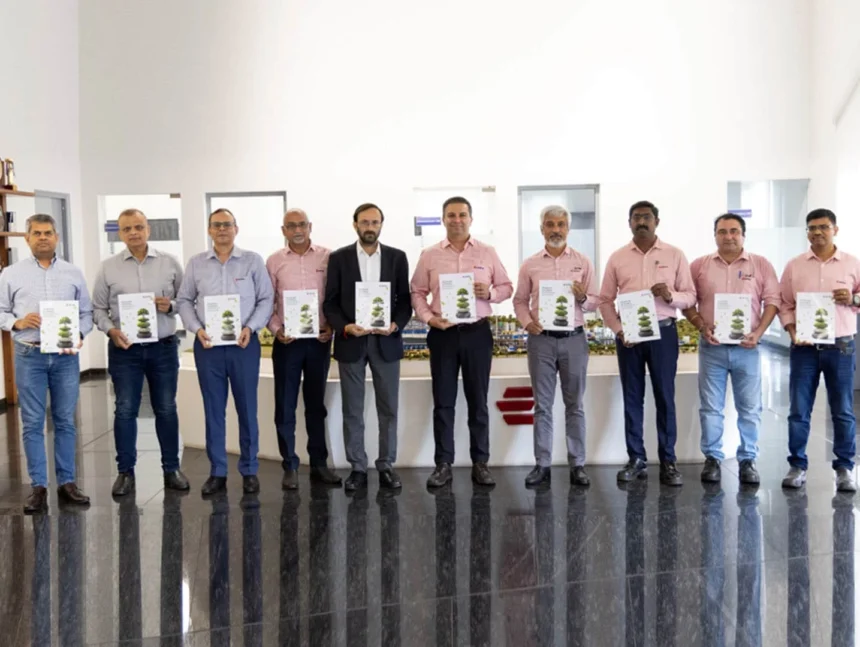
October 2026, India – Epsilon Carbon has reported significant progress in its environmental and sustainability performance, including a 98% reduction in Scope 2 emissions intensity from its FY2022-23 baseline.
The carbon black and specialty carbon producer disclosed the progress in its sixth Sustainability Report for FY2025-26, titled “Anchored in Carbon. Embedded in Circularity.”
The report highlights the company’s performance across emissions reduction, energy efficiency, waste heat recovery, workplace safety, diversity and community development.
Scope 2 Emissions Intensity Drops 98%
Epsilon Carbon said its Scope 2 emissions intensity declined by 98% compared with the FY2022-23 baseline.
The company also achieved a 6% reduction in energy consumption intensity during FY2025-26, which it attributed to improvements in operational efficiency.
A key component of its decarbonisation strategy is its 17 MW captive power plant, which uses waste hot gases generated during production to produce power.
During FY2025-26, the company reported 77% utilisation of its waste heat recovery system.
According to Epsilon Carbon, the system helped avoid more than 89,000 tonnes of CO₂ emissions by reducing reliance on coal-based electricity.
Scope 3 Emissions Intensity Also Declines
The company reported an 8.13% year-on-year reduction in Scope 3 emissions intensity during FY2025-26.
Scope 3 emissions cover emissions associated with activities across a company’s wider value chain. Epsilon Carbon said the reduction forms part of its efforts to improve environmental performance beyond its direct operations and support more sustainable manufacturing for its customers.
The company operates a manufacturing facility at Vijayanagar, with annual capacity of 215,000 tonnes of carbon black and 500,000 tonnes of specialty carbon.
Its products are used across applications including tyres, rubber products, manufacturing and industrial sectors.
Circularity Remains Central to Operations
Epsilon Carbon’s sustainability strategy also focuses on the utilisation of industrial by-products and resource efficiency.
The company said its operations use captive feedstock and raw materials sourced from the steel industry.
Its manufacturing operations also include a Zero Liquid Discharge (ZLD) system, through which treated wastewater is reused within the facility.
The company’s captive power plant further supports resource efficiency by using recovered waste gases generated during production.
Together, these systems are designed to improve resource utilisation while reducing dependence on conventional energy sources.
Focus on Workplace Safety and Inclusion
The sustainability report also highlights Epsilon Carbon’s social performance.
The company reported zero fatalities during FY2025-26, while women represented 10% of its Board and 9.41% of its overall workforce.
These figures form part of the company’s broader focus on workplace safety, inclusion and employee development.
CSR Programmes Reach Around 140,000 People
Epsilon Carbon also reported progress through its corporate social responsibility initiatives.
According to the company, its CSR programmes impacted approximately 140,000 people during FY2025-26.
The initiatives form part of the company’s wider sustainability agenda, which combines environmental performance with workplace and community-focused programmes.
Epsilon Carbon’s Sustainability Strategy
The latest sustainability report highlights Epsilon Carbon’s focus on combining carbon manufacturing with circularity, energy efficiency and responsible resource management.
The company’s reported reduction in Scope 2 emissions intensity, increased waste heat recovery utilisation and decline in Scope 3 emissions intensity point to an approach centred on improving efficiency across both its operations and value chain.
As industrial manufacturers face increasing pressure to reduce emissions and improve resource efficiency, initiatives such as waste heat recovery, captive renewable or alternative power systems, wastewater reuse and industrial feedstock utilisation are becoming increasingly important components of sustainability strategies.
Epsilon Carbon’s FY2025-26 report positions these measures as part of its ongoing efforts toward more responsible and efficient manufacturing.
India’s Wind Energy Sector Set for Rapid Growth, Annual Installations Could Reach 13.2 GW by FY31