

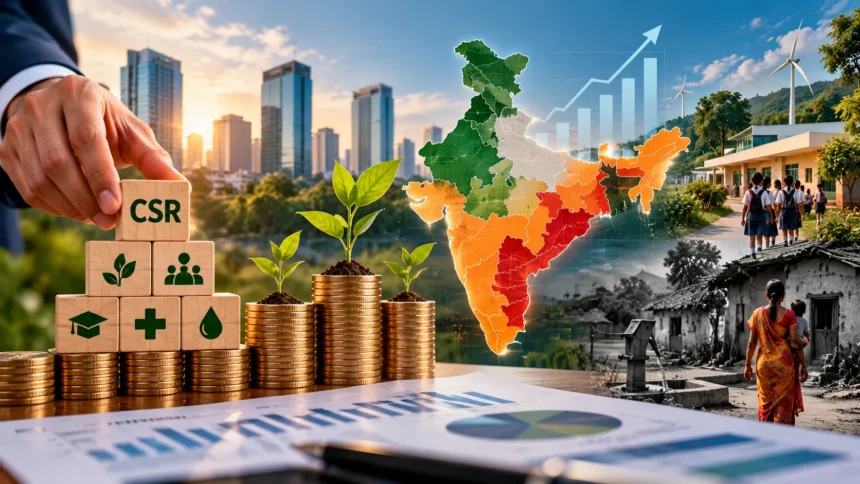
October 29, 2026 – India’s corporate social responsibility (CSR) spending has grown significantly since mandatory CSR provisions came into effect under the Companies Act, 2013. A new report suggests that the country’s annual CSR expenditure could exceed ₹77,000 crore by 2030, highlighting the growing role of corporate funding in India’s social and developmental priorities.
- What Is the India CSR Outlook Report 2026?
- India’s CSR Spending: From ₹10,065 Crore to a Projected ₹77,000 Crore
- Why India’s Growing CSR Spend Does Not Automatically Mean Equal Development
- 1. Corporate Presence Can Influence Funding Decisions
- 2. Local Organisations Need Access to CSR Funding
- 3. Spending Should Be Evaluated Against Development Outcomes
- One Purpos India Forum: Bringing CSR and Philanthropy Together
- What the CSR Spending Outlook Means for Indian Companies
- Map CSR Spending by Geography
- Strengthen Partnerships With Local Organisations
- Measure Outcomes, Not Just Expenditure
- Align Programmes With Long-Term Needs
- Improve Transparency and Accountability
- Can India’s CSR Funding Deliver More Inclusive Growth by 2030?
Released by CSRBOX at the 13th edition of the One Purpos India Forum (OPIF) in New Delhi, the India CSR Outlook Report 2026 examines the expansion of corporate social investment and the challenges surrounding its distribution.
According to figures attributed to CSRBOX, annual CSR spending has increased from approximately ₹10,065 crore in FY2014–15 to a projected ₹77,000 crore or more by 2030. The report also estimates that cumulative CSR expenditure between April 2014 and March 2030 could exceed ₹5.5 lakh crore.
However, the report highlights an important question: will this increase in funding translate into more balanced development across India’s states and districts?
The challenge is not simply to increase the amount companies spend. It is also to ensure that funding reaches communities where social and developmental needs remain underserved.
What Is the India CSR Outlook Report 2026?
The India CSR Outlook Report 2026 assesses the growth of India’s corporate social responsibility ecosystem and examines how corporate funding can contribute to national development.
The report was presented at the One Purpos India Forum, held from October 26 to 28, 2026, in New Delhi. The event brought together stakeholders from business, government, philanthropy, civil society and the social-impact sector.
The forum also represents a consolidation of CSRBOX’s earlier platforms, bringing together initiatives focused on corporate social responsibility, water and rivers, philanthropy, purpose-driven businesses and social-impact recognition.
This broader platform aims to encourage collaboration between organisations working on interconnected development priorities.
For businesses, the report provides a perspective on the expanding scale of CSR funding. For policymakers and implementing organisations, it raises questions about how effectively this capital is distributed and used.
The central issue is whether India’s growing CSR resources can deliver more equitable and measurable outcomes across the country.
India’s CSR Spending: From ₹10,065 Crore to a Projected ₹77,000 Crore
India introduced a distinctive approach to corporate social responsibility through Section 135 of the Companies Act, 2013.
Under the framework, companies meeting specified financial thresholds are required to comply with CSR provisions, including spending requirements generally linked to at least 2% of their average net profits over the preceding three financial years, subject to the applicable legal provisions.
The framework created a formal mechanism for directing corporate resources towards eligible social-development activities.
According to the figures highlighted by CSRBOX, India’s annual CSR expenditure stood at approximately ₹10,065 crore in FY2014–15, the first financial year of implementation.
The report projects that annual spending could exceed ₹77,000 crore by 2030.
If realised, this would represent an increase of more than seven times compared with the FY2014–15 figure.
CSRBOX also estimates that cumulative spending over the period from April 2014 to March 2030 could cross ₹5.5 lakh crore.
These figures point to the potential scale of corporate funding available for development initiatives. However, the ₹77,000 crore figure is a projection, not a confirmed future expenditure total. Actual spending will depend on company financial performance, applicable CSR obligations and spending decisions.
Key Figures at a Glance
- ₹10,065 crore: Reported annual CSR spending in FY2014–15.
- ₹77,000 crore or more: CSRBOX’s projection for annual CSR expenditure by 2030.
- ₹5.5 lakh crore: Estimated cumulative CSR spending from April 2014 to March 2030.
- October 26–28, 2026: Dates of the One Purpos India Forum in New Delhi.
- February 2030 is not the deadline: The ₹77,000 crore figure refers to a projected annual spending level by 2030, not a confirmed commitment or regulatory target.
Source: Figures attributed to CSRBOX’s India CSR Outlook Report 2026, as reported by ANI and other media outlets.
Why India’s Growing CSR Spend Does Not Automatically Mean Equal Development
The projected growth in CSR funding is significant, but spending totals alone cannot establish whether the money is reaching the communities that need it most.
The geographical distribution of CSR expenditure remains an important issue for companies, policymakers and development organisations.
Funding may be easier to deploy in locations where companies already operate, implementation partners are established and projects can be monitored efficiently. This can create practical incentives for businesses to support initiatives in familiar regions.
However, communities in less industrialised districts may face substantial development challenges while having fewer corporate headquarters, established implementing organisations or connections to potential CSR funders.
The India CSR Outlook Report 2026 highlights geographical disparities as an issue requiring attention. Its findings reinforce the need to examine not only how much companies spend, but also where that expenditure is directed.
Three considerations are particularly important.
1. Corporate Presence Can Influence Funding Decisions
Companies may find it easier to identify projects and implementation partners in areas where they have offices, factories, employees or established community relationships.
Although local engagement can improve accountability, it may also influence where funding is concentrated.
A more geographically balanced approach would require companies to assess needs beyond their immediate operating locations while continuing to meet applicable CSR requirements.
2. Local Organisations Need Access to CSR Funding
Community organisations and non-governmental organisations often understand local challenges and have established relationships with beneficiaries.
However, smaller organisations may struggle to access corporate funding because they lack visibility, administrative resources or the capacity to navigate complex proposal and reporting processes.
Improving connections between CSR funders and credible local organisations could help expand the range of projects receiving support.
3. Spending Should Be Evaluated Against Development Outcomes
A large CSR budget does not necessarily translate into proportionately better outcomes.
Companies should assess whether their programmes improve access to education and healthcare, strengthen livelihoods, improve environmental conditions or address other clearly defined development needs.
Tracking outcomes across districts can help companies identify underserved communities and understand whether their funding is producing lasting benefits.
The objective should be to move beyond expenditure reporting towards evidence of meaningful social impact.
One Purpos India Forum: Bringing CSR and Philanthropy Together
The One Purpos India Forum 2026 brought together several previously separate CSRBOX initiatives under a broader platform.
According to the event announcement, the consolidated forum brings together five platforms:
- India CSR and ESG Summit
- India Water & Rivers Forum
- India Philanthropy Forum
- Purpose Expo
- Doing Good for Bharat Awards
The initiative reflects an effort to encourage collaboration across corporate responsibility, philanthropy, water management and other social-impact priorities.
These areas frequently overlap. For example, a programme addressing rural livelihoods may also involve water security, environmental protection, education and women’s economic participation.
Closer coordination between funders and implementing organisations could help reduce duplication and encourage projects that address multiple community needs.
Bhomik Shah, founder and CEO of CSRBOX, emphasised the importance of collaboration in achieving India’s development ambitions.
The broader question is whether this consolidated approach can translate into more coordinated funding, stronger partnerships and measurable results for communities.
What the CSR Spending Outlook Means for Indian Companies
As India’s CSR ecosystem expands, companies have an opportunity to review how their programmes are designed, funded and evaluated.
Rather than focusing exclusively on meeting statutory spending requirements, businesses can use CSR planning to establish clearer development priorities and improve the effectiveness of their investments.
Map CSR Spending by Geography
Companies should examine where their funding goes at the state, district and community levels.
Combining expenditure data with indicators of local development needs can help identify geographical gaps and inform future project selection.
Strengthen Partnerships With Local Organisations
Working with credible local implementation partners can help businesses better understand community priorities and reach populations that may otherwise be overlooked.
Due diligence, transparent selection processes and appropriate monitoring remain essential.
Measure Outcomes, Not Just Expenditure
CSR reporting should explain what programmes achieve, not merely how much money is allocated or spent.
Depending on the initiative, relevant indicators could include improvements in school attendance, access to healthcare, livelihood opportunities, water availability or environmental conditions.
Align Programmes With Long-Term Needs
Short-term projects can deliver immediate benefits, but some development challenges require sustained engagement.
Companies should consider whether their programmes have clear objectives, realistic timelines and plans for maintaining outcomes beyond the initial funding period.
Improve Transparency and Accountability
Clear reporting on project locations, beneficiaries, spending and outcomes can help companies assess effectiveness and strengthen stakeholder confidence.
Better data can also support comparisons between intended outcomes and actual results, helping businesses improve future CSR decisions.
Can India’s CSR Funding Deliver More Inclusive Growth by 2030?
CSRBOX’s projections suggest that India’s corporate social responsibility ecosystem could become an increasingly significant source of development funding over the coming years.
If annual CSR spending exceeds ₹77,000 crore by 2030, the scale of available resources could create opportunities for initiatives across education, healthcare, livelihoods, environmental sustainability and community development.
But higher spending alone will not resolve geographical inequalities or guarantee lasting social impact.
The effectiveness of India’s CSR framework will depend on how companies identify community needs, select projects, work with implementation partners and measure results.
The India CSR Outlook Report 2026 brings this challenge into focus: the next phase of CSR growth must be measured not only by the money spent, but also by the communities reached and the outcomes achieved.
For corporate leaders, investors and development organisations, the priority is to turn growing financial commitments into transparent, measurable and geographically inclusive progress.
Follow ESG World News for the latest updates on CSR, ESG, sustainability, climate finance and responsible business.
ISSB Moves Beyond Climate: New Nature-Related Disclosure Proposals Put Biodiversity Risk in Focus