

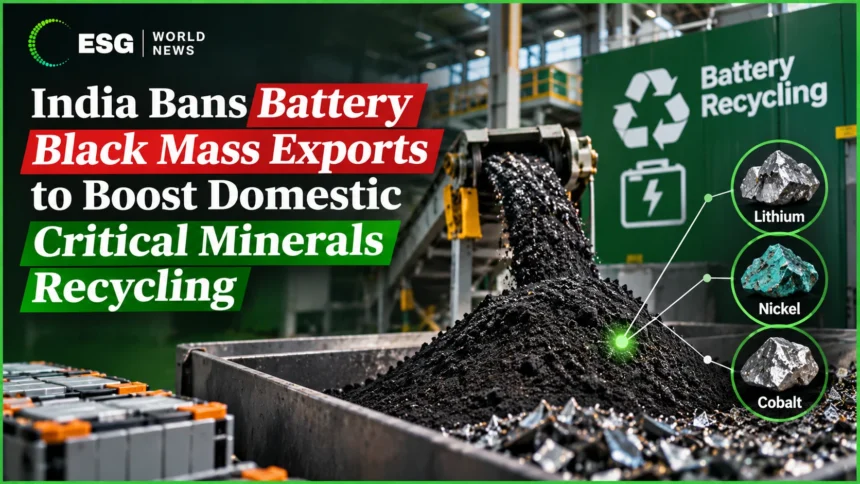
ESG World News Desk, 16 November 2026 – India has taken a significant step towards strengthening its domestic critical-minerals supply chain by prohibiting exports of lithium-ion battery black mass. The Directorate General of Foreign Trade (DGFT) introduced the restriction through a notification dated 10 November 2026, changing the export status of the material from “Free” to “Prohibited”.
- What Is Battery Black Mass and Why Is India Restricting Its Exports?
- India’s Battery Recycling Capacity: The Feedstock Challenge
- ₹1,500-Crore Incentive Scheme to Strengthen Critical Minerals Recycling
- Why Critical Minerals Recycling Matters to India’s EV and Battery Industry
- Key Facts: India’s Battery Black Mass Export Ban
- What the Export Ban Means for Businesses and ESG Investors
- What to Watch Next
The decision is intended to ensure that valuable materials recovered from used batteries are processed within India rather than shipped overseas for refining. It comes alongside a Cabinet-approved ₹1,500-crore incentive scheme for domestic critical-minerals recycling and a separate exemption from basic customs duty on imports of lithium-ion battery scrap.
Together, these measures signal a stronger policy push to develop India into a domestic hub for battery recycling and critical-mineral recovery.
What Is Battery Black Mass and Why Is India Restricting Its Exports?
Black mass is the powder-like material produced when used lithium-ion batteries are dismantled and shredded. It contains valuable metals, including lithium, cobalt, nickel and manganese, which can be recovered through specialised refining processes.
The material is generated from end-of-life electric vehicle batteries, consumer electronics and energy-storage systems. However, black mass is not ready for direct use in new battery cells. It must first undergo further processing to separate and purify its constituent metals.
Until the DGFT restriction, Indian recyclers could export this intermediate material to overseas refiners after processing spent batteries. This meant that a significant part of the value-creation process could take place outside India.
By prohibiting exports, the government aims to encourage domestic refining and retain a greater share of the critical-minerals value chain within the country.
India’s Battery Recycling Capacity: The Feedstock Challenge
India’s battery recycling industry has developed substantial processing infrastructure, but the availability of domestic feedstock remains a major constraint.
Industry estimates cited alongside the policy announcement indicate that the country has:
- More than 100,000 tonnes per year of battery-shredding capacity.
- Over 60,000 tonnes per year of refining capacity for recovered battery materials.
- Less than 15,000 tonnes per year of current domestic black mass generation.
This gap between installed capacity and available material has left parts of the recycling ecosystem underutilised.
The export restriction is designed to address this imbalance by retaining domestically generated black mass within the country. Greater feedstock availability could improve utilisation of existing recycling infrastructure and support investment in advanced refining technologies.
However, the long-term impact will depend on how effectively domestic facilities can process the retained material and produce battery-grade recovered metals.
₹1,500-Crore Incentive Scheme to Strengthen Critical Minerals Recycling
The export ban is supported by a ₹1,500-crore incentive scheme approved by the Union Cabinet to expand domestic recycling capacity for critical minerals recovered from secondary sources, including battery scrap.
The scheme is intended to encourage investment in the infrastructure and processes required to recover valuable minerals from discarded materials.
The government has also exempted lithium-ion battery scrap imports from basic customs duty. This measure can lower the cost of sourcing recyclable material from overseas and potentially improve the economics of domestic recycling operations.
The combination of export restrictions and import-duty relief reflects a two-sided approach: retain valuable battery-recycling material generated in India while making it easier for domestic recyclers to source additional scrap internationally.
If implemented effectively, the approach could help India develop a larger and more competitive critical-minerals recycling ecosystem.
Why Critical Minerals Recycling Matters to India’s EV and Battery Industry
Lithium, cobalt, nickel and manganese are important inputs in several lithium-ion battery chemistries. These materials support electric vehicles, grid-scale energy storage, consumer electronics and other advanced manufacturing applications.
India’s growing demand for batteries has increased the strategic importance of securing reliable supplies of these minerals. Dependence on imported materials exposes manufacturers to international price movements, supply disruptions and concentrated processing capacity in global markets.
Battery recycling offers an additional source of supply without relying entirely on newly mined minerals. As more electric vehicles and electronic devices reach the end of their useful lives, the volume of recoverable battery materials is expected to become increasingly important.
This makes recycling a strategic component of India’s critical-minerals policy, as well as an important part of its circular-economy ambitions.
Key Facts: India’s Battery Black Mass Export Ban
| Policy or industry indicator | Details |
|---|---|
| DGFT notification date | 10 November 2026 |
| Export policy change | “Free” to “Prohibited” |
| Recycling incentive scheme | ₹1,500 crore |
| Battery-shredding capacity | More than 100,000 tonnes annually |
| Refining capacity | More than 60,000 tonnes annually |
| Domestic black mass generation | Below 15,000 tonnes annually |
| Additional policy support | Basic customs duty exemption on lithium-ion battery scrap imports |
What the Export Ban Means for Businesses and ESG Investors
For battery recyclers and critical-mineral refiners, the export restriction could improve access to domestically generated black mass and support better utilisation of existing facilities.
For electric vehicle and battery manufacturers, stronger domestic recycling capacity could eventually provide an additional source of recovered materials and help diversify supply chains.
The policy also has implications for ESG investors and companies tracking resource efficiency, circularity and supply-chain resilience. Recovering metals from used batteries can reduce dependence on primary mineral extraction and help keep valuable resources in productive use for longer.
Nevertheless, the success of the policy will depend on more than the availability of feedstock. Refiners will need to demonstrate consistent recovery rates, material purity, operational efficiency and the ability to supply recovered metals that meet manufacturers’ quality requirements.
What to Watch Next
The next phase will be determined by how quickly India’s recycling industry can translate the policy changes into higher domestic refining activity.
Three developments will be particularly important:
- Refining capacity utilisation: Whether domestic processors can absorb the black mass retained following the export restriction.
- Imported battery-scrap supply: Whether customs-duty relief attracts additional international feedstock for Indian recycling facilities.
- Battery-grade material quality: Whether refiners can consistently recover high-purity lithium, cobalt, nickel and other metals that meet industry requirements.
If these developments progress successfully, India could strengthen its position in the global battery-recycling value chain while reducing its exposure to imported critical minerals.
The export ban is therefore more than a trade restriction. It represents a strategic attempt to retain material value, strengthen domestic processing and make battery recycling an important pillar of India’s clean-energy manufacturing ambitions.
Indian Oil Gets SAF Approval at Panipat Refinery | India 2027 Target