

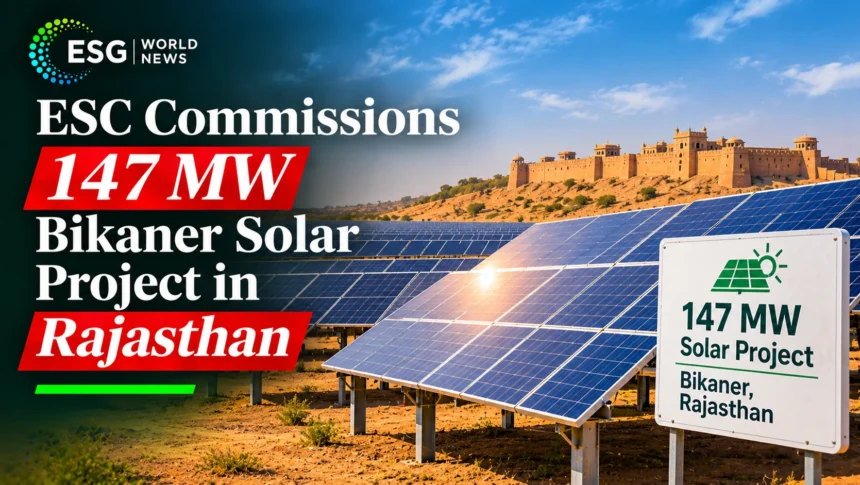
ESG World News Desk – CESC Limited has commenced commercial operations for 147 MW of its 150 MW solar project in Bikaner, Rajasthan. The project, developed through subsidiary Deshraj Solar Energy, is connected to India’s Inter-State Transmission System.
India’s renewable energy capacity received another boost after CESC Limited announced the commencement of commercial operations at 147 MW of its 150 MW solar power project in Bikaner district, Rajasthan.
The commercial operation date for the commissioned capacity took effect on November 21, 2026, according to the company. The project is being developed through CESC’s step-down subsidiary, Deshraj Solar Energy Private Limited.
Located at Village Karnisar Bhatiyan in Bikaner, the solar installation is connected to the Inter-State Transmission System (ISTS) through the Bikaner-III substation. The remaining 3 MW is expected to commence commercial operations by January 31, 2027.
The development adds to Rajasthan’s position as a major destination for large-scale solar power projects and marks another step in CESC’s expansion of its renewable energy portfolio.
CESC’s Bikaner Solar Project Clears Grid Trial Run
Before commercial operations began, the project’s trial run received certification from the Grid Controller of India’s Northern Regional Load Despatch Centre on November 19, 2026.
The certification preceded the commercial operation date of November 21 for the 147 MW capacity.
With the plant connected to the Inter-State Transmission System, the project is positioned to supply electricity through India’s wider transmission network.
The commissioning of 147 MW brings the project close to its planned capacity of 150 MW. The final 3 MW tranche remains scheduled for commercial operation by the end of January 2027.
Why Rajasthan Remains Important for Solar Energy
Rajasthan has emerged as one of India’s leading states for utility-scale solar power development. Its solar resources and large project-development areas have supported the growth of major renewable energy installations.
Bikaner is part of this broader solar development landscape. The district’s growing renewable energy activity contributes to Rajasthan’s role in India’s transition towards a more diversified electricity mix.
Projects connected to the Inter-State Transmission System also form part of the infrastructure required to move electricity across state boundaries, linking generation centres with demand across the country.
CESC’s Bikaner project therefore adds renewable generation capacity in a state that already plays a significant role in India’s solar energy expansion.
CESC Expands Its Renewable Energy Portfolio
CESC has traditionally been associated with its integrated power utility operations in West Bengal. The Bikaner project represents an addition to its renewable generation activities beyond its established operating geography.
The use of Deshraj Solar Energy Private Limited as the project subsidiary places the solar asset within a separate project-level corporate structure.
The commissioning also provides a concrete update on the company’s renewable energy development pipeline, moving most of the planned 150 MW project into commercial operation.
Further details about the project’s power-purchase arrangements and the identity of its electricity buyers were not specified in the information provided with the announcement.
Key Details of the CESC Bikaner Solar Project
- Company: CESC Limited
- Project subsidiary: Deshraj Solar Energy Private Limited
- Location: Village Karnisar Bhatiyan, Bikaner district, Rajasthan
- Total planned capacity: 150 MW
- Commercially operational capacity: 147 MW
- Commercial operation date: November 21, 2026
- Trial-run certification: November 19, 2026
- Certifying authority: Northern Regional Load Despatch Centre, Grid Controller of India
- Grid connection: Inter-State Transmission System through Bikaner-III substation
- Remaining capacity: 3 MW
- Expected completion of remaining capacity: January 31, 2027
Why the Commissioning Matters for India’s Clean Energy Transition
The commissioning of 147 MW adds to India’s expanding base of grid-connected renewable energy capacity.
For the power sector, projects such as CESC’s Bikaner installation demonstrate the continued development of large-scale solar generation and the importance of transmission infrastructure in connecting renewable energy projects to the wider electricity network.
For CESC, the project strengthens its renewable generation portfolio and adds a substantial solar asset outside its traditional operating market.
For Rajasthan, the development reinforces the state’s role in India’s solar energy landscape.
What to Watch Next
The immediate milestone will be the commissioning of the remaining 3 MW capacity, which CESC expects by January 31, 2027.
Further updates on the project’s full operational status, power-purchase arrangements and any additional renewable energy investments by CESC will provide a clearer picture of the company’s longer-term clean energy strategy.
Source: CESC Limited announcement, as reported by ThePrint, BioEnergy Times, Power Peak Digest and Kalpa Power.
India CSR Spending Hits ₹40,794 Crore, Sattva Report Finds Funding Gaps