

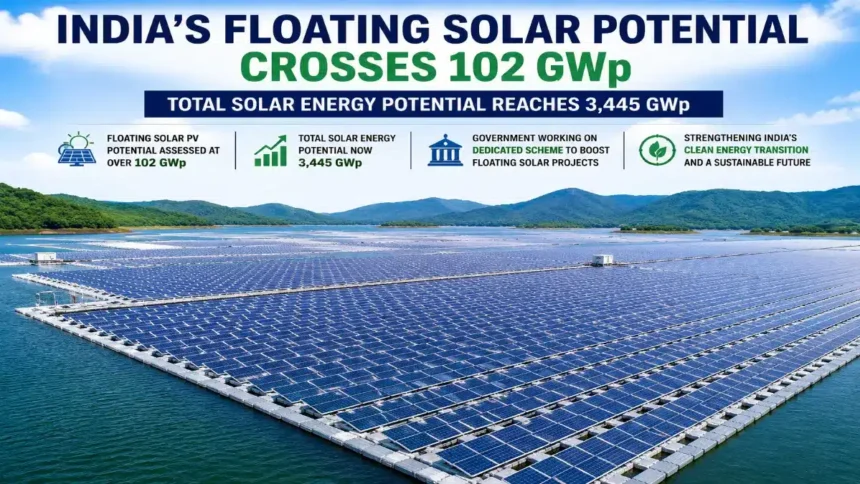
India has the potential to deploy more than 102 GWp of floating solar photovoltaic (PV) capacity, according to a new assessment released by the National Institute of Solar Energy (NISE). The findings significantly expand the country’s renewable energy landscape, increasing India’s total assessed solar potential from ground-mounted and floating solar installations to 3,445 GWp.
- Floating Solar Emerges as a Major Renewable Energy Opportunity
- How NISE Assessed India’s Floating Solar Potential
- Balancing Renewable Energy Growth with Environmental Protection
- Over 4,500 Square Kilometres Identified as Suitable
- Maharashtra Leads India’s Floating Solar Potential
- Floating Solar Supports India’s Renewable Energy Goals
- Policy Support Expected to Accelerate Adoption
- Outlook
The report highlights the growing role floating solar technology could play in India’s clean energy transition while addressing land availability challenges associated with large-scale renewable energy projects.
Floating Solar Emerges as a Major Renewable Energy Opportunity
The newly released assessment estimates that India has 102.18 GWp of deployable floating solar potential, complementing NISE’s earlier estimate of 3,343 GWp of ground-mounted solar PV potential.
The findings were unveiled by Union Minister for New and Renewable Energy Pralhad Joshi, who stated that the Ministry of New and Renewable Energy (MNRE) is actively working on a dedicated policy framework to accelerate floating solar deployment across the country.
As India continues to expand its renewable energy capacity, floating solar projects are increasingly being viewed as an effective solution for generating clean electricity while minimizing land-use conflicts.
How NISE Assessed India’s Floating Solar Potential
To determine the country’s floating solar capacity, NISE conducted a comprehensive evaluation of water bodies across India using a series of technical, environmental, and infrastructure-based criteria.
The assessment focused on hydro-lake water bodies with a minimum area of 10 hectares, excluding smaller reservoirs that may not be suitable for utility-scale solar installations.
Key criteria used in the study included:
- Year-round water availability
- Water depths ranging between 3 and 30 metres
- Minimum Global Horizontal Irradiation (GHI) of 4.5 kWh/m²/day
- Proximity of up to 10 kilometres from road infrastructure
- Distance of up to 10 kilometres from electrical substations
The study also considered technical deployment parameters, including the use of 545-watt solar modules with 21% efficiency installed at a tilt angle of five degrees.
According to NISE, approximately 0.019 square kilometres of water surface area is required to install 1 MW of floating solar capacity under these conditions.
Balancing Renewable Energy Growth with Environmental Protection
Recognising the need to preserve aquatic ecosystems and support competing water uses such as fisheries, irrigation, and recreation, the assessment places limits on solar deployment.
NISE recommends that floating solar installations should cover no more than 20% of the surface area of any eligible water body.
This approach aims to minimise ecological impacts while ensuring that floating solar projects can coexist with other economic and environmental functions.
Over 4,500 Square Kilometres Identified as Suitable
The study mapped a total water body area of 10,725.99 square kilometres across India.
Of this, 4,546.01 square kilometres were identified as suitable for floating solar development after applying screening criteria.
Following the recommended 20% utilisation cap, the effective deployment area was calculated at 1,946.24 square kilometres, resulting in a national floating solar potential of 102.18 GWp.
The findings underscore the significant opportunity available for scaling renewable energy generation without placing additional pressure on land resources.
Maharashtra Leads India’s Floating Solar Potential
Among Indian states, Maharashtra emerged as the leader in floating solar potential, with an estimated capacity of 16.28 GWp.
Other states with substantial deployment opportunities include:
| State | Floating Solar Potential |
|---|---|
| Maharashtra | 16.28 GWp |
| Madhya Pradesh | 14.89 GWp |
| Karnataka | 13.69 GWp |
| Odisha | 12.81 GWp |
| Telangana | 10.72 GWp |
These states benefit from large reservoirs, favourable solar irradiation levels, and suitable infrastructure conditions that support floating solar deployment.
Floating Solar Supports India’s Renewable Energy Goals
Floating solar technology is increasingly attracting attention globally due to its ability to generate renewable energy while reducing land acquisition challenges.
The technology offers several advantages, including:
- Efficient utilisation of existing water bodies
- Reduced evaporation losses from reservoirs
- Improved solar panel efficiency due to cooling effects from water
- Lower land-use conflicts
- Enhanced support for large-scale renewable energy targets
For India, where land availability can be a constraint for utility-scale renewable projects, floating solar could become an important contributor to achieving clean energy and climate goals.
Policy Support Expected to Accelerate Adoption
The Ministry of New and Renewable Energy is reportedly working on a dedicated scheme aimed at promoting floating solar projects nationwide.
Industry experts believe targeted policy incentives, streamlined approvals, and financing support could unlock significant investments in the sector over the coming years.
As India pursues its long-term renewable energy ambitions, floating solar is expected to play a growing role alongside ground-mounted solar, wind power, energy storage, and green hydrogen initiatives.
Outlook
The NISE assessment highlights the enormous untapped potential of floating solar energy in India, adding more than 102 GWp to the country’s renewable energy opportunity pipeline.
With supportive policies, technological advancements, and increasing investor interest, floating solar could become a key pillar of India’s clean energy strategy, helping the nation expand renewable power generation while optimizing the use of valuable land and water resources.