

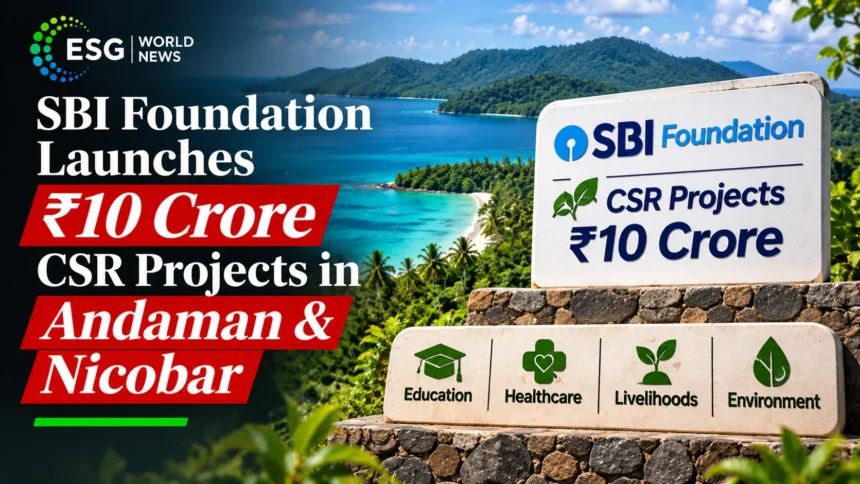
ESG World News Desk – SBI Foundation has launched two corporate social responsibility (CSR) initiatives worth a combined ₹10 crore in the Andaman and Nicobar Islands, bringing healthcare access and wildlife conservation into focus.
- SBI Foundation’s Cancer Screening Programme Targets 50,000 People
- Wildlife Conservation Initiative Distributes 2,100 Safety Kits
- Why the Andaman Islands Need Targeted CSR Investment
- Key Highlights of SBI Foundation’s ₹10 Crore CSR Initiatives
- How the Initiatives Connect Social Impact and Environmental Responsibility
- What to Watch: Screening Outcomes and Community Safety
- Conclusion
The programmes include a three-year cancer-screening initiative designed to reach 50,000 people through mobile medical units, alongside a conservation-led safety project aimed at reducing encounters between fishing communities and saltwater crocodiles.
The healthcare programme, titled SBIF Cancer Care, is being implemented in partnership with Ashray Foundation. It aims to screen people for breast, cervical and oral cancers, while reaching another 200,000 people through community awareness activities.
The second initiative, SBIF CONSERW: Reducing Human–Saltwater Crocodile Conflict in the Andaman Islands, is being carried out with Dakshin Foundation. Under this programme, 2,100 safety kits have been distributed to members of the fishing community to help reduce risks associated with crocodile encounters during fishing activities.
Both initiatives were launched in the islands as part of SBI Foundation’s efforts to address local social and environmental challenges through targeted CSR investment.
SBI Foundation’s Cancer Screening Programme Targets 50,000 People
Access to preventive healthcare and early diagnosis can be challenging for communities spread across geographically dispersed island territories.
In the Andaman and Nicobar Islands, the distance between inhabited islands and healthcare facilities can create additional barriers to routine screening. Travel requirements and limited access to diagnostic services can make early detection more difficult for residents in remote locations.
To address this challenge, SBI Foundation has partnered with Ashray Foundation to introduce two mobile medical vans under its SBIF Cancer Care programme.
The initiative will focus on screening for three cancer types:
- Breast cancer
- Cervical cancer
- Oral cancer
Over the next three years, the programme aims to screen 50,000 people. In addition, community awareness sessions are expected to reach approximately 200,000 people, supporting greater awareness of cancer prevention and early detection.
The mobile screening model is intended to bring healthcare services closer to communities rather than relying exclusively on patients travelling to centralised medical facilities.
The two medical vans were flagged off on October 31, 2026, by Lieutenant Governor Dr. Dinesh Sharma.
Wildlife Conservation Initiative Distributes 2,100 Safety Kits
Alongside healthcare, SBI Foundation is supporting a separate initiative focused on reducing human–wildlife conflict in the Andaman Islands.
The programme, titled SBIF CONSERW: Reducing Human–Saltwater Crocodile Conflict in the Andaman Islands, is being implemented in partnership with Dakshin Foundation.
Saltwater crocodiles are part of the islands’ coastal and mangrove ecosystems. Fishing communities working in and around these environments can face safety risks when their livelihoods bring them into proximity with crocodile habitats.
The initiative addresses this challenge through practical safety measures for people working in the fishing sector.
As part of the programme, 2,100 safety kits have been distributed to members of the fishing community. The objective is to help reduce the risk of crocodile encounters and improve safety during fishing-related activities.
The project takes a conflict-reduction approach, focusing on helping communities manage risks while recognising the importance of conserving local wildlife.
Why the Andaman Islands Need Targeted CSR Investment
The geographical characteristics of the Andaman and Nicobar Islands create specific challenges for public services, community welfare and environmental management.
Healthcare programmes must account for communities spread across multiple islands, while conservation initiatives need to consider the close relationship between local livelihoods and natural ecosystems.
SBI Foundation’s two programmes address different aspects of these challenges.
The cancer-care initiative focuses on improving access to screening and awareness, while the crocodile-safety project aims to support fishing communities through practical risk-reduction measures.
Together, they demonstrate how CSR programmes can be designed around the needs of specific communities and local environmental conditions.
Key Highlights of SBI Foundation’s ₹10 Crore CSR Initiatives
| Initiative | Key details |
|---|---|
| Combined CSR investment | ₹10 crore |
| Cancer-care programme | SBIF Cancer Care |
| Healthcare implementation partner | Ashray Foundation |
| Mobile medical units | 2 vans |
| Cancer screening target | 50,000 people over three years |
| Community awareness target | 200,000 people |
| Cancer types covered | Breast, cervical and oral |
| Wildlife conservation programme | SBIF CONSERW |
| Conservation partner | Dakshin Foundation |
| Safety equipment distribution | 2,100 kits |
| Mobile van launch date | October 31, 2026 |
How the Initiatives Connect Social Impact and Environmental Responsibility
The two projects highlight different dimensions of responsible corporate investment.
The healthcare programme places emphasis on preventive care, early detection and public awareness. By using mobile medical units, it seeks to improve access to screening for communities that may face geographical barriers to healthcare services.
The wildlife-conservation programme, meanwhile, recognises the safety concerns of fishing communities living and working close to saltwater crocodile habitats. Its approach focuses on practical protection measures rather than wildlife removal.
This combination is significant for CSR planning because social welfare and environmental conservation often intersect, particularly in ecologically sensitive regions where communities depend on natural resources for their livelihoods.
For the Andaman and Nicobar Islands, initiatives that address both community wellbeing and wildlife protection can contribute to a more locally responsive approach to development.
What to Watch: Screening Outcomes and Community Safety
The impact of the two programmes will become clearer as implementation progresses.
For SBIF Cancer Care, an important measure will be progress towards the three-year target of screening 50,000 people and reaching 200,000 through awareness activities. Updates on screening coverage and subsequent referrals could offer further insight into the programme’s reach.
For SBIF CONSERW, the effectiveness of the safety-kit distribution will be important to assess over time. Information on community participation and changes in reported human–crocodile encounters could help demonstrate whether the intervention is improving safety for fishing communities.
The initiatives establish measurable targets, but their long-term impact will depend on implementation, monitoring and the outcomes reported over the coming years.
Conclusion
SBI Foundation’s ₹10 crore CSR push in the Andaman and Nicobar Islands brings together two important priorities: expanding access to cancer screening and improving safety for communities living alongside wildlife.
With two mobile medical vans targeting 50,000 screenings, awareness outreach planned for 200,000 people and 2,100 safety kits distributed to fishing communities, the initiatives have established clear programme-level targets.
Their progress will be worth watching as India continues to explore CSR models that connect measurable social outcomes with environmental conservation.
About ESG World News
ESG World News covers developments in environmental sustainability, social impact, corporate governance, climate policy and responsible business.
Sources:
- India CSR – SBI Foundation Launches Cancer Care and Crocodile Safety Initiatives in Andaman & Nicobar
- Nicobar Times – Mobile Medical Vans and Safety Equipment Initiatives
- Andaman Sheekha – Cancer Screening Mobile Vans Flagged Off
- The CSR Journal – SBI Foundation’s ₹10 Crore CSR Projects
The programme details and targets are based on the supplied source material. Actual outcomes will depend on implementation and subsequent reporting.