

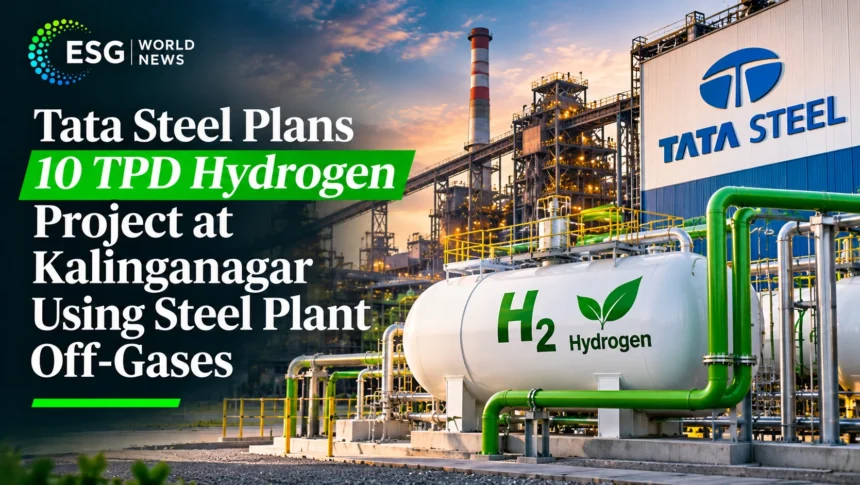
ENVIRONMENT | CLEAN ENERGY | INDIA | 24 NOVEMBER 2026 – India’s steel industry could be approaching a new phase in industrial decarbonisation as Tata Steel partners with Houston-based clean-hydrogen technology developer Utility Global to explore hydrogen production using gases generated within an integrated steel plant.
- How Tata Steel’s Off-Gas-to-Hydrogen Project Will Work
- Why Kalinganagar Is Important for Tata Steel’s Hydrogen Strategy
- What Is Utility Global’s H2Gen Technology?
- FEED Study Is the Next Step — Construction Is Not Yet Approved
- Key Numbers: Tata Steel’s Kalinganagar Hydrogen Project
- Why the Project Matters for India’s Steel Industry
- What to Watch Next
- A New Direction for Hydrogen in India’s Steel Industry
The companies have agreed to undertake Front-End Engineering and Design (FEED) studies for a proposed 10-tonne-per-day (TPD) hydrogen production unit at Tata Steel’s Kalinganagar facility in Odisha.
The project will use a combination of blast furnace gas and basic oxygen furnace (BOF) gas as feedstock. Utility Global’s proprietary H2Gen technology is designed to recover hydrogen from industrial off-gases by using their residual thermal and chemical energy, rather than depending on grid electricity for conventional electrolysis.
If implemented, the facility would mark Utility Global’s first announced industrial H2Gen deployment in India and its largest industrial project announced globally to date.
The proposal also supports Tata Steel’s broader ambition to achieve net-zero carbon emissions by 2045.
How Tata Steel’s Off-Gas-to-Hydrogen Project Will Work
Integrated steel plants generate several gas streams during ironmaking and steelmaking. These include blast furnace gas and basic oxygen furnace gas, which contain chemical and thermal energy.
Tata Steel and Utility Global plan to use these industrial byproducts as feedstock for hydrogen production at Kalinganagar.
Utility Global’s H2Gen technology is designed to extract hydrogen from water by utilising the residual energy contained in industrial off-gases. Unlike conventional electrolysis, which requires electricity to split water into hydrogen and oxygen, the proposed process is designed to avoid dependence on grid electricity.
The approach could offer steelmakers another way to recover value from existing industrial processes while producing hydrogen for potential use within their operations.
Instead of treating off-gases only as a residual energy stream, the proposed system aims to convert their available energy into a useful industrial input.
The planned facility will have a production capacity of 10 tonnes of hydrogen per day, subject to the outcome of the engineering and investment process.
Why Kalinganagar Is Important for Tata Steel’s Hydrogen Strategy
Tata Steel’s Kalinganagar operations in Odisha provide the setting for the proposed technology deployment.
The company has been expanding its presence at the site, which includes major integrated steelmaking infrastructure. Its scale and existing industrial processes make it a potential location for testing hydrogen recovery from steel plant off-gases.
The project also aligns with Tata Steel’s stated ambition to achieve net-zero carbon emissions by 2045.
Steelmaking is among the more challenging industrial sectors to decarbonise because conventional production routes rely heavily on coal and coke, particularly in ironmaking.
Hydrogen is being explored as one potential tool for reducing dependence on fossil-based processes. However, the economics of hydrogen production, availability of suitable infrastructure and integration with existing steelmaking operations remain important considerations.
The proposed Kalinganagar project offers an opportunity to examine whether hydrogen recovered from industrial off-gases can contribute to this transition.
What Is Utility Global’s H2Gen Technology?
Utility Global has developed H2Gen, a technology designed to produce hydrogen using the residual thermal and chemical energy available in industrial off-gases.
The proposed Tata Steel deployment will use blended blast furnace and basic oxygen furnace gases.
The technology’s central proposition is that industrial facilities may be able to generate hydrogen by recovering energy already present in their operations, rather than relying entirely on separately generated electricity.
For energy-intensive industries, this could create an additional route for hydrogen production and industrial energy recovery.
The proposed project is particularly significant because it represents Utility Global’s first announced deployment in India and its largest industrial H2Gen project announced globally so far.
Its eventual performance, production economics and integration requirements will be important indicators of whether the technology can be replicated across other steelmaking facilities.
FEED Study Is the Next Step — Construction Is Not Yet Approved
An important distinction is necessary when assessing the project’s current status.
Tata Steel and Utility Global have agreed to undertake a Front-End Engineering and Design (FEED) study. This is a detailed engineering and cost-assessment stage that generally precedes a Final Investment Decision (FID).
The FEED exercise is expected to examine key project requirements, including:
- Equipment configuration and production capacity.
- Integration with existing steel plant infrastructure.
- Feedstock availability and processing requirements.
- Project engineering and capital cost estimates.
- Implementation planning and potential timelines.
The findings will help the companies assess the project’s technical and commercial feasibility.
However, completing a FEED study does not automatically mean that construction has been approved. A separate investment decision will be required before the project moves into the construction phase.
Consequently, the proposed 10 TPD hydrogen facility should be viewed as an active engineering initiative rather than an operational hydrogen plant or a project with a confirmed construction schedule.
Key Numbers: Tata Steel’s Kalinganagar Hydrogen Project
- 10 TPD: Proposed daily hydrogen production capacity.
- 2045: Tata Steel’s net-zero carbon emissions target.
- Two off-gas streams: Blast furnace gas and basic oxygen furnace gas will serve as feedstock.
- First India deployment: Utility Global’s first announced industrial H2Gen project in India.
- Largest announced deployment: The proposed facility is Utility Global’s largest industrial H2Gen project announced globally to date.
Why the Project Matters for India’s Steel Industry
The proposed project could have wider implications for India’s efforts to decarbonise energy-intensive manufacturing.
1. Industrial energy recovery
The project seeks to convert energy available in steel plant off-gases into hydrogen, potentially improving the utilisation of existing industrial resources.
2. Alternative hydrogen production pathways
Green hydrogen production through renewable-powered electrolysis is attracting investment, but electricity costs, infrastructure and project economics remain important considerations. Off-gas-based hydrogen recovery offers another technology pathway for industrial facilities.
3. Steel sector decarbonisation
Hydrogen is being explored as a potential tool for reducing fossil-fuel dependence in steelmaking. The proposed Kalinganagar facility could provide valuable insight into how hydrogen production can be integrated into existing industrial operations.
4. Technology commercialisation
For Utility Global, an eventual deployment at Kalinganagar could provide an important commercial reference point for its H2Gen technology in India and potentially other industrial markets.
5. ESG and emissions management
Steelmakers face increasing pressure to demonstrate credible emissions-reduction strategies. Projects that improve energy recovery and introduce alternative production processes could become relevant to their long-term sustainability plans.
What to Watch Next
The next major milestone will be the outcome of the FEED study and whether Tata Steel proceeds with a Final Investment Decision.
Several aspects will determine the project’s commercial significance:
- The final engineering design and estimated capital expenditure.
- The quantity and quality of hydrogen that can be recovered from the off-gas streams.
- The cost competitiveness of the hydrogen produced.
- How the hydrogen will be used within Tata Steel’s operations.
- The project’s eventual construction and commissioning timeline.
The intended end use of the hydrogen will be particularly important in assessing its contribution to the company’s wider emissions-reduction strategy.
A New Direction for Hydrogen in India’s Steel Industry
Tata Steel’s proposed partnership with Utility Global highlights an emerging approach to industrial decarbonisation: producing hydrogen by recovering energy from existing manufacturing processes.
The planned 10 TPD facility at Kalinganagar is still at the engineering-study stage, but it represents a potentially important development for India’s steel and hydrogen sectors.
If the project advances beyond FEED and demonstrates commercial viability, it could offer other integrated steelmakers a model for exploring hydrogen production from their own industrial off-gases.
For India’s steel transition, the next breakthrough may not come only from building new renewable energy capacity. It could also come from finding smarter ways to recover and reuse the energy already generated inside industrial plants.
Sources: Tata Steel, Gasworld, PR Newswire and Chemical Engineering. This article is an original editorial rewrite based on the supplied source material.
India Green Hydrogen: IH2A Proposes ₹1,400-Crore Demand Fund