

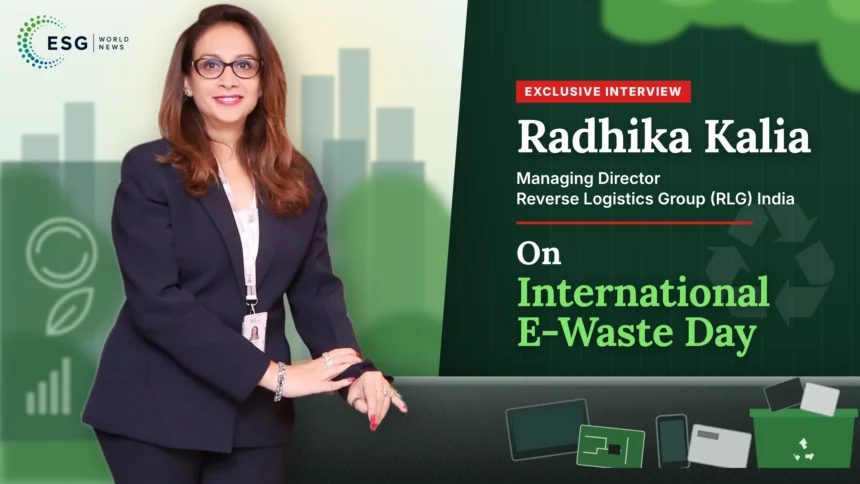
In this exclusive International E-Waste Day interaction with Ankitt Y, Editor, ESG World News, Radhika Kalia, Managing Director, Reverse Logistics Group (RLG) India, discusses the realities of India’s e-waste ecosystem, the need for stronger traceability, and how reverse logistics can turn end-of-life products into economic value. Drawing on decades of experience across corporate affairs, CSR and consumer-facing industries, the leader also shares insights on formalising informal collection networks, building consumer trust, adapting global take-back models to Indian realities, and creating a more resource-efficient future by 2030.
From boardroom to waste chain. You spent three decades in corporate affairs and CSR at Panasonic, Samsung, Haier and HT Media before leading a reverse logistics company. What drew you to this sector, and how has your communications background shaped the way you run RLG India?
Honestly, I see my shift to reverse logistics from my earlier career as a somewhat natural progression. At Samsung and Haier, I was exposed to products, markets and consumer behaviour. At HT Media, the experience was more commercial and revenue-driven. At Panasonic, where I headed Corporate Affairs and CSR, I worked closely with government and regulatory institutions, including the Central Pollution Control Board and the Ministry of Environment, Forest and Climate Change, on environmental and regulatory matters. That was where I realized that India did not necessarily suffer from a shortage of policies. The gap existed between policy formulation and what actually happened on the ground. Leading RLG gave me an opportunity to build systems that could actually execute them.
My communications background has been extremely useful because waste management is a problem of which logistics, recycling and stakeholder-alignment are integral components. While a producer speaks the language of cost, compliance and risk, a recycler thinks in terms of feedstock and recovery. At the same time, a regulator needs evidence and accountability while a waste collector is concerned about livelihood and price. Further still, a consumer wants convenience and confidence that an old device will be handled properly. The job of leadership is often to make these different interests work within one credible system. In this context, communication entails translating regulation into something operational, explaining complex requirements to different stakeholders, building trust and ensuring that the purpose of compliance is understood throughout the chain.
I also carry important lessons from my earlier commercial roles. For example, sustainability cannot remain separate from business logic. A circular system ultimately has to work environmentally and economically. That thinking has significantly shaped RLG’s approach, from compliance and take-back to aggregation, resource recovery, traceability and what we call Return to Value. The relevance of this approach is clearer today. At the recent World Circular Economy Forum 2026 discussions, one of the central questions was precisely how India moves from pilots and promises to transparent, scalable material flows involving policy, industry, technology and people together.
The EPR reality check. India’s EPR rules for e-waste, batteries and plastic have tightened sharply in recent years. From where you sit as a PRO, are producers treating EPR as a box to tick or as a real business responsibility? What’s still missing in how it’s enforced on the ground?
I would first make a small distinction about the terminology. RLG entered India under the earlier Producer Responsibility Organisation, or PRO, framework and was among the early organisations working in that ecosystem. Under the E-Waste (Management) Rules, 2022, however, the architecture has evolved considerably. Producers and registered recyclers are now connected more directly through EPR obligations, certificates and the central portal. Our own role has evolved beyond the traditional PRO construct into areas such as collection, aggregation, take-back, traceability, material recovery and compliance support.
EPR itself is now in a transition. Some companies still approach it primarily as a compliance obligation, while others increasingly understand it as a broader business responsibility linked to supply-chain risk, ESG, resource security, reputation and access to secondary materials. That is an encouraging development. The government’s circular-economy framework now extends EPR across multiple streams, including e-waste, batteries, plastics, tyres, used oil, end-of-life vehicles and non-ferrous metal scrap. The direction is clearly towards greater producer accountability and measurable recovery.
However, there is still a danger of reducing EPR to the purchase of a certificate. A certificate cannot become a substitute for knowing what happened to the material. The real issues are, was the waste actually collected, where did it come from, who transported it, did it physically reach the recycler, was that recycler capable of processing it, what was recovered, and where did the recovered material finally go.
The importance of this distinction was illustrated very sharply by recent developments. In September 2026, Reuters reported on a government tax investigation involving major appliance companies and an allegedly spurious recycler, in which authorities alleged that documents and photographs were fabricated even though actual recycling had not been established. The companies said they were cooperating with authorities, while the recycler denied wrongdoing. Whatever the eventual outcome of that investigation, the larger lesson for the industry is that documentary compliance without physical verification creates serious regulatory and reputational risk. This is why enforcement now needs to move from certificate verification towards material-flow verification. GST-linked invoices, weighbridge records, transportation records, recycler capacity, input-output reconciliation, periodic physical audits and digital traceability should reinforce one another. CPCB’s requirement for GST-linked invoices in the e-waste system is an important step in this direction. In my view, EPR must deliver outcomes, not just paperwork. This is currently India’s biggest EPR reality check according to me.
The informal sector question. Most of India’s e-waste still flows through informal recyclers. How does RLG work with this sector instead of competing against it, and what would it take to bring these workers into the formal, safer value chain at scale?
We must recognise that the informal sector is not external to India’s waste-management system. It is already one of its largest collection networks. Any model that tries to build a formal circular economy while pretending that this network does not exist will struggle to scale. The main challenge is to separate the informal sector’s strengths (reach, collection capability, local knowledge and livelihood generation) from unsafe processing practices that can harm workers and the environment.
We have therefore focused on integration instead of displacement. Over the years, RLG has worked with informal collectors and dismantlers on safe collection and storage, segregation, accounting, documentation and formal business practices. During our early work with informal scrap dealers, RLG helped operators understand licensing, documentation and regulatory requirements. Six of them subsequently formalised their operations and established recycling or dismantling units under the applicable e-waste rules. We then expanded this approach through E-Safai, our initiative with GIZ India, which focused on capacity-building and integrating informal-sector stakeholders into formal e-waste value chains.
But formalisation should not mean telling every waste picker or small collector that they must suddenly become a sophisticated recycler. We need a graduated pathway to formalisation. A collector can remain a collector while becoming identifiable, trained and linked to an authorised aggregation centre. Aggregators can provide safe storage, sorting, documentation and consolidation. Authorised recyclers can perform the specialised processing. Digital records can then connect these stages. This is why I see aggregation centres and hub-and-spoke systems as particularly important for India. They allow a decentralised collection network to feed into a controlled formal downstream system without destroying the livelihood structure that made collection possible in the first place. At WCEF2026, this was again a central theme. Traceability frameworks need to be transparent and interoperable, but they also need to integrate informal actors rather than exclude them.
At scale, formalisation will require more than regulation. Workers need training, easier registration, banking and digital payment access, predictable pricing, access to aggregation infrastructure, skill certification and, eventually, greater social protection. Most importantly, formal channels must make economic sense. If an informal collector receives significantly more from an unsafe buyer than from the formal system, regulation alone will not redirect the material. We should therefore focus on formalising the relationship and the material flow rather than eliminating the people who have spent decades building the collection network.
Compliance as revenue. RLG talks about turning environmental compliance into “revenue potential” through its Return-to-Value model. Can you give a real example of a brand that has recovered value, not just cost, from its take-back programme?
“Return to Value” is based on the simple principle that when a product comes back, the first effort should be towards determining the value that remains in it. That value can exist at several levels. To illustrate, a product may be reusable, repairable or refurbishable; components may have a second life; materials such as copper, aluminium, steel, plastics, lead or battery metals may be recoverable. A structured take-back programme can also strengthen the relationship with the customer, support a replacement purchase and provide better visibility of a product’s lifecycle. RLG’s original articulation of Return to Value specifically referred to returning value from materials, products and customer relationships. A clear public example is ‘Apple Trade In’ in India. Eligible devices are assessed for a trade-in value that can be applied towards a new purchase. Devices in suitable condition can be directed towards reuse, while those that are not eligible for trade-in credit can be recycled free of charge. The same reverse channel therefore distinguishes between reuse value and material value rather than treating every returned device as waste. Another useful example is HP’s Planet Partners programme, where returned cartridges are sorted and processed and recovered material can be incorporated into new cartridges and other applications.
Closer to RLG’s own operating areas, batteries illustrate the economics particularly well. RLG’s industrial and automotive battery solution is designed to secure valuable materials for reuse and achieve the highest possible value retention, while reducing costs and the need for virgin raw resources. Proper end-of-life battery management can also help address disposal, insurance and maintenance costs, as well as the safety risks associated with improper storage, transport and recycling. I have maintained that the high use of recycled lead in the lead-acid battery industry is evidence that circularity can make commercial sense when there is a strong secondary-material market.
For individual RLG clients, however, commercial recovery figures and programme economics are often confidential, so I would not attach a client’s name or revenue number without its consent. I would like to emphasize here that it is important to see compliance as the starting point, not the end goal. The real opportunity lies in preserving as much value as possible in products, components, materials and customer relationships before they reach the end of their useful life.
Changing behaviour, not just collecting waste. Clean to Green has reached about 4 million people through more than 2,500 activities across 26 states and 7 UTs. What has actually worked in getting citizens, RWAs and schools to give up their old devices responsibly? And how do you measure behaviour change, not just reach?
The reach numbers are important, but reach is an input, not the final outcome. RLG’s current profile records more than four million people reached through Clean to Green across 26 states and seven Union Territories, with 2,510 activities. One important lesson from these years is that people do not always keep old electronics because they are irresponsible. Often, they simply do not know what the trusted next step is. They do not know who will take the device, will someone come to collect it, is the recycler authorised, what happens to personal data, or is a charger or cable even worth handing over.
That is why convenience and trust have worked better than awareness in isolation. Clean to Green has worked through schools, colleges, RWAs, retailers, offices and the informal sector, but crucially it has combined communication with collection opportunities. RLG’s collection model has used local drives, a toll-free pickup mechanism and collection routes through marketplaces and residential communities.
Schools work particularly well because children become multipliers. A student who understands the issue can take the conversation into the household. RWAs work when there is a clearly announced handover date and a convenient collection point rather than a general appeal to “dispose responsibly”. With organisations, recurring drives work better than one-time awareness sessions. The next stage must be to measure conversion rather than exposure. If 500 residents attend an activity, how many subsequently surrender an unused electronic product? How many households participate again six months later? How many kilograms or devices move into authorised channels per activation? Does an RWA organise its second collection without being persuaded again? Does a school make e-waste collection an annual practice? How many pickup enquiries turn into completed collections? These are stronger indicators of behavioural change.
Global playbook, Indian context. RLG operates in more than 80 countries and is now part of the Reconomy Group. What have you borrowed from European take-back systems, and what has India forced you to reinvent?
The advantage of being part of a global organisation is that we do not have to rediscover every principle from the beginning. RLG today operates across more than 80 countries and has experience in environmental compliance, data management, circular take-back and deposit-return systems across multiple regulatory environments. There are several lessons from Europe that are highly relevant to India, including stable producer-responsibility systems, permanent take-back infrastructure rather than occasional collection drives, strong data and audit discipline, design for disassembly and recovery, and the development of reliable markets for secondary materials.
But the principle I would emphasise is that while global principles can travel, operating models have to be localised. India’s collection ecosystem is far more fragmented. We have a very large informal network, strong repair and resale markets, enormous differences between cities and regions and millions of transactions that occur through small dealers and aggregators. Simply transplanting a highly centralised European model into this environment would ignore one of India’s most important strengths, namely its decentralised collection capability.
That is why India has forced us to think much more seriously about aggregation, inclusion and last-mile economics. We need systems in which local collectors can feed material into organised aggregation centres. Technology has to support the physical system rather than assume that an app alone will solve it. So while we can take from Europe the importance of system discipline, India teaches us that discipline must coexist with inclusion, decentralisation and scale. The strongest Indian circular-economy model will probably be a combination of European and traditional elements.
The road to 2030. If you could change one policy, one industry habit and one consumer mindset to speed up India’s move to a circular economy, what would they be? And as a woman leading in a male-dominated logistics sector, what’s your message to the next generation of sustainability leaders?
If I could change one policy issue, I would push for a much more unified and interoperable framework for circular-material governance and traceability. India has already made remarkable progress in building EPR frameworks. By March 2026, the government had EPR-based systems covering e-waste, batteries, plastic packaging, tyres, used oil, end-of-life vehicles, construction and demolition waste and non-ferrous metal scrap. The next challenge is to make these systems more interoperable. Regulatory records, GST-linked invoices, material-movement documentation, recycler input-output data and transactions involving recovered materials should be capable of being cross-verified across the value chain.
If I could change one industry habit, I would end the practice of treating end-of-life management as a year-end compliance activity. Circularity needs to begin when the product is designed and when suppliers are selected. Durability, repairability, disassembly, recycled-material content, take-back logistics and downstream recovery should become normal procurement and product-development considerations. The battery rules are already moving in this direction by requiring minimum domestically recycled-material content in new batteries from FY2027-28.
If I could change one consumer mindset, it would be the belief that an unused product has become worthless. An old phone in a drawer is not merely clutter. A battery, cable, appliance or computer contains materials that have already been mined, processed, manufactured and transported. Keeping those materials outside the productive economy has an economic cost as well as an environmental one. We need to move from a throw-away mindset to a return mindset.
And to young sustainability professionals, particularly women, I would say, build capability before you build visibility. When I began my career, far fewer women occupied leadership roles in sectors such as logistics, manufacturing and environmental services. What I have learnt over time is that preparation, clarity, integrity and performance ultimately matter far more than the stereotype attached to a sector. Leadership is beyond just a title. It is the willingness to take responsibility for a decision and its consequences. Sustainability also needs many kinds of professionals now, including engineers, economists, communicators, data specialists, policy experts, entrepreneurs, researchers and supply-chain professionals. Do not assume you have to fit a traditional image of what a waste-management or logistics professional looks like.
By 2030, I hope we will also have changed our language. Instead of seeing this primarily as a waste-management industry, I would like India to see it as part of its resource economy. The country that becomes better at recovering, tracking and reintegrating its own materials will be cleaner, more resilient and resource-secure.
Exclusive Interview: Viktoriia Betina on Green Hydrogen, SAF and the Future of Decarbonisation