

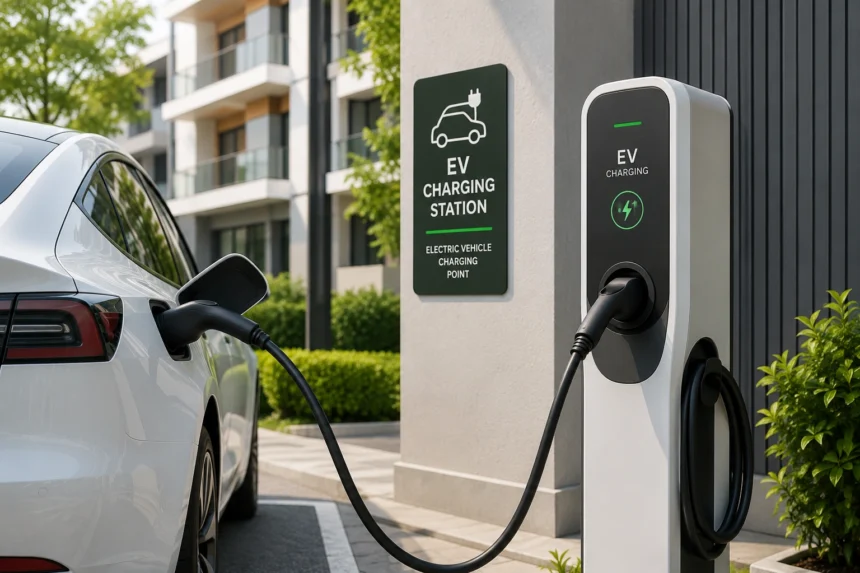
In a major push towards sustainable transportation and electric mobility, the Haryana Government has amended the Haryana Building Code (HBC)-2017, making electric vehicle (EV) charging infrastructure mandatory in new and renovated residential and commercial developments across the state.
- Haryana Strengthens EV Infrastructure Policy
- Commercial Buildings Must Allocate EV Charging Spaces
- Residential Projects Required to Provide EV Charging Facilities
- EV Charging Allowed in Basements and Stilt Parking Areas
- Mandatory Disclosure During Occupation Certificate Approval
- Existing Residents Can Install Private EV Chargers
- Focus on Fire and Electrical Safety
- Boosting Electric Vehicle Adoption in Haryana
- Supporting India’s Net-Zero and Clean Energy Goals
- Outlook
The revised regulations, notified by the Town and Country Planning Department, are designed to strengthen EV adoption by ensuring widespread access to charging facilities while creating future-ready urban infrastructure aligned with India’s clean mobility goals.
The amendments apply to all residential and commercial projects that provide parking facilities for at least 10 vehicles.
Haryana Strengthens EV Infrastructure Policy
As electric vehicle adoption gains momentum across India, one of the biggest challenges remains the availability of reliable and accessible charging infrastructure.
Recognizing this need, Haryana has introduced new building regulations that require developers to integrate EV charging facilities into project designs from the outset, rather than retrofitting infrastructure later.
The move aligns with India’s broader efforts to reduce transportation-related emissions, improve air quality, and support the transition towards low-carbon mobility.
Commercial Buildings Must Allocate EV Charging Spaces
Under the revised building code, commercial and non-residential developments—including:
- Shopping malls
- Office complexes
- Hotels
- Commercial centers
- Business parks
must provide a minimum of one EV charging point for every three parking spaces.
In addition, all parking bays within such projects must be made EV-ready, with the necessary conduits, wiring pathways, and supporting electrical infrastructure installed to facilitate future charger deployment.
This provision ensures that commercial properties can scale charging infrastructure as EV ownership continues to increase.
Residential Projects Required to Provide EV Charging Facilities
The amended regulations also cover residential developments, including:
- Group housing societies
- Cooperative housing projects
- Apartment complexes
- Residential communities managed by Resident Welfare Associations (RWAs)
Developers will now be required to provide at least one EV charging spot for every five parking spaces.
Furthermore, all parking spaces in new and renovated residential developments must be equipped with EV-ready infrastructure, allowing homeowners and residents to install charging equipment as demand grows.
The requirement is expected to remove a significant barrier for EV buyers who often cite lack of home charging access as a concern when considering electric vehicles.
EV Charging Allowed in Basements and Stilt Parking Areas
To maximize charging accessibility, the Haryana Government has permitted the installation of EV charging stations in:
- Basement parking areas
- Stilt parking spaces
However, these installations must comply with prescribed fire safety and electrical safety regulations.
Developers and property owners will be required to obtain certification and approval from the Fire Department before operationalizing charging infrastructure in these locations.
Mandatory Disclosure During Occupation Certificate Approval
To ensure compliance, developers seeking Occupation Certificates (OCs) for new projects must disclose the allocation and installation status of EV charging infrastructure.
The measure is expected to improve transparency and ensure that EV charging provisions are implemented as part of project completion requirements.
Industry experts believe that linking EV infrastructure to occupancy approvals will significantly improve compliance levels across the real estate sector.
Existing Residents Can Install Private EV Chargers
The revised regulations also provide flexibility for residents of existing housing societies and buildings.
Individual homeowners and allottees will be permitted to install EV charging facilities in their designated parking spaces, subject to:
- Electrical safety compliance
- Fire safety requirements
- Approval from the Fire Department
- Approval from the concerned power distribution company
This provision is expected to accelerate charger adoption among existing EV owners while ensuring operational safety.
Focus on Fire and Electrical Safety
As EV charging infrastructure expands, safety remains a key consideration.
To support safe deployment, the Haryana Government has directed the Fire and Emergency Services Department to formulate comprehensive fire safety guidelines for EV charging installations.
The guidelines will be developed in consultation with power sector authorities, including Haryana Vidyut Prasaran Nigam Limited (HVPNL), which has been tasked with helping establish appropriate electrical safety standards.
The framework aims to minimize operational risks while promoting widespread charger deployment.
Boosting Electric Vehicle Adoption in Haryana
The new regulations are expected to play a critical role in supporting Haryana’s clean mobility ambitions.
By integrating EV charging infrastructure into residential and commercial developments, the state aims to:
- Increase consumer confidence in electric vehicles
- Improve charging accessibility
- Reduce range anxiety
- Support urban sustainability goals
- Encourage adoption of cleaner transportation technologies
- Strengthen EV ecosystem development
Experts believe that embedding charging infrastructure into building design is one of the most effective ways to accelerate EV adoption, particularly in densely populated urban areas.
Supporting India’s Net-Zero and Clean Energy Goals
The building code amendments also contribute to India’s broader sustainability and climate objectives.
Transportation remains one of the largest contributors to greenhouse gas emissions globally. Expanding electric mobility infrastructure is viewed as a critical step toward reducing carbon emissions and improving urban air quality.
As more states adopt EV-friendly regulations, India is moving closer to creating a nationwide ecosystem capable of supporting mass electric vehicle adoption.
Outlook
Haryana’s decision to mandate EV charging infrastructure in new and renovated buildings marks a significant milestone in the state’s clean mobility journey.
By ensuring that residential and commercial developments are equipped with future-ready charging facilities, the government is laying the foundation for a more sustainable transportation ecosystem.
As EV sales continue to rise and charging demand grows, policies that integrate infrastructure planning with urban development are expected to play a vital role in shaping India’s transition to greener and more energy-efficient mobility solutions.