

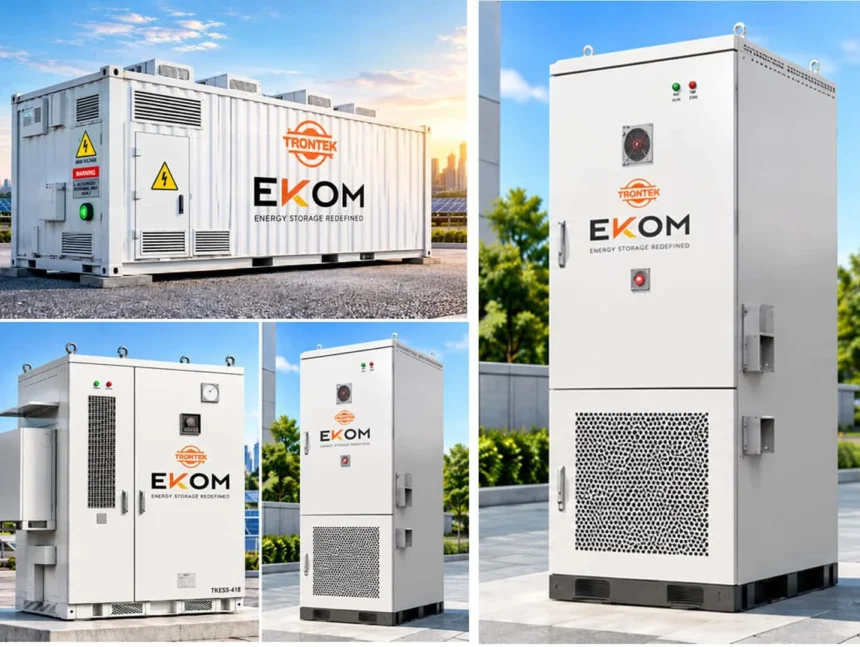
12 October 2026, India – Trontek Electronics has announced plans to establish 12 GWh of annual battery energy storage system (BESS) manufacturing capacity by 2028, marking a strategic expansion beyond its existing battery technology, electric mobility, charging and energy businesses.
- BESS Portfolio Targets Residential, Commercial and Utility Applications
- 215 kWh Systems for Commercial and Industrial Users
- 418 kWh Systems for Larger Facilities
- 5 MWh Systems for Utility-Scale Projects
- Local Manufacturing at the Centre of Trontek’s Expansion
- Trontek Diversifies Beyond Electric Mobility and Battery Solutions
- Why Battery Energy Storage Matters for India’s Energy Transition
Announced on October 12, 2026, the expansion will broaden the company’s portfolio to address residential, commercial, industrial and utility-scale energy storage requirements. Its Made-in-India offering will include containerised battery storage systems with capacities of up to 5 MWh.
The company is developing solutions for applications ranging from household energy management and commercial power optimisation to large-scale industrial and grid-connected storage.
The planned expansion comes as battery energy storage gains importance in supporting renewable energy integration, improving electricity management and balancing fluctuations in power supply and demand.
Samrath S. Kochar, Founder and CEO of Trontek, said the company’s entry into BESS builds on more than two decades of experience in battery and energy technology. He added that the business aims to contribute to the development of domestic energy storage manufacturing capabilities in India.
BESS Portfolio Targets Residential, Commercial and Utility Applications
Trontek’s planned energy storage portfolio spans capacities from 215 kWh to 5 MWh, addressing different requirements across the energy ecosystem.
215 kWh Systems for Commercial and Industrial Users
The company’s 215 kWh-class systems are designed for commercial and industrial (C&I) applications, including hotels, offices and small and medium-sized manufacturing enterprises.
These solutions are intended to support energy demand management, improve energy utilisation and strengthen power reliability for businesses.
418 kWh Systems for Larger Facilities
For larger installations, Trontek is offering 418 kWh-class systems aimed at factories, warehouses, hospitals and industrial campuses.
These facilities can use energy storage to support operational power requirements and manage electricity consumption more effectively.
5 MWh Systems for Utility-Scale Projects
At the larger end of the portfolio, Trontek’s 5 MWh systems are designed for industrial parks, utilities and large solar-plus-storage projects.
Such systems can support the integration of renewable electricity and provide storage capacity for applications requiring larger volumes of energy.
The portfolio also includes modular solutions for residential and distributed energy applications, intended to improve renewable energy utilisation, household energy management and power resilience.
According to the company, it is already engaging with customers across these market segments as it develops its presence in India’s battery energy storage market.
Local Manufacturing at the Centre of Trontek’s Expansion
Trontek plans to build its BESS business around domestic engineering and manufacturing capabilities. The company’s approach includes battery systems, testing, system integration, technology development and after-sales service.
Its target of reaching 12 GWh in annual manufacturing capacity by 2028 is intended to support demand across commercial, industrial and utility-scale applications.
The company is also developing solutions tailored to India’s varied operating environments and application requirements.
However, Trontek has not disclosed the investment required to achieve the target, the locations of the proposed manufacturing facilities or the phased commissioning schedule for the planned capacity.
Trontek Diversifies Beyond Electric Mobility and Battery Solutions
Founded in 2004, Trontek manufactures battery and energy solutions for electric mobility, residential energy, telecommunications, charging and other applications.
The proposed BESS expansion represents a broader diversification of its business, positioning large-scale energy storage as an additional growth area alongside its existing operations.
By extending its capabilities into larger storage systems, the company aims to serve a wider range of customers as energy infrastructure requirements evolve.
Why Battery Energy Storage Matters for India’s Energy Transition
As renewable energy deployment and electrification expand, managing the availability and timing of electricity becomes increasingly important.
Battery energy storage systems can store electricity for later use, help manage fluctuations in supply and demand, and support the integration of variable renewable sources such as solar and wind.
For commercial and industrial users, storage can also support energy management and power resilience. At the grid level, larger systems can contribute to flexibility in electricity networks and renewable energy projects.
Trontek’s planned manufacturing expansion reflects the opportunity for domestic manufacturers to develop battery storage solutions across these applications.
Conclusion
Trontek Electronics’ target of 12 GWh in annual BESS manufacturing capacity by 2028 marks a significant planned expansion of its energy technology portfolio. With systems ranging from 215 kWh to 5 MWh, the company aims to serve residential, commercial, industrial and utility-scale markets while strengthening domestic energy storage manufacturing.
The execution of this plan will depend on manufacturing scale-up, customer adoption and the investment and commissioning decisions required to deliver the proposed capacity.
This article is based on the supplied company announcement. The 12 GWh figure is a future manufacturing target, not confirmed operational capacity.
Global Electronics Association Releases IPC-1783-CO2E Standard for Carbon Emissions Reporting