
Every time a factory in India flips on a diesel generator, it pays between ₹25 and ₹35 per unit of electricity. Grid power, by comparison, costs ₹6 to ₹9 per unit. Stored solar energy even less.
That gap — between what India’s commercial and industrial sector pays for backup power and what it should pay — is not a technology problem. It is a deployment problem. The technology to fix it has existed for years. What has been missing is a full-stack operator willing to install it, own the intelligence layer on top of it, and make the economics work at the point of consumption.
VoltSeal, a New Delhi-based energy storage startup, is building exactly that. And on June 4, 2026, the company announced that Theia Ventures has led its pre-seed funding round, with participation from Rainmatter, Momentum Capital, Social Alpha, and a group of angel investors. The round makes Theia the company’s first institutional partner.
The Problem VoltSeal Is Solving — In Numbers
India’s energy transition story has a structural contradiction at its heart. The country has moved fast on renewable capacity — renewables now account for 43% of installed generation capacity, and India recently secured the third position globally in renewable energy installed capacity per IRENA 2026 rankings. But installed capacity and actual generation are very different things.
Because solar energy generates during daylight hours while industrial demand peaks in the evening, renewables contribute only 22% of actual electricity generated. The gap is bridged by thermal generation and, at the facility level, by diesel generators that are expensive, carbon-intensive, and ubiquitous across India’s industrial landscape.
The numbers define the opportunity precisely:
- ₹25–₹35 per unit — what C&I consumers pay to run diesel backup power
- ₹6–₹9 per unit — grid power cost, several times cheaper
- 43% — India’s renewable share of installed capacity, with only 22% actual generation contribution
- 160 GWh — the storage requirement projected by India’s Central Electricity Authority by 2030
- $2.05 billion — the current size of India’s Battery Energy Storage Systems market, growing at 27% CAGR
- $1.7 billion — the projected size of India’s Virtual Power Plant market by 2033, up from just $58 million in 2024
- $100 billion+ — the estimated capital deployment opportunity in India’s industrial energy transition by 2030
How VoltSeal Works: Storage First, Intelligence Second
VoltSeal’s model begins with a straightforward value proposition and builds toward something considerably more ambitious.
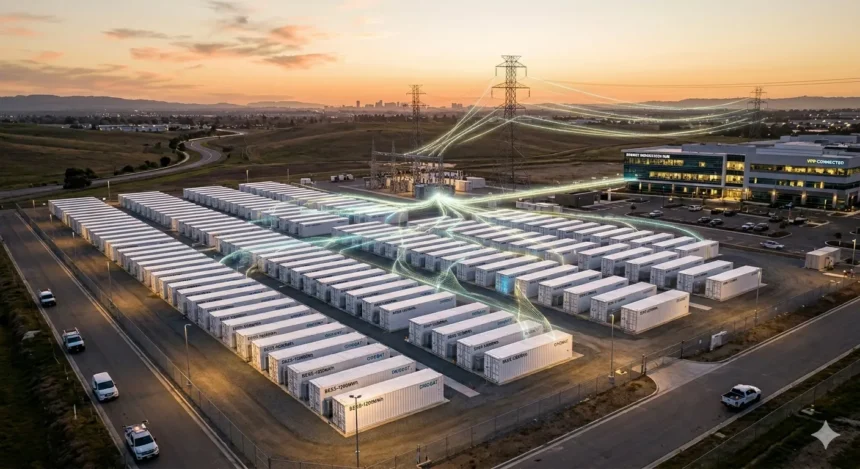
At the entry point, VoltSeal installs modular Lithium Iron Phosphate (LFP) battery systems directly at commercial and industrial sites — behind the meter, at the point of consumption. LFP chemistry is well-suited to this application: it offers longer cycle life, better thermal stability, and lower degradation than alternative battery chemistries, making it appropriate for the daily charge-discharge cycles an industrial backup and peak-shaving system demands.
The immediate value is clear and bankable. By replacing diesel generators with stored renewable energy, a C&I customer can reduce backup power costs substantially and achieve a payback period short enough to finance the asset through conventional debt. This is not a speculative future benefit — it is an immediate, calculable cost reduction that makes the business case compelling without requiring the customer to believe in any broader energy transition thesis.
But the more significant layer of VoltSeal’s model lies above the hardware.
Every deployed unit remains under VoltSeal’s operational dispatch control as a condition of each installation. This means the company does not simply sell a battery and walk away — it retains the ability to command when each system stores, when it discharges, and how it responds to changing price signals, grid conditions, and operational patterns at the site.
That data and control layer is the foundation of VoltSeal’s long-term value. As the company deploys more units across more sites, individual batteries begin to function not as isolated assets but as nodes in a coordinated network. That network is the building block for what the energy sector calls a Virtual Power Plant — an aggregation of distributed assets that can collectively provide grid-balancing services, respond to frequency signals, and participate in emerging market structures like time-of-day pricing and Green Day Ahead Market procurement.
The transition from standalone storage to networked intelligence is where value compounds in the model. And it is why Theia Ventures believes the competitive position deepens with scale rather than diluting.
The Founders: Rare Depth in a Sector That Needs It
Mudit Narain brings over 18 years of lending, operating, and investing experience in the energy sector. His background includes formal training at MIT’s Technology and Policy Program, seven years in the World Bank’s Energy practice, and six years working with the Government of India at the Atal Innovation Mission, NITI Aayog, and the Office of the Principal Scientific Advisor. He has also been associated with two venture capital funds — INFUSE and Blume — and led the science and technology think tank FAST India.
Co-founder Abhijeet Pandey brings deep experience across strategy, investments, and large-scale transformations in energy, infrastructure, and sustainability, with prior involvement across IIM Ahmedabad Ventures, Bharat Innovations Fund, INFUSE, and ADB Ventures between 2020 and 2025.
Together, they represent something genuinely unusual in the Indian climate-tech ecosystem: founders who have spent years working within the policy, regulatory, and investment structures that will determine how quickly the distributed energy storage market unlocks. They are not learning the sector from the outside.
Mudit Narain put the company’s founding thesis directly: “The bridge between renewable energy and reliable energy has always been storage of some kind, and we believe batteries are the best option. They also enable microgrids, coupled with distributed generation and some demand side management. The concept of microgrids has been around for decades, but with batteries, it is an idea whose time has finally come. We are building for a large chunk of Indian consumption, the commercial and industrial sector, and we are delighted to get started with a big bang.”
Why Theia Ventures Led the Round
Theia Ventures has been building a concentrated portfolio in India’s industrial energy transition. The fund previously led the $1 million pre-seed round for EarthSync Technologies, a Bengaluru-based decision intelligence platform for the C&I energy segment, with the thesis that India’s energy transition bottleneck has shifted from physical capacity to execution intelligence. VoltSeal sits in the same investment thesis — distributed energy resources where the competitive position deepens with deployment scale.
Priya Shah, Founder and General Partner at Theia Ventures, described the investment rationale: “We are proud to be VoltSeal’s first institutional partner as they build the intelligent battery layer that India’s energy transition demands. Mudit and Abhijeet bring a rare combination of energy policy depth, strategic execution, and a genuine founder-market conviction that positions VoltSeal to become a critical node in India’s distributed energy infrastructure.”
The participation of Rainmatter — the climate-focused investment arm associated with Zerodha’s Nithin Kamath — alongside Social Alpha, Momentum Capital, and a group of angels signals that VoltSeal’s pre-seed round drew investors aligned specifically with the climate infrastructure thesis rather than generic technology venture capital.
The ESG and Policy Dimension
For India’s corporate sector, VoltSeal’s model addresses a problem that is becoming increasingly material from an ESG disclosure standpoint.
Under SEBI’s Business Responsibility and Sustainability Reporting framework, India’s top 1,000 listed companies must disclose their energy consumption, energy intensity, and the proportion of energy sourced from renewable sources. For companies operating large manufacturing or warehousing facilities — precisely the customers VoltSeal is targeting — diesel generator dependence is a disclosure liability. It inflates Scope 1 emissions, raises energy intensity ratios, and is increasingly difficult to justify to investors scrutinising BRSR filings.
Battery storage changes that calculus. A C&I facility running on stored solar energy instead of diesel reduces its Scope 1 emissions, lowers its energy cost, and improves its BRSR energy metrics simultaneously. The commercial case and the ESG case are the same case — which is the structural condition that tends to drive rapid adoption.
The policy environment is also moving in the right direction. India’s Green Day Ahead Market, time-of-day pricing mechanisms, and the Central Electricity Authority’s 160 GWh storage target by 2030 collectively create a pathway for VoltSeal’s aggregated network to eventually participate in grid services — the Virtual Power Plant phase of the model that unlocks the largest potential revenue streams.
What Comes Next
VoltSeal is at pre-seed — early, by any measure. The company is headquartered in New Delhi, its current focus is on building its first deployments and demonstrating the behind-the-meter storage value proposition at real industrial sites. The intelligence and aggregation layers are the medium-term roadmap, not the immediate deliverable.
But the structural conditions that make the model viable — rising industrial energy costs, renewable intermittency, tightening ESG disclosure requirements, and a regulatory environment being designed explicitly to enable distributed storage — are all present now. The $100 billion industrial energy transition opportunity in India is not a projection about 2040. It is a deployment race that is already underway.
Theia’s bet is that VoltSeal’s combination of policy-fluent founders, a full-stack operational model, and the intelligence layer built on top of physical deployment gives it the ingredients to compound value in a way that hardware-only approaches cannot.
The diesel generator has dominated India’s industrial energy backup for decades — not because it is good, but because nothing better was economically accessible and operationally reliable at scale. VoltSeal is building the alternative. The funding is the starting gun.
Sources: Theia Ventures investment memo; VoltSeal; Rainmatter; Central Electricity Authority; IRENA 2026; Ministry of New and Renewable Energy; SEBI BRSR framework.
ESG World News covers sustainability, clean energy, and corporate ESG developments across India and the world. For more on India’s distributed energy transition, battery storage market, and ESG investing, explore our India Focus and Environmental sections at esgworldnews.com