
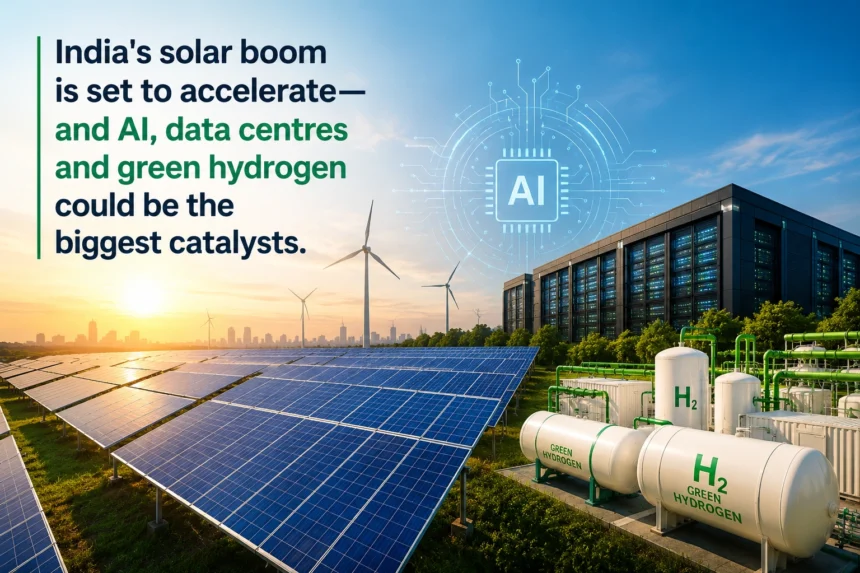
New Delhi: India’s solar energy sector is expected to witness another wave of rapid growth, with annual solar installations projected to increase from nearly 50 GW in FY27 to around 85 GW by FY30, according to a report by Equirus Securities. The report attributes this growth to rising demand from data centres, green hydrogen production and Battery Energy Storage Systems (BESS), alongside the country’s expanding renewable energy pipeline.
- Solar Installations Expected to Accelerate by FY30
- Data Centres, Green Hydrogen and BESS to Drive New Demand
- India Has a Strong Renewable Energy Pipeline
- Firm Renewable Power Projects Gain Momentum
- Data Centre Expansion Creates Significant Solar Opportunity
- Green Hydrogen Mission to Boost Solar Capacity
- Battery Storage Emerging as a High-Growth Segment
- Integrated Renewable Developers Expected to Benefit
- Outlook
- Frequently Asked Questions (FAQs)
The findings highlight India’s strengthening position as one of the world’s fastest-growing renewable energy markets, supported by large-scale infrastructure investments and increasing demand for reliable clean power.
Solar Installations Expected to Accelerate by FY30
According to the report, India’s annual solar capacity additions are expected to rise significantly over the next few years.
The projected increase will be supported by growing electricity demand from emerging industries that require uninterrupted, low-carbon power supplies.
By FY30, annual installations could reach approximately 85 GW, compared with around 50 GW expected in FY27, reinforcing solar power’s central role in India’s energy transition.
Data Centres, Green Hydrogen and BESS to Drive New Demand
The report identifies three major sectors expected to fuel the next phase of solar growth:
- Data centres
- Green hydrogen production
- Battery Energy Storage Systems (BESS)
Together, these sectors could create an additional 15–20 GW of annual solar demand from FY29 onwards.
As businesses increasingly seek reliable renewable electricity, integrated solar and battery storage projects are expected to become a preferred solution for ensuring round-the-clock power availability.
India Has a Strong Renewable Energy Pipeline
India already possesses one of the world’s largest renewable energy development pipelines.
According to the report:
- 215 GW of utility-scale renewable energy projects have been awarded through Letters of Award (LOAs) between FY18 and FY26.
- 145 GW of projects have signed Power Purchase Agreements (PPAs).
- Around 75 GW has already been commissioned.
- Approximately 70 GW remains under various stages of execution.
The remaining pipeline includes:
- 58 GW of solar projects
- 12 GW of wind energy projects
This substantial project pipeline provides long-term visibility for developers, equipment suppliers and infrastructure companies.
Firm Renewable Power Projects Gain Momentum
The report notes that while 58 GW of unsigned solar PPAs remain under consideration, not all projects are expected to move forward at the same pace.
Nearly 43 GW belongs to conventional solar and hybrid projects, where signing timelines remain uncertain.
However, projects involving:
- Round-The-Clock (RTC) renewable power
- Firm and Dispatchable Renewable Energy (FDRE)
- Solar coupled with Battery Energy Storage Systems (Solar+BESS)
are expected to witness faster implementation due to increasing demand for reliable renewable electricity.
Data Centre Expansion Creates Significant Solar Opportunity
India’s rapidly growing digital infrastructure is emerging as one of the strongest long-term demand drivers for renewable energy.
The report highlights that more than 300 data centre projects have already been approved, while major technology companies including Amazon Web Services (AWS), Microsoft and Google have announced multi-billion-rupee investments in expanding India’s cloud and AI infrastructure.
As artificial intelligence, cloud computing and digital services continue to expand, data centres will require uninterrupted electricity with lower carbon emissions.
According to Equirus Securities, a 100 MW data centre operating entirely on renewable energy would require approximately:
- 250 MW of solar capacity
- 150 MW of wind capacity
- 450 MWh of battery storage
This illustrates the growing importance of integrated renewable energy solutions.
Green Hydrogen Mission to Boost Solar Capacity
India’s National Green Hydrogen Mission is expected to become another major catalyst for solar demand.
The government’s target of producing 5 million tonnes of green hydrogen annually by 2030 could require nearly 100 GW of dedicated solar capacity.
The report estimates that producing one million tonnes of green hydrogen requires approximately 20 GW of solar power, making renewable electricity essential for India’s hydrogen ambitions.
Battery Storage Emerging as a High-Growth Segment
Battery Energy Storage Systems (BESS) are expected to become a critical component of India’s clean energy ecosystem.
The report projects that India’s BESS demand will grow from:
- 34.7 GWh during 2022–2027
- To 236.2 GWh during 2027–2032
The growth will be driven by:
- Renewable energy integration
- Grid stability requirements
- Government incentives
- Declining battery costs
- Improving project economics
As renewable penetration increases, battery storage will play an increasingly important role in ensuring stable electricity supply.
Integrated Renewable Developers Expected to Benefit
The report concludes that the market is shifting towards firm renewable energy solutions capable of supplying electricity throughout the day.
This trend is expected to benefit integrated Independent Power Producers (IPPs) that combine:
- Solar power
- Wind energy
- Battery storage
- Advanced energy management systems
Such integrated projects will be better positioned to meet the growing demand for reliable, low-carbon electricity from industries, data centres and emerging clean technology sectors.
Outlook
India’s renewable energy transition is entering a new phase where solar power, battery storage, green hydrogen and digital infrastructure are becoming increasingly interconnected.
With a robust 215 GW renewable energy pipeline, rising investments in AI-driven data centres, ambitious green hydrogen targets and expanding battery storage deployment, the country is well positioned to significantly scale its clean energy capacity over the coming decade.
If current trends continue, annual solar installations could reach 85 GW by FY30, strengthening India’s progress toward energy security, industrial decarbonisation and its long-term net-zero ambitions.
Frequently Asked Questions (FAQs)
1. How much could India’s annual solar installations reach by FY30?
According to Equirus Securities, India’s annual solar installations could increase to approximately 85 GW by FY30.
2. Which sectors will drive future solar demand in India?
The biggest demand drivers are expected to be data centres, green hydrogen production, Battery Energy Storage Systems (BESS) and round-the-clock renewable energy projects.
3. What is India’s current renewable energy project pipeline?
India currently has a 215 GW utility-scale renewable energy pipeline, including 145 GW of signed PPAs and around 70 GW of projects awaiting execution.
4. Why are Battery Energy Storage Systems (BESS) important?
BESS enables renewable energy to be stored and supplied during non-solar hours, improving grid reliability, energy security and renewable energy integration.
5. How does green hydrogen increase solar power demand?
Producing one million tonnes of green hydrogen requires approximately 20 GW of dedicated solar capacity, making solar energy a critical component of India’s hydrogen economy.