

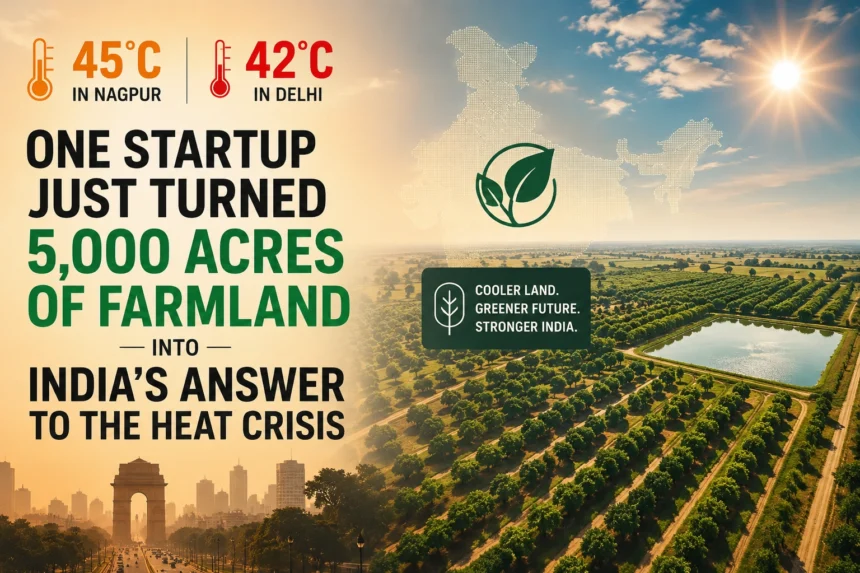
April 2026. Nagpur hit 45°C. Ahmedabad reached 44°C. Delhi crossed 42°C. Even Bengaluru — once known as India’s garden city — recorded 37°C.
India’s heatwaves are no longer anomalies. They are the new normal, arriving earlier, lasting longer, and pushing further into regions that once considered themselves insulated from extreme heat. And the link between these temperatures and India’s shrinking forest cover is no longer disputed by climate scientists.
India has lost substantial forest cover over decades of agricultural expansion, infrastructure development, and urbanisation. India’s State of Forest Report shows that while agroforestry has grown by 20% over the past decade, actual natural forest cover continues to decline — a distinction scientists are careful to maintain. Growing trees on farmland is not the same as recovering a forest. But at the scale India needs to act, it may be the most viable place to start.
A Pune-based startup called Farmers for Forests — F4F — has spent six years proving that it can be done. And in April 2026, it made headlines when Zerodha co-founder Nithin Kamath publicly backed the organisation through Rainmatter Foundation, confirming new funding to scale from 5,000 to 40,000 acres in just three years.
6 Numbers That Define the F4F Story
50 → 5,000 → 40,000 — the acre trajectory of F4F’s agroforestry programme over six years, and the target for the next three.
4x — the carbon sequestration per acre F4F records on agroforestry land compared to conventional crop farming on the same area. Agroforestry systems in India fix over 15 tonnes of carbon per hectare per year on average, compared to less than 0.3 tonnes for rice-wheat cropping systems.
3x — the farmer income increase F4F is observing per acre versus traditional single-crop farming, through revenue from fruits, timber, intercrops, and eventually carbon credits.
5–7 years — the time before fruit trees reach productive maturity, the core financial challenge that has historically stopped farmers from committing to agroforestry.
15 — the number of other organisations now using TreeLens, F4F’s open-source drone-based tree-tracking technology, built to make carbon sequestration measurable and independently verifiable at scale.
₹250–₹500 per acre — the approximate cost to farmers of inputs including saplings and drip irrigation per hectare at entry, with F4F also paying farmers roughly ₹4,000 per hectare annually to conserve trees while produce matures.
The Problem With India’s Tree-Planting History
India plants trees. Millions of them, every year, across state government schemes, corporate CSR programmes, and international climate commitments. Most of them do not survive.
The reason is structural, not botanical. Most tree-planting in India is monoculture — just rows of one species. A plantation is not a forest. Single-species plantations are ecologically fragile, economically thin, and frequently abandoned after the planting photographs have been taken.
The second failure is economic. A farmer who plants a mango tree today will not earn from it for five to seven years. A farmer living on seasonal crop income, with loan obligations and no income buffer, cannot afford to wait. This is why most agroforestry initiatives — however well-intentioned — have struggled to achieve genuine adoption at the smallholder level.
F4F was founded in December 2019, headquartered in Pune, with a mission to support and create biodiverse farms and forests that improve climate, biodiversity, and rural livelihoods — and from the outset, it approached both problems at the same time.
How F4F’s Model Works — and Why It Is Different
F4F’s approach is grounded in what ecologists call multi-layer agroforestry. Rather than monoculture rows, F4F plants multi-layer agroforests with fruit trees, timber species, shrubs, intercrops, and native vegetation — designed to mimic what an actual forest does.
The ecological logic: a multi-species, multi-canopy system creates microclimate effects — reducing soil temperature, retaining moisture, suppressing weeds, supporting pollinators — that a monoculture plantation cannot. It also creates multiple income streams: fruit in the early years, timber later, intercrops between the trees throughout, and eventually carbon credits as the system matures.
The financial logic: by diversifying income sources and shortening the time to first revenue — fruits and intercrops begin generating income within two to three years — F4F reduces the financial exposure that has historically deterred farmers from making the transition.
F4F uses a blended finance model that combines philanthropy, government scheme funding, carbon revenue, and income from sustainably harvested forest produce — bringing a Payments for Ecosystem Services (PES) model to India’s forestry sector for the first time at this scale.
TreeLens: Making Climate Action Measurable
One of F4F’s most significant contributions is not on the ground — it is in the data layer above it.
F4F built TreeLens, an open-source tree-tracking system that uses drone imagery to measure carbon sequestration, tree height, and biodiversity across thousands of small farms. Fifteen other organisations now use it.
This matters enormously for the carbon finance dimension of F4F’s work. Carbon credits are only worth something if the carbon removal they represent can be verified — independently, repeatedly, and at a cost that does not wipe out the economic value of the credit itself. Drone-based monitoring, combined with AI-assisted analytics, provides a scalable verification pathway that ground surveys alone cannot deliver.
Drones and AI-powered analytics allow F4F to monitor the growth of young trees and verify carbon sequestration for payments to both F4F and farmers. This traceability is what makes F4F’s carbon credits credible in a market that has faced serious scrutiny globally over the quality and permanence of nature-based carbon removals.
The Finance Innovation: Solving the 7-Year Problem
The biggest barrier to agroforestry at scale has never been the ecology. It has been the timeline.
Fruit trees take five to seven years to generate meaningful income. Timber takes longer. Carbon credits require established canopy. In the meantime, a farmer has land tied up, reduced food crop output, and no guarantee of a buyer when the produce is ready.
F4F is now working with the government and the broader ecosystem to design financial instruments — including carbon bonds and first-loss guarantees — that protect farmers while the trees grow.
Carbon bonds would essentially allow F4F to sell forward the carbon sequestration value of trees that have not yet matured — providing capital today against verified future removals. First-loss guarantees reduce the downside risk to farmers if the agroforestry system underperforms or faces adverse weather. Together, these instruments transform agroforestry from a long-term bet into a financially structured investment — which is precisely what is needed to bring institutional capital into the model.
Indian farmers adopting climate-smart practices can earn supplementary income of several thousand rupees per hectare per year through carbon markets — while simultaneously making their fields more climate-resilient. F4F’s work is building the infrastructure that makes that income stream real, verifiable, and bankable.
The Rainmatter Backing: Why It Matters
Nithin Kamath’s involvement through Rainmatter Foundation is more than a funding story. It is a signal about where India’s next generation of climate finance is moving.
Rainmatter has built a reputation for backing climate solutions that work at the intersection of ecology and economics — not one at the expense of the other. Its support brought early confidence in F4F’s model and has helped validate its approach, providing the capital needed to experiment with on-ground systems, farmer partnerships, and long-term climate finance design.
Kamath’s public endorsement in April 2026 — “Really glad we backed Arti, Aditya, and Krutika early” — came at a moment when India’s heatwave was making front pages across the country, giving the story an urgency that was impossible to ignore.
The new funding secured to reach 40,000 acres over three years is a significant scale jump. From 5,000 acres to 40,000 is an 8x expansion — and it will require not just more land and more farmers, but more robust supply chains for native saplings, more field advisory capacity, and deeper government partnerships to unlock scheme funding at state level.
The ESG and BRSR Dimension
For India’s corporate sector, F4F’s work opens up a set of questions that will grow more urgent as SEBI’s BRSR framework matures.
The agroforestry sector offers significant potential to sequester carbon in trees and soil, creating opportunities to meet India’s NDC targets and generate carbon credits through market structures. For companies seeking credible nature-based carbon offsets to support their net-zero commitments, F4F’s drone-verified, BRSR-compatible agroforestry credits represent exactly the kind of high-integrity solution that the market currently lacks.
Companies that invest in or purchase credits from programmes like F4F also benefit from the social dimension: rural livelihood improvement, soil health restoration, and biodiversity enhancement are all material ESG impacts that can be disclosed under the S and E pillars of BRSR reporting.
The convergence of supply — F4F’s expanding verified agroforestry estate — and demand — Indian corporates seeking credible nature-based offsets under tightening disclosure obligations — creates a market opportunity that is only just beginning to be recognised.
What Comes Next
F4F’s roadmap to 40,000 acres by 2029 is ambitious but structured. The pipeline already includes 30,000 hectares of agroforestry deals awaiting the capital and operational capacity to execute. Government partnerships — already underway with state bodies — will be critical to unlocking land access and scheme subsidies at the scale required.
The TreeLens platform’s adoption by 15 other organisations suggests that F4F’s monitoring infrastructure is becoming a sector standard — which could position the organisation to provide measurement, reporting, and verification services to a far wider set of agroforestry projects beyond its own.
And the financial instruments under development — carbon bonds, first-loss guarantees — if successfully piloted, could transform the economics of agroforestry investment not just for F4F but for the entire Indian climate finance ecosystem.
India’s heatwaves are not going to stop. But the land that was stripped of trees over decades can, acre by acre, be returned to something that helps. F4F is showing that the economics can work, the monitoring can be trusted, and the farmers can be partners rather than bystanders in India’s climate response.
The trees are growing. The data proves it.
Sources: Rainmatter Foundation / Nithin Kamath Substack; Farmers for Forests (F4F); Mulago Foundation portfolio report; Mongabay India; CEEW Agroforestry Research; The Tribune India; Farmonaut; MDPI Forests journal (January 2026).
ESG World News covers sustainability, climate finance, and corporate ESG developments across India and the world. For more on India’s carbon markets, agroforestry policy, and BRSR disclosures, explore our India Focus and Environmental sections at esgworldnews.com