
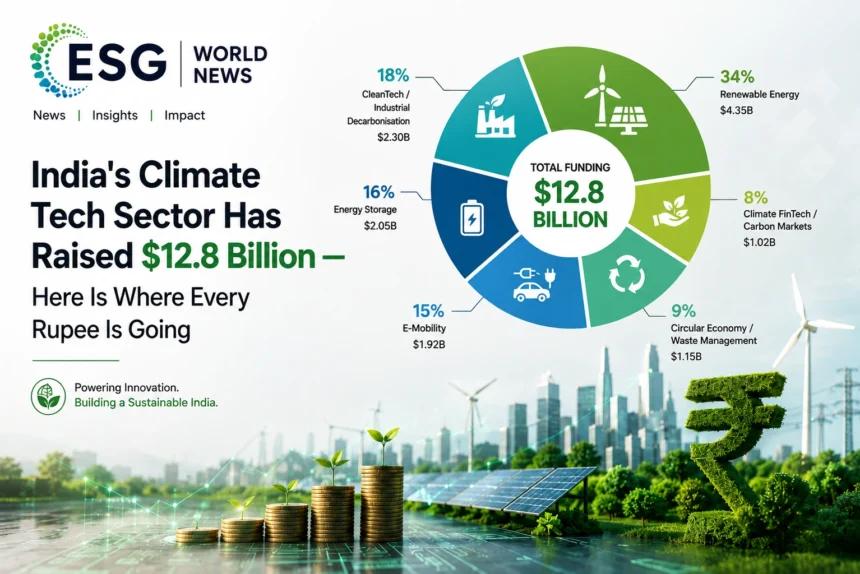
India’s climate technology sector has crossed a threshold. With $12.8 billion raised across 1,583 funded companies — and $4.4 billion deployed in the last 24 months alone — this is no longer a market defined by early bets and speculative rounds. It is a capital-intensive, institutionally-backed, policy-reinforced ecosystem in full-scale growth mode.
That is the central finding of Tracxn’s India Climate Tech 2026 Geo Annual Report, a comprehensive analysis of funding trends, investor activity, exit patterns and geographic distribution across the sector. What the data reveals is a market undergoing a significant structural shift: fewer rounds, larger cheques, and a concentration of capital into companies and sectors with proven commercial models.
The Five-Year Arc: From $315 Million to $2.6 Billion
The headline funding trajectory tells a compelling story. Annual climate tech investment in India rose from approximately $315 million in 2020 to $2.6 billion in 2025 — a growth of over 725 per cent in five years. Total funding across all years stands at $12.8 billion, with 8,831 companies tracked on the Tracxn platform, of which 1,583 have received equity funding.
The ecosystem has also produced meaningful exits: 55 acquisitions, 49 IPOs, and 1 unicorn to date, alongside 29 Soonicorns and 166 Minicorns currently in the pipeline. A further 506 companies have been flagged as Editor’s Picks — curated high-potential bets that have cleared Series A or beyond (211 companies at Series A+, 25 at Series C+).
The flip side of maturity is concentration. The 3-year funding CAGR stands at -30 per cent, and the 5-year CAGR at -1 per cent — a reflection not of decline, but of a market that has moved past the phase of broad-based early-stage activity and into conviction-led, late-stage deployment.
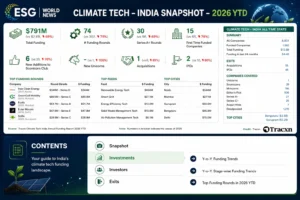
2026 YTD: $791 Million, 74 Rounds, and a Clear Flight to Scale
The first five months of 2026 have deployed $791 million across 74 rounds — down 69 per cent in dollar terms and 75 per cent in round count versus the same period in 2025, but the comparison is misleading if read as weakness. What the 2026 data actually shows is a market consolidating hard around its highest-conviction opportunities.
Late-stage deals (Series C and above, PE, Pre-IPO) accounted for $524 million across just 5 rounds — meaning 66 per cent of all 2026 YTD capital went into five transactions. Early-stage rounds (Series A and B) contributed to the balance, while seed funding stood at $61 million across 44 rounds. First-time funded companies numbered just 15, with 6 new Soonicorns, 2 IPOs and 1 acquisition rounding out the early-cycle signals.
The message is unambiguous: the era of broad seed experimentation is giving way to scaled deployment behind proven models.
The Deals That Defined the Market
To understand where conviction capital is going, the individual transactions matter as much as the aggregates.
The largest single round in Indian climate tech history remains Erisha E Mobility’s $1 billion Series D in 2025 — a landmark that announced the arrival of billion-dollar scale in Indian EV infrastructure. Tata Passenger Electric Motors contributed two massive rounds: a $496 million Series D and a $460 million Series D. Vertelo raised $405 million in a Series D, Serentica Renewables closed a $400 million PE round, and TI Clean Mobility secured $359 million in a Series D.
In 2026 YTD, the standout transaction is Inox Clean Energy’s $344 million Series D — backed by CalPERS, Authum and SUN Group Global — which alone accounts for 43 per cent of all funding deployed in the year to date. Other significant 2026 rounds include GreenCell Mobility’s $89 million Series C (backed by IFC and British International Investment), Ecofy’s $55 million Series B (Finnfund, British International Investment, EverSource Capital), and Euler Motors’ $48 million Series E (Blume Ventures, Lightrock, Innoven Capital).
Further down the stack, a healthy mid-tier of rounds reflects genuine breadth: Solfin raised $29 million in a Series C, Kimbal closed $22 million in a Series B, Zeno secured $21 million in a Series A, Statiq raised $18 million backed by Shell and Y Combinator, and Aerem raised $15 million in a Series A backed by SE Ventures, Blume and Riverwalk Holdings.
Sector Breakdown: Renewable Energy Leads, But the Story Is Broadening
Renewable Energy Technology leads cumulative funding at $1.5 billion — a function of the capital-intensive nature of generation, grid infrastructure and storage. In 2026 YTD alone, the sector attracted $464 million, driven almost entirely by the Inox Clean Energy round.
But the more significant long-term signal is the breadth developing across adjacent sectors. Four areas have collectively attracted over $1.2 billion in cumulative funding:
- Solid Waste Management Technology: $477 million (cumulative) / $10.9 million YTD
- Energy Efficiency Technology: $352 million (cumulative) / $12 million YTD
- Air Pollution Management Technology: $237 million (cumulative) / $8.1 million YTD
- Water & Wastewater Management Technology: $208 million (cumulative)
- Smart Grid: $27.1 million in 2026 YTD alone
A climate tech ecosystem that draws capital across waste, efficiency, air quality, water and grid infrastructure is structurally far more resilient than one concentrated in a single technology vertical.
Who Is Investing: The Institutional Backbone
The investor base behind India’s climate tech sector spans domestic VCs, global development finance institutions and international PE — a combination that reflects both commercial confidence and strategic alignment with India’s energy transition goals.
British International Investment (BII) leads all PE investors in 2026 YTD with three separate transactions: Euler Motors, GreenCell Mobility and Ecofy. IFC, Finnfund and FMO have each participated in at least one significant round, collectively underscoring the role of development finance in anchoring India’s clean-energy capital stack.
Among domestic seed VCs, Transition VC leads with three investments in 2026 YTD (Exponent Energy, GreenTech, Intrinsic Foundries), followed by Rainmatter with two (Zerocircle, PolyCycl) and Speciale Invest with two (Fermbox, NewTrace). At the early stage, Accel (Optimist, Vimag Labs) and Congruent Ventures (Zeno) are among the most active international names. At the late stage, TDK Ventures, Lightspeed Venture Partners and Blume Ventures each backed Exponent Energy — a sign of cross-stage conviction in the fast-charging infrastructure company.
On the accelerator and incubator side, AdvantEdge and IvyCap Ventures each made two investments in 2026 YTD, while Y Combinator continued its selective India climate bet with its participation in Statiq’s round.
The first-time investor CAGR tells a nuanced story: down 53 per cent over two years and 42 per cent over four, reflecting a tightening of new entrants into the market. The investors still active are those with long-term, high-conviction mandates — not tourists chasing early-stage momentum.
The Policy Architecture Driving It All
India’s government has constructed one of the most comprehensive climate-technology policy frameworks in any major emerging economy — and 2026 has brought several of its most consequential elements into effect.
PM E-DRIVE — a ₹10,900 crore programme extended through 2028 — provides demand-side certainty for EV adoption and charging infrastructure, directly supporting companies like Statiq, Euler Motors, GreenCell Mobility and Exponent Energy.
The Carbon Credit Trading Scheme, effective October 2026, establishes India’s first compliance carbon market covering approximately 490 industrial units across nine sectors. This creates a genuine price signal for carbon reduction that will reshape capital allocation across heavy industry — and create new revenue streams for climate tech companies that can generate verifiable carbon outcomes.
The Rare Earth Permanent Magnets Scheme — a ₹7,280 crore initiative — targets domestic production of the critical minerals essential for wind turbines, EV motors and clean energy storage. With roughly 85 per cent of India’s crude oil currently imported, this programme addresses a strategic vulnerability that sits at the intersection of climate goals and national energy security.
That dual mandate — climate action and energy independence reinforcing each other — is perhaps the single most important structural feature of the Indian climate tech investment case. It means the tailwinds behind this sector do not depend solely on global climate consensus; they are embedded in India’s own economic and geopolitical priorities.

The Geography of Capital: Noida Emerges, Bengaluru Leads All-Time
All-time cumulative funding is dominated by Bengaluru ($3.5 billion) and Gurugram ($2.2 billion) — reflecting the long-established startup ecosystems in both cities. But the 2026 YTD city rankings tell a different story.
Noida leads 2026 YTD funding with $344 million — 43 per cent of the national total — almost entirely attributable to Inox Clean Energy’s Series D. Mumbai follows with $161 million (20 per cent share), driven by GreenCell Mobility ($89 million), Ecofy ($55 million) and Aerem ($15 million). Gurugram placed third with $93 million (12 per cent), led by Solfin ($43 million) and Statiq ($18 million). Bengaluru came in fourth with $86 million (11 per cent), anchored by Zeno ($21 million), Exponent Energy ($15 million) and TIEA ($8 million). Delhi rounded out the top five with $75 million (9 per cent), including Euler Motors ($48 million) and Kimbal ($22 million).
Emerging cities are also beginning to register: Jaipur ($5 million), Ahmedabad ($4 million), Navi Mumbai ($4 million), Coimbatore ($3 million) and Kalka ($3 million) each recorded funding activity in 2026 YTD — a signal that India’s climate tech geography is gradually decentralising beyond its traditional metro hubs.
Exits: Early Signals in a Market Still Building
The exit landscape in 2026 YTD reflects an ecosystem that is still in its growth phase. Two IPOs have been recorded: GRE Renew Enertech (founded 1999, Ahmedabad; IPO market cap $16.5 million) and Victory EV India (founded 2011, Jhajjar; IPO market cap $10.9 million). One acquisition has closed: Gramophone (founded 2016, Indore; $27.5 million raised) was acquired by Unnati in January 2026.
The averages are instructive. Companies that IPO’d in 2026 YTD took an average of just 1.7 years from first funding to listing — significantly compressed versus the 2025 average of 18.4 years — suggesting that the current IPO cohort includes leaner, faster-moving ventures. The single acquisition involved a company that had raised $27.5 million on average before exit, up sharply from the 2025 average of $1.1 million.
With 29 Soonicorns in the ecosystem and 211 companies at Series A or above, the exit pipeline for 2027 and beyond is building meaningfully.
The Ecosystem in Motion: What the News Flow Signals
Beyond the funding data, the recent news flow from the sector reveals an ecosystem in active operational development. Ola Electric — despite a 57 per cent revenue drop to Rs 265 crore in Q4 FY26 and a 5 per cent workforce reduction — is simultaneously infusing Rs 2,000 crore into subsidiaries and expanding its battery cell capacity to 20 GWh. Exponent Energy co-founder Sanjay Jagannath has stepped down to an advisory role. IIT Delhi and startup Optimist have successfully completed pilot tests of an air conditioning system designed for 50°C heat. Recyclekaro has partnered with IIT Bombay for critical mineral extraction and battery recycling. Solfin has raised INR 280 crore to accelerate India’s energy transition.
These are not the signals of a sector in retreat. They are the signals of a sector consolidating, restructuring, and preparing for the next phase of scale.
What Comes Next
India’s climate tech sector took five years to grow from $315 million to $2.6 billion in annual funding. The policy architecture — carbon markets, EV incentives, critical mineral supply chains — is now more complete than at any point in the sector’s history. The institutional investor base, led by development finance institutions and global VCs, has demonstrated sustained, multi-round commitment. And the commercial models, at least at the late stage, have been validated at scale.
The consolidation visible in 2026 YTD data is not contraction. It is the natural evolution of a market moving from broad-based exploration to focused, large-scale execution. With $4.4 billion deployed in the last 24 months, 29 Soonicorns in the pipeline, and a compliance carbon market about to come online, the conditions for the next phase of growth are firmly in place.
Source: Tracxn India Climate Tech 2026 Geo Annual Report. Data covers equity funding rounds tracked on the Tracxn platform; debt, grant, post-IPO and ICO funding excluded. YTD data covers 1 January to 31 May 2026.