

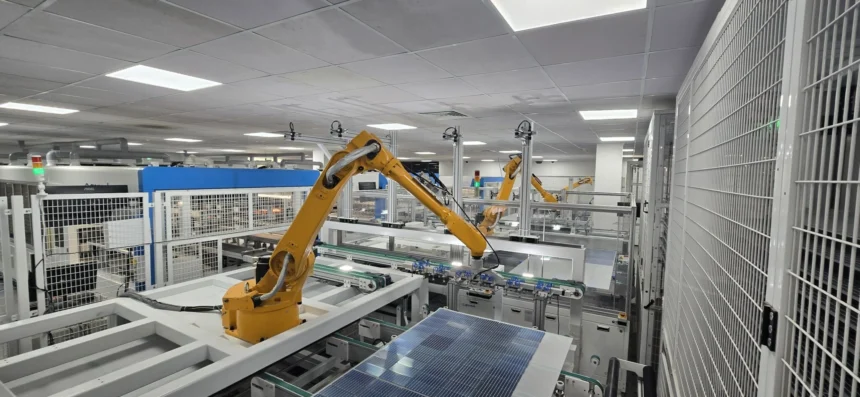
Gujarat-headquartered Ganesh Green Bharat Limited has closed FY26 with a landmark financial performance, becoming a ₹1,000 crore company for the first time in its history. The solar PV module manufacturer and EPC services provider reported consolidated revenue from operations of ₹1,067.60 crore for the financial year ended March 31, 2026 — a 232% surge compared to ₹321.76 crore in FY25, marking one of the most significant growth trajectories among India’s listed clean energy players this year.
A Milestone Fiscal Year Built on Execution
The revenue breakthrough was driven primarily by the accelerated execution of solar module manufacturing, supply contracts, and installation, testing and commissioning (SITC) projects at scale. What distinguishes this growth is not merely its size but its pace: the company’s revenue nearly quadrupled in the second half of FY26 compared to the same period in the prior year, reflecting how rapidly Ganesh Green Bharat ramped up order fulfilment once its manufacturing and delivery pipelines hit full stride.
The company’s net worth rose to ₹280.31 crore from ₹205.12 crore in FY25, long-term borrowings declined to ₹9.16 crore from ₹13.82 crore, and total assets expanded to ₹487.90 crore — while operating cash flows turned positive at ₹20.95 crore, compared to an outflow of ₹28.72 crore a year earlier. Together, these metrics indicate that the growth has been financially disciplined and not debt-fuelled.
Profitability: Strong Growth, Moderating Margins
Earnings before interest, taxes, depreciation and amortisation (EBITDA) grew 122% year-on-year to ₹113.58 crore, while profit after tax rose 149% to ₹75.18 crore. These are strong absolute gains — yet EBITDA margin contracted to 10.64% from 15.90% in FY25, a compression the company attributes to structural and market-side factors rather than operational weakness.
The primary driver of margin moderation was a shift in business mix: large-scale SITC project execution — which inherently carries lower margins than module supply — accounted for a growing share of revenue as the business scaled approximately threefold. Additionally, management flagged the impact of global geopolitical tensions, US dollar exchange-rate volatility, rising input costs across key raw materials including aluminium, copper and silver, and a manufacturing segment mix that exceeded 70% of total revenue — a segment where margins are structurally thinner.
Management has stated that improving profitability through operational efficiencies, an optimised product mix, and more strategic project selection will be a key focus area in FY27.
Balance Sheet Strength and Cash Flow Improvement
Beyond the headline numbers, Ganesh Green Bharat demonstrated meaningful balance sheet improvement in FY26. The company’s ability to reduce long-term debt while simultaneously expanding total assets and turning cash-flow positive underscores a maturing financial profile — a critical signal for investors assessing sustainability of growth in the capital-intensive solar manufacturing and EPC space.
FY27 Outlook: Targeting ₹1,500–₹1,700 Crore Revenue
Looking ahead, Ganesh Green Bharat has guided for FY27 revenue in the range of ₹1,500 crore to ₹1,700 crore, implying year-on-year growth of 40% to 59% over FY26. The guidance rests on two pillars: a current executable order book of approximately ₹700 crore providing near-term revenue visibility, and an active tender pipeline of over ₹3,000 crore spanning EPC and module supply contracts.
The company expects to convert tenders worth more than ₹1,000 crore into confirmed orders, citing its demonstrated execution track record and its assessment of the competitive landscape in India’s rapidly expanding solar infrastructure market.
The company has already signalled its commercial momentum for FY27, having secured a domestic order valued at over ₹430 crore for the supply of advanced 630 Wp G12R TOPCon n-type bifacial solar PV modules — among the most efficient module technologies currently available in the market.
Strategic Context: Why This Matters for India’s Solar Sector
Ganesh Green Bharat’s FY26 performance is not an isolated data point. It reflects a broader acceleration in India’s domestic solar manufacturing ecosystem, which is being propelled by the Production Linked Incentive (PLI) scheme, the government’s 500 GW renewable energy target by 2030, and a deliberate policy push to reduce dependence on imported solar components.
The company has scaled its manufacturing capacity from 236 MW in FY24 to 750 MW in FY25, targeting 1.1 GW by FY26 — a capacity expansion trajectory that positions it among the faster-growing mid-tier domestic module manufacturers. As India’s solar installation pipeline deepens and SITC contracts grow in scale and complexity, integrated players like Ganesh Green Bharat — combining manufacturing with end-to-end project execution — are increasingly well-positioned to capture a disproportionate share of order flows.
Margin Recovery: The Key Variable to Watch
The central question for analysts and investors tracking Ganesh Green Bharat into FY27 will be whether management can stabilise and improve margins even as the company targets another year of sharp volume growth. The company has identified three levers: operational cost reduction, a more balanced product mix that shifts weight back toward higher-margin module supply, and selective project bidding that prioritises margin quality over pure revenue volume.
Whether these levers prove sufficient will depend in part on external variables — commodity prices, currency movements, and the intensity of competition in India’s SITC tender market — that remain outside the company’s direct control. However, the positive cash flow turn and balance sheet deleveraging in FY26 suggest the company has the financial headroom to execute its FY27 strategy without stretching its capital structure.
In Summary
Ganesh Green Bharat’s FY26 results mark a genuine inflection point — from a fast-growing regional player to a credible, scaled participant in India’s national solar infrastructure buildout. Crossing the ₹1,000 crore revenue threshold, tripling topline, growing PAT by 149%, and turning cash-flow positive in a single year is a multi-dimensional achievement. The path to ₹1,500–₹1,700 crore in FY27 will require sustained execution, margin discipline, and successful order conversion from a bulging tender pipeline — but the foundation, by all financial measures, appears solid.