

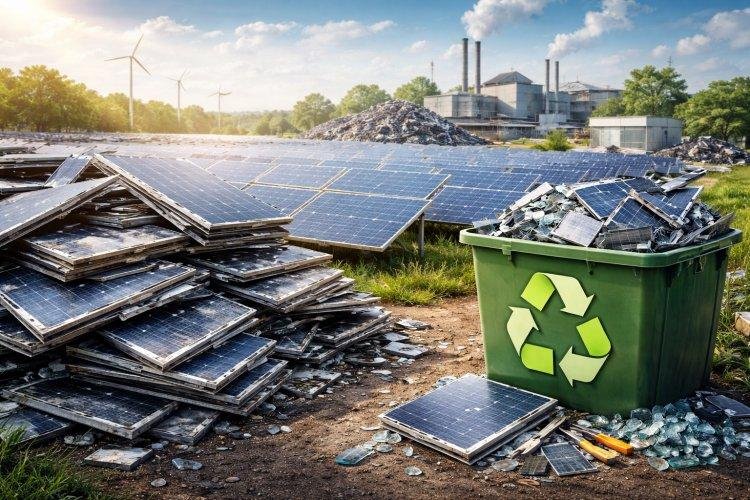
India is racing to install solar capacity — but almost nobody is talking about what happens when those panels die.
Nearly all the economic value in a crystalline silicon solar module is concentrated in one material that most people overlook. Silver makes up just 0.03% of a panel’s mass, yet at current prices it can be worth more than the glass, aluminium, and silicon in the module combined. A standard module weighing around 11.6 kg contains silver contacts worth approximately EUR 600 — while its glass, aluminium frame, and silicon cells together yield roughly EUR 300.
This isn’t a niche materials science problem. For India, it is shaping up to be a serious economic, environmental, and strategic challenge.
India’s Scale Makes This Unavoidable
India has committed to 500 GW of renewable energy capacity by 2030, with solar forming the backbone of that target. Tens of gigawatts of panels installed during the early 2010s — many under the Jawaharlal Nehru National Solar Mission — are now approaching or crossing their 20–25 year design lifespans. A wave of decommissioning is not a distant hypothetical. It is already beginning.
Prof. Yansong Shen of UNSW estimated Australia alone would face roughly 1 million metric tons of end-of-life panels by 2035. India’s installed base is significantly larger and growing faster. Proportionally, the waste volumes India will need to manage within the next decade dwarf those of most other nations — and unlike Germany or Japan, India has almost no commercial recycling infrastructure capable of handling it.

The Silver Problem Is India’s Problem
Silver is not just a recyclable commodity — it is a strategic material. The global PV industry consumed approximately 6,000 metric tons of silver in 2023, against world annual mine production of around 30,000 metric tons. India mines negligible quantities of silver domestically and is almost entirely import-dependent for the metal.
Every solar panel that ends up in a landfill or informal waste stream is effectively burying imported silver that cost the country foreign exchange to acquire. Without industrial-scale recycling, India will need to keep buying silver on international markets to manufacture new panels — at prices that have already tripled in two years, rising from around $20 to $68–69 per troy ounce.
The photographic industry, at its peak, recovered more than 70% of the silver it consumed. The global PV industry currently recovers almost none. India is contributing to that gap with almost no plan to close it.
Why Recovery Is Hard — And Why That Matters Here
Silver in a solar panel is not sitting loose waiting to be extracted. It is finely dispersed through the cell metallisation and sealed inside a laminated encapsulant. Recovering it properly requires either hydrometallurgical or thermal pyrolysis processes — neither of which exists at commercial scale in India today.
The cheaper alternative, mechanical crushing and shredding, is what most Indian recyclers currently rely on for e-waste broadly. But mechanical separation contaminates the silver stream along with glass and silicon, leaving most of the value unrecovered. It also generates mixed waste streams that are difficult to dispose of cleanly.
Thermal pyrolysis — which breaks down encapsulants at high temperature and enables cleaner material separation — costs around $1,000 per metric ton of PV waste processed. That is a steep price point for a country where informal recycling has historically undercut formal facilities on cost, often by ignoring environmental and safety standards entirely.

The Informal Sector Risk
This is where India’s specific structural challenge becomes acute. India has a large, entrenched informal e-waste recycling economy. Informal operators use acid baths, open burning, and other crude methods to extract metals — processes that are toxic, uncontrolled, and, in the case of solar panels, poorly suited to recovering silver at useful purity.
The risk is that India’s decommissioned solar panels follow the same path as its discarded mobile phones and circuit boards — into a grey economy that extracts some metal value while releasing toxic byproducts, loses most of the silver, and leaves behind a contaminated glass and polymer residue with no safe disposal route.
At the volumes India will generate by the 2030s, that outcome would represent both a public health failure and a massive destruction of recoverable economic value.
Policy Has Not Kept Pace
India’s e-waste rules, last significantly updated in 2022, do not yet have sector-specific provisions for solar PV waste. There is no mandated take-back scheme for panel manufacturers, no producer responsibility framework tailored to PV, and no certified recycling standard that distinguishes high-recovery hydrometallurgical processing from basic mechanical separation.
The Bureau of Indian Standards has not published purity specifications for recycled PV silicon or silver, meaning there is no domestic market signal incentivising investment in higher-quality recovery processes. Without a price signal and without regulatory pressure, the economics of doing recycling properly simply do not work.
The Window Is Closing
The global experience — from Germany’s missing-modules mystery to Australia’s infrastructure gap — shows that the time to build recycling capacity is before the waste wave arrives, not after. Facilities need capital investment, permitting, and years of operational learning before they can run at scale. The waste volumes needed to make them financially viable are themselves irregular, with a peak in the early 2030s followed by a trough before volumes recover in the 2040s.
India has a narrow window — perhaps five to seven years — to establish the regulatory framework, attract investment in proper processing technology, and develop domestic markets for recycled solar-grade materials before decommissioned panels begin arriving faster than any infrastructure can absorb them.
Silver reserves globally, on current consumption trajectories without large-scale recycling, could be largely consumed within 25 years. India, as both a massive solar market and a silver-importing nation, has more reason than almost any other country to treat panel recycling not as an environmental afterthought but as a critical materials and industrial policy priority.
The panels are coming. The question is whether India will recover what is in them — or bury it