
Wind energy has always been defined by a single, unmistakable image: towering steel structures with three enormous blades sweeping through the air, visible for miles, audible to anyone nearby. That image has served the clean energy transition well — global wind capacity grew by 170 GW in 2025 alone, and is forecast to add another 160 GW in 2026. But the blade-based turbine also carries a set of stubborn problems that no amount of engineering refinement has fully resolved: noise, bird strikes, visual impact, mechanical complexity, and an inability to function in the dense, low-wind environments where much of humanity actually lives.
France may have quietly found a different answer — and it doesn’t spin at all.
A Turbine That Vibrates Instead of Rotates
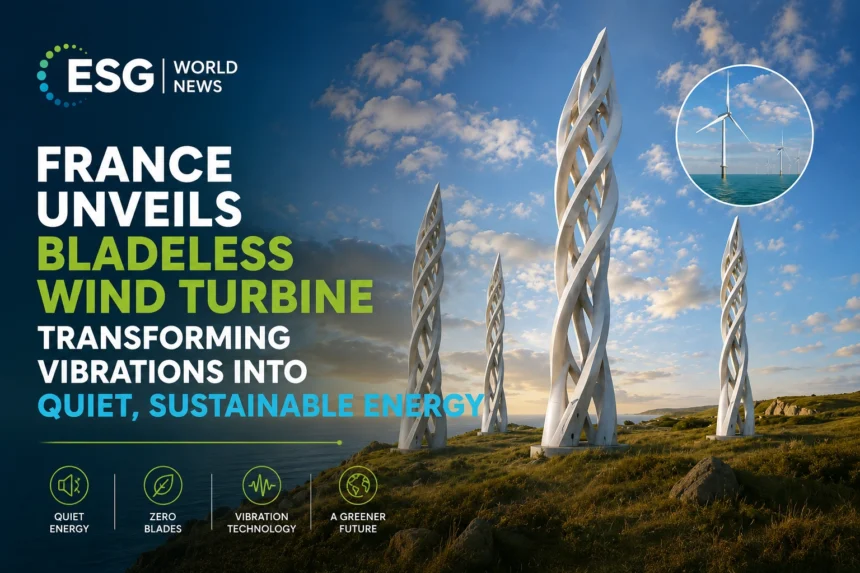
On a wind plateau in Normandy, engineers have unveiled what may be one of the most elegant energy systems yet developed: a wind turbine without blades. No spinning components, no gears, no noise — just a slender tower that vibrates quietly in the breeze, turning that movement into clean, usable electricity.
These devices do not rotate. Instead, they harness a physical phenomenon called vortex shedding. When air flows around their cylindrical structure, it forms alternating swirls on both sides. This sequence creates a periodic and controlled oscillation in the main column. The resulting vibration is the primary engine of the system.
The cylinder vibrates in the moving wind, and the vortices vibrate at the same frequency, resulting in a back-and-forth swaying that produces kinetic energy — a process known as aeroelastic resonance. Internal magnets and coils harness the kinetic energy, and the moving magnets produce electricity.
Formally described as vortex-induced vibration (VIV), this concept replaces rotating blades with a vertical mast that undergoes wind-induced oscillations, passively converted into electrical energy. The aerodynamic behavior and structural response of the system have been validated through computational fluid dynamics and finite element analysis under low-wind-speed conditions representative of urban environments.
Why No Blades Changes Everything
The problems that bladeless turbines sidestep are not cosmetic. Conventional wind turbines remain limited in densely populated environments due to acoustic emissions, mechanical complexity, cost, and risks to avian wildlife. These constraints have effectively ruled out wind energy as a power source for the majority of the world’s population, who live in cities, towns, and peri-urban areas where standard turbines simply cannot be sited.
The absence of blades makes these turbines quieter, less expensive to maintain, and safer for wildlife, while still capturing wind energy efficiently through their unique design and operation. Because it has no moving parts — no blades, bearings, or gearboxes — this generator requires almost zero maintenance. It doesn’t kill birds or disturb neighbours. From a few feet away, it looks more like a minimalist art sculpture than a power system.
That last point matters more than it might seem. One of the persistent barriers to wind energy deployment has been community opposition driven by visual and acoustic impact. A turbine that is both silent and aesthetically unobtrusive removes two of the most common objections to wind installations in residential and mixed-use zones.
Small Units, Big Ambitions
The Normandy vortex generators are not designed to replace utility-scale wind farms. Each unit generates about 100 watts — not much on its own, but ideal for rooftops, rural barns, off-grid homes, and places where traditional turbines cannot fit. When placed in clusters, these silent columns form low-profile microgrids that can power lighting, small appliances, and emergency systems even in areas where solar underperforms.
That distributed model opens a genuinely different set of deployment opportunities. The system is lightweight, easy to transport, and does not require a heavy concrete foundation. A farmer could install a dozen of these by hand. A refugee camp could deploy meaningful electricity generation in hours rather than months.
France’s approach sits alongside a parallel innovation from its own clean tech ecosystem. French company New Wind’s “Wind Tree” — standing just 11 metres tall and resembling a real tree, with 36 leaf-shaped micro-turbines that harness gentler urban breezes — represents the same underlying philosophy: bring wind energy into the environments and scales where conventional turbines cannot go. The Wind Tree can generate up to 10 kW of clean energy from gentle urban breezes, making it viable for parks, plazas, commercial rooftops, and public spaces.
The Physics Are Not New — The Application Is
It is worth noting that vortex-induced vibration is not a recent discovery. Engineers have been aware of the phenomenon for over a century — the Tacoma Narrows Bridge collapse in 1940 was caused by exactly this kind of aeroelastic resonance. What is new is the deliberate engineering of structures to harness rather than resist it.
Spanish startup Vortex Bladeless has been developing this concept since 2010, raising significant funding and producing working prototypes of what the internet has nicknamed the “Skybrator” due to its shape and characteristic swaying motion. The company is now targeting a massive 100 MW prototype in 2026, a scale that would represent a fundamental leap from the current demonstration phase into something approaching grid-relevant output.
France’s Normandy deployment adds a new geography and a new institutional context to a technology that has been slowly accumulating proof points across Spain, the United States, and now northern Europe.
What This Means for the Energy Transition
Bladeless vibration turbines are not going to replace conventional wind infrastructure at scale anytime soon. A single large offshore wind turbine can generate 15 MW or more — a figure that thousands of vortex units would struggle to match in the same footprint. The economics of utility-scale power generation still favour rotating machines for the foreseeable future.
But that is not the right comparison. The more relevant question is what bladeless technology enables that conventional wind cannot. The answer is: distributed urban generation, off-grid rural electrification, building-integrated energy systems, and deployment in ecologically sensitive zones where blade turbines are prohibited or inappropriate.
Global electricity demand is expected to grow by an average of 3.4% annually through 2026 and beyond. Meeting that demand will require not just more large-scale generation but a much broader range of generation formats that can be deployed closer to where energy is actually consumed. Bladeless turbines represent one promising piece of that mosaic.
As France rolls out pilot projects across the countryside, this technology could soon power homes, farms, and remote dwellings with nothing but vibrations and wind — a sentence that would have sounded like science fiction a decade ago, and today sounds increasingly like a procurement decision