

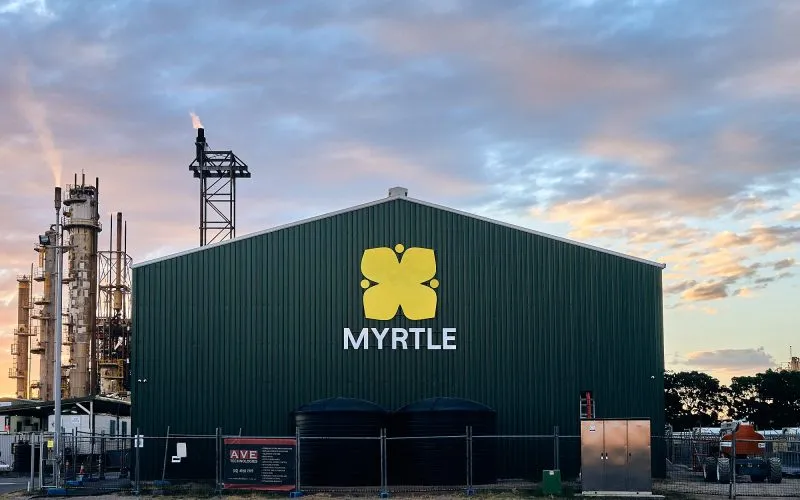
Australia has achieved a significant breakthrough in industrial decarbonisation with the launch of Myrtle, the world’s first fully integrated multi-purpose carbon refinery. Operated by clean technology company MCi Carbon, the facility is designed to convert industrial carbon dioxide emissions and low-value mineral waste into valuable construction materials, creating a new pathway for reducing emissions from heavy industries.
Located on Kooragang Island in Newcastle, the facility is the result of more than 15 years of Australian research and development and showcases how carbon emissions can be transformed from an environmental challenge into a commercial opportunity.
Turning Carbon Emissions Into Valuable Products
At the heart of Myrtle is MCi Carbon’s proprietary mineral carbonation technology, which captures industrial CO₂ emissions and combines them with mineral feedstocks such as steel slag and waste rock.
The process produces high-quality carbon-embedded materials that can be used in a wide range of construction applications, including:
- Concrete
- Plasterboard
- Paints
- Adhesives
- Building materials
Unlike conventional carbon capture systems that focus on storing carbon underground, MCi Carbon permanently locks carbon dioxide into products at the molecular level, creating durable materials while preventing emissions from entering the atmosphere.
According to the company, the technology has the potential to reduce net emissions in hard-to-abate industrial sectors by as much as 90%.
A New Business Model for Decarbonisation
One of the most innovative aspects of the project is its ability to transform carbon emissions into a revenue-generating resource.
Traditionally, industrial decarbonisation has been viewed as a costly compliance requirement. MCi Carbon is seeking to change that narrative by creating products that generate economic value while reducing emissions.
With global demand for low-carbon building materials increasing, the market for carbon-embedded construction products is projected to reach US$1 trillion annually by 2050, creating substantial growth opportunities for the sector.
The company believes its technology can help industries reduce emissions while simultaneously creating new revenue streams from materials that would otherwise be considered waste.
Flexible Technology for Global Deployment
The Myrtle facility has been designed with flexibility in mind.
The platform can process multiple types of carbon dioxide emissions and mineral feedstocks, making it suitable for deployment across a wide range of industries and geographies.
Potential deployment models include:
- On-site integration within industrial facilities
- Regional hub-and-spoke carbon processing networks
- Standalone carbon refining operations
This adaptability positions the technology as a scalable solution for industries seeking practical pathways to decarbonisation.
Supporting Commercial-Scale Development
Myrtle is already being used to validate commercial applications of the technology.
The facility is hosted at Orica’s Kooragang Island ammonia plant, providing industrial partners with an opportunity to test the platform against their own operational and emissions requirements.
MCi Carbon is currently conducting a validation programme with global refractory materials company RHI Magnesita. The collaboration aims to support the development of a first-of-its-kind commercial-scale carbon refinery in Austria by 2030.
The project is expected to play an important role in demonstrating the commercial viability of mineral carbonation technology in international markets.
Backed by Government and Private Investment
The development of Myrtle has been supported by more than AUD $80 million (approximately US$56 million) in combined government funding and private sector investment.
The funding reflects growing confidence in technologies that can accelerate industrial decarbonisation while supporting economic growth and resource efficiency.
Industry experts increasingly view carbon utilisation technologies as a critical complement to renewable energy, electrification, and carbon capture initiatives in the global effort to achieve net-zero emissions.
A New Pathway for Heavy Industry
Heavy industry currently accounts for more than 30% of global greenhouse gas emissions, making it one of the most challenging sectors to decarbonise.
By transforming carbon dioxide into useful industrial materials, MCi Carbon’s Myrtle facility demonstrates how emissions can become a valuable resource rather than a waste product.
As governments and industries worldwide seek scalable solutions to meet climate targets, projects like Myrtle highlight the growing role of carbon utilisation technologies in building a low-carbon economy.
The launch of the world’s first integrated carbon refinery represents not only a technological milestone but also a potential blueprint for how industries can reduce emissions while creating sustainable economic value.