

Fact-check upfront: This claim is real. It comes from UNICEF’s Children’s Climate Risk Report 2026, released June 16, 2026, and independently confirmed across UNICEF’s own Global Child Hazard Database, Down To Earth, Ground Report, and multiple other outlets. If anything, the full report contains figures more alarming than the headline number alone suggests.
- The Headline Number, and What It Actually Means
- Drought and Heat Are the Real Story — Not Floods
- India Is Worse Than the Global Average — By a Meaningful Margin
- Beyond the Weather: Air Pollution and Malaria Compound the Damage
- The Systems Meant to Protect Children Are Already Falling Short
- This Isn’t a Future Risk — It’s Already Disrupting Classrooms Today
- What Happens If Nothing Changes
- What UNICEF Is Actually Asking For
- The Bottom Line
The Headline Number, and What It Actually Means
UNICEF’s Children’s Climate Risk Report 2026 found that 411.62 million children in India — roughly 97% of the country’s entire child population — are exposed to at least two overlapping climate or disaster-related hazards. These aren’t distant, hypothetical risks: they include drought, riverine and coastal floods, tropical storms, heatwaves, extreme heat, wildfires, and sand and dust storms, mapped using UNICEF’s new Global Child Hazard Database at a level of geographic precision not previously available.
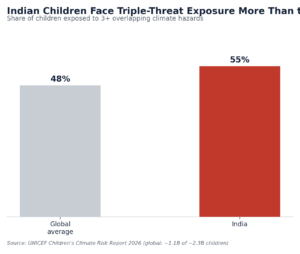
The number that should worry policymakers even more sits one layer deeper: more than 234 million Indian children — about 55% of the country’s child population — face at least three overlapping hazards simultaneously. That’s not “a bad monsoon” or “an unusually hot summer.” That’s the new normal, compounding on itself, for more than half of India’s children.
Drought and Heat Are the Real Story — Not Floods
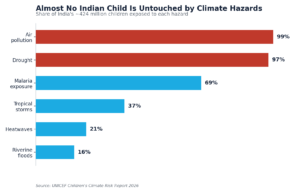
Public conversation about India’s climate risk tends to fixate on floods and cyclones, but UNICEF’s data tells a different story. Drought is the single most widespread hazard, affecting more than 410.2 million children — over 96% of India’s child population — through agricultural or meteorological drought that threatens food security, nutrition, and livelihoods long before it makes headlines.
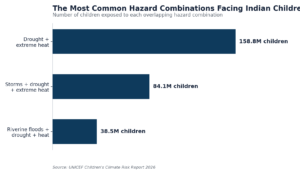
The most common overlapping combination is drought paired with extreme heat, affecting 158.8 million children — more than the entire population of Russia. Add tropical storms to that combination, and another 84.1 million children are exposed to all three at once. A smaller but still enormous 38.5 million children face the combination of riverine floods, drought, and extreme heat together.
Individually, 155.7 million children live in areas exposed to tropical storms, 89.3 million (roughly one in five) are exposed to heatwaves, and 66.9 million (about 16%) are exposed to riverine floods — each a serious hazard on its own, but the report’s real finding is that almost none of these children face just one of them in isolation.
India Is Worse Than the Global Average — By a Meaningful Margin
This is the detail that should reframe how India’s climate risk gets discussed internationally: UNICEF’s global topline finding is that 1.1 billion children worldwide — nearly half of all children on the planet — face at least three overlapping climate hazards. India’s figure of 55% is meaningfully higher than that global average of roughly 48%, meaning Indian children are more likely than the average child anywhere on Earth to be living inside compounding climate risk.
Globally, the report also found that 1.8 billion children (three-quarters of all children worldwide) are exposed to drought, 1.5 billion to heatwaves, 1.2 billion to extreme heat, and 662 million to tropical storms — with a small but staggering subset of more than 4 million children facing up to six overlapping hazards at once.
Beyond the Weather: Air Pollution and Malaria Compound the Damage
UNICEF’s report doesn’t stop at weather-driven hazards — it also tracks climate-sensitive health threats that get worse as the climate changes, even though climate change doesn’t directly cause them. In India, the numbers here are arguably even starker than the weather data:
- Nearly 99% of Indian children — about 421 million — live in areas with unhealthy air. India scored 9.94 out of 10 on the report’s air pollution risk scale, among the highest of any country assessed.
- Malaria affects an estimated 294.1 million Indian children — nearly seven in ten. Transmission patterns rise and fall directly with temperature and rainfall, meaning a changing climate is actively reshaping malaria risk zones.
The Systems Meant to Protect Children Are Already Falling Short
Perhaps the most policy-relevant finding in the entire report is this: about 48% of children under 15 in India have no access to any social protection program — the cash transfers and support systems specifically designed to help families absorb climate shocks. Nearly half the country’s children have no safety net at exactly the moment they need one most.
Food security compounds the problem. About 40% of Indian children already live in severe food poverty, and UNICEF warns that repeated droughts and floods — which destroy crops and disrupt supply chains — will deepen malnutrition that already exists, not create a new problem from scratch.
This Isn’t a Future Risk — It’s Already Disrupting Classrooms Today
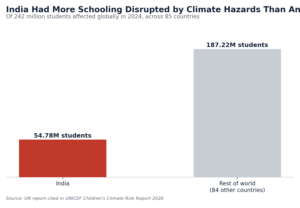
UNICEF’s report cites UN data showing that in 2024 alone, climate-related hazards disrupted schooling for at least 242 million students across 85 countries — and India accounted for 54.78 million of them, more than any other country on Earth, with heatwaves as the leading cause.
That’s not a 2026 abstraction, either — it’s still happening as this report is being read. Odisha extended school closures across five districts until June 20, 2026 because of extreme heat. In April 2026, temperatures across Uttar Pradesh, Odisha, Maharashtra, Jharkhand, Bihar, and Madhya Pradesh climbed to between 42°C and 45°C, forcing revised school hours and early summer breaks. Schools in parts of Jharkhand shut for several days, and in Uttarakhand, Dehradun’s administration closed every school and anganwadi center on April 27 because the heat had become too dangerous to keep classrooms open.
What Happens If Nothing Changes
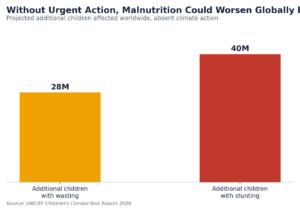
UNICEF’s warning extends to 2050: without urgent action, the report projects an additional 28 million children could suffer from wasting and 40 million from stunting globally, worsening a malnutrition crisis that climate-driven crop failures and food insecurity are already accelerating.
What UNICEF Is Actually Asking For
The report doesn’t just document the problem — it makes specific asks of governments: cut greenhouse gas emissions, phase out fossil fuels, and make schools, health clinics, and water systems resilient enough to keep functioning through climate shocks rather than shutting down every time one hits. It also calls for something less commonly demanded in climate policy circles: including children’s voices directly in climate policy and finance decisions, rather than treating them purely as subjects to be protected by decisions made entirely by adults.
The Bottom Line
This isn’t a story about a distant, worst-case climate future. It’s a description of where 411 million Indian children are living right now — in a country where drought touches nearly every child, air pollution touches almost all of them, and nearly half have no social safety net to fall back on when the next heatwave, flood, or crop failure hits. The most uncomfortable number in the entire report may be the simplest one: India’s children are already facing compounding climate risk at a higher rate than the rest of the world’s children combined.
Sourced from UNICEF’s Children’s Climate Risk Report 2026 (released June 16, 2026) and UNICEF’s Global Child Hazard Database, cross-verified against independent reporting from Down To Earth and Ground Report.