

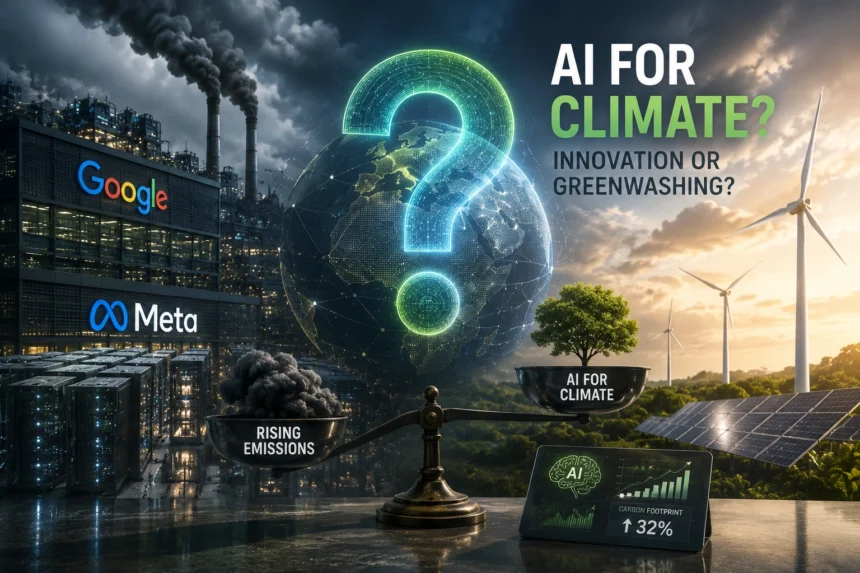
Google’s emissions are up 82% since 2019, Microsoft and Meta aren’t far behind, and Big Tech is now signing gas contracts to power AI. Here’s the global data — and what it means for India’s own AI-driven power demand.
The Contradiction at the Heart of “AI for Climate”
For years, the tech industry has pitched artificial intelligence as a climate solution — a tool that could optimize grids, accelerate materials science, and model climate change itself. That pitch is increasingly running into an inconvenient fact: the companies building AI are missing their own climate targets because of AI itself.
The clearest recent evidence came via The Guardian‘s TechScape newsletter, authored by US tech editor Blake Montgomery, who reported that Google and Amazon’s net-zero pledges are “slipping out of reach” as a direct consequence of their AI infrastructure buildout. According to Google’s own environmental disclosures, the company’s total greenhouse gas emissions have risen 82% since 2019, including an 18% jump in the most recent year alone — even as Google maintains a public commitment to cut emissions in half by 2030. Some independent analyses have found the real increase may be even steeper: one review reported by The Guardian‘s Johana Bhuiyan found Google’s emissions climbing by as much as 65% using stricter accounting methods, while Google’s electricity demand specifically has reportedly grown by 250% since 2019, with a 37% jump in the most recent year alone.
Google isn’t alone. Amazon’s emissions rose 58% since 2019, including a 40% jump tied specifically to data center construction and a 16% year-over-year increase. Reporting cited in the same TechScape piece notes Meta’s emissions jumped roughly 64% in a single year, and Microsoft is now tracking around 23% above its 2020 baseline. All four companies still formally maintain net-zero commitments. Google, notably, has stopped citing concrete numerical 2030 targets in some contexts, instead referring to certain goals as “climate moonshots” — its own term for ambitious, uncertain projects that may or may not materialize.
The Real Story: Big Tech Is Quietly Going Back to Gas
Perhaps the most telling detail in the reporting is what’s actually being built to solve the power problem. Per The Guardian, Google, Amazon, Microsoft, and Meta have all signed contracts for gas-generated electricity in Texas, Indiana, and Louisiana to keep pace with AI power demand. This isn’t a minor, one-off compromise — the non-profit Environmental Integrity Project has tracked plans for 74 new gas-fired power plants across the US specifically built to serve data centers, which the group estimates could collectively emit more than 660 million tons of greenhouse gas per year — roughly equivalent to the annual emissions of the entire country of Australia.
That single data point reframes the “AI for climate” narrative. The near-term reality isn’t that AI lacks climate applications in theory — it’s that AI’s own electricity appetite is currently growing faster than clean power, transmission, and storage can be built to match it, and gas is filling the gap in the meantime.
Just How Big Is AI’s Power Problem, Globally?
The scale here is worth putting numbers to. According to the International Energy Agency (IEA):
- Global data center electricity consumption reached roughly 415 terawatt-hours (TWh) in 2024 — about 1.5% of total global electricity use — and has been growing at 12% annually over the past five years, more than four times faster than overall global electricity demand
- The IEA’s base case projects this figure will roughly double to around 945 TWh by 2030, with electricity consumption specifically tied to AI-accelerated servers growing at 30% per year
- In 2025 alone, global data center electricity demand grew 17%, while electricity use from AI-focused data centers specifically surged 50%
- Analyst firm Gartner separately estimates global data center power demand will rise 27% in 2026 to reach 132 gigawatts (GW), on its way to roughly 290 GW by 2030
- Capital expenditure by the largest technology companies on data center infrastructure exceeded $400 billion in 2025 and is expected to jump by a further 75% in 2026, per the IEA — a level of spending now larger than global investment in oil and gas production combined
On the supply side, the mix powering all this remains heavily fossil-dependent: one 2024 estimate cited by Brookings found 40% of data center electricity came from natural gas, with renewables at 24%, nuclear at 20%, and coal at 15%. Looking ahead to 2035, 56% of new global data center capacity is expected to be built alongside renewable sources — but a separate estimate suggests 64% of the incremental power generation added to serve that new capacity will still come from fossil fuels, largely because it’s faster to bring online than new clean firm capacity.
UAE PropTech Startup Keyper Raises $11 Million to Expand Digital Rent Payment Platform
Why This Matters for India
India is not a bystander in this story — it’s one of the fastest-growing data center markets in the world, and its own numbers echo the same tension between AI ambition and power reality.
According to the Institute for Energy Economics and Financial Analysis (IEEFA), India’s data center capacity is projected to grow from around 1.4 GW to 9 GW by 2030, a more than six-fold increase. In doing so, data centers are expected to consume roughly 3% of India’s total electricity by 2030, up from under 1% today. That may sound modest next to the US, but it represents a rapid, concentrated surge in demand in specific grid regions, arriving at the same time India’s broader electricity demand is already accelerating — the IEA projects India’s overall electricity demand will grow at 6.4% annually through 2030, adding more than 570 TWh of new annual consumption, with industry contributing roughly a third of that growth.
India’s data center sector is, in some respects, ahead of the global curve on clean power integration. The Yotta NM1 data center near Mumbai, India’s largest, already sources about half its power from renewables, with a stated target of 70%. Renewable energy tenders in India have also been moving toward “firm and dispatchable” clean power — continuous, reliable renewable supply — with recent tariffs for such power coming in at ₹4.98-4.99 per unit, actually undercutting the Central Electricity Authority’s median natural gas tariff of ₹5.4 per unit. That price advantage matters, because it undercuts the economic logic that has pushed US hyperscalers toward gas: in India, clean firm power is not necessarily the more expensive option.
That said, India’s own natural gas dynamics carry real risk if the country follows the same path as US hyperscalers. Domestic gas production meets only about half of India’s gas needs, and demand across residential, commercial, and industrial users is expected to rise 60% by 2030 — meaning any large-scale pivot to gas-fired power for Indian data centers would deepen reliance on imported gas, exposing operators to volatile global pricing at precisely the moment global gas markets are also absorbing new US data center demand.
The Actual Investment Thesis: Power For AI, Not “AI For Power”
The broader point — one echoed across the Guardian reporting and IEA’s own analysis — is that the more urgent, less glamorous investment opportunity isn’t abstract “AI for climate” pitch decks. It’s the unsexy infrastructure that determines whether a data center’s next megawatt comes from a gas turbine or a clean source: grid software and demand response, long-duration energy storage (LDES), geothermal, advanced nuclear (including small modular reactors), behind-the-meter clean firm power, thermal storage, and the interconnection engineering that decides whether a clean electron can actually reach a server rack in time.
India’s own policy signals point the same direction. Government incentives like the Viability Gap Funding (VGF) scheme — offering up to 30% capital expenditure support for standalone battery energy storage system (BESS) projects — have driven a sharp rise in activity: standalone energy storage tenders reportedly reached 6.1 GW in the first quarter of a recent year alone, already exceeding the entire prior year’s total and accounting for 64% of all utility-scale energy storage tenders issued.
The Bottom Line
Both the US and Indian data points converge on the same conclusion: AI’s climate story isn’t being decided by what AI can theoretically do for the climate — it’s being decided by where the next gigawatt of power for AI actually comes from. In the US, that answer is currently trending toward gas, fast enough that four of the world’s most climate-committed companies are missing their own targets to build it. In India, the outcome is still genuinely open, helped by clean firm power that’s already cost-competitive with gas — but only if that advantage is built on deliberately, rather than assumed to hold by default as AI demand accelerates.
Reporting on Google, Amazon, Meta, and Microsoft’s emissions and gas contracts is credited to Blake Montgomery and Johana Bhuiyan of The Guardian’s TechScape. Additional data sourced from the International Energy Agency (IEA), the Institute for Energy Economics and Financial Analysis (IEEFA), the Environmental Integrity Project, Brookings, Gartner, and ESG Dive.
India’s Real Water Crisis Isn’t Technology — It’s That Nobody’s Buying the Treated Water