
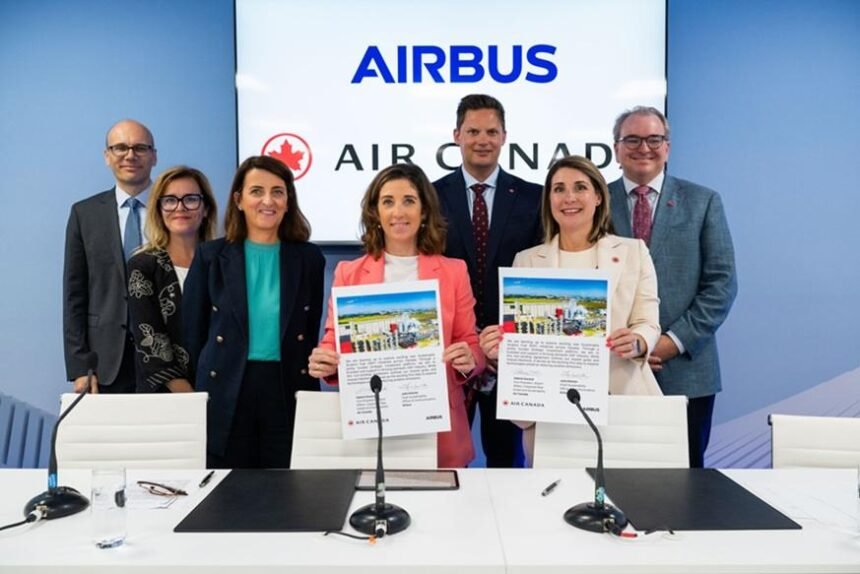
Air Canada and Airbus have announced a strategic collaboration to accelerate the growth of Sustainable Aviation Fuel (SAF) production in Canada through a series of new initiatives, including the creation of a jointly funded Sustainability Co-Investment Platform.
- Joint Investment to Strengthen Canada’s SAF Ecosystem
- Focus on Advancing Commercial SAF Projects
- Why Sustainable Aviation Fuel Matters
- Expanding Corporate Sustainability Programs
- Supporting Aviation’s Energy Transition
- Air Canada’s Net-Zero Roadmap
- Growing Global Momentum for Sustainable Aviation Fuel
- Looking Ahead
The companies plan to invest up to CAD$13.7 million (approximately US$10 million) to help establish a commercial-scale Sustainable Aviation Fuel ecosystem in Canada, supporting the aviation industry’s long-term decarbonisation goals.
The initiative reflects the growing collaboration between airlines, aircraft manufacturers, and governments to scale alternative aviation fuels and reduce the sector’s carbon footprint.
Joint Investment to Strengthen Canada’s SAF Ecosystem
The proposed Sustainability Co-Investment Platform will serve as a catalyst for expanding domestic Sustainable Aviation Fuel production while encouraging broader industry participation.
Through the platform, Air Canada and Airbus aim to support projects that can accelerate commercial-scale SAF manufacturing and improve fuel availability across the country.
The companies also plan to continue engaging with government agencies and industry stakeholders to establish supportive policy frameworks that encourage investment and large-scale production.
Focus on Advancing Commercial SAF Projects
One of the primary objectives of the collaboration is to accelerate a jointly identified Canadian Sustainable Aviation Fuel project toward a Final Investment Decision (FID).
The partners believe that scaling domestic production capacity will play a critical role in addressing one of the aviation industry’s biggest sustainability challenges—limited availability of Sustainable Aviation Fuel.
Although SAF is widely recognised as one of the most effective solutions for reducing aviation emissions, commercial adoption has been constrained by limited supply and production costs that remain significantly higher than conventional jet fuel.
Why Sustainable Aviation Fuel Matters
Fuel consumption accounts for the majority of greenhouse gas emissions generated by commercial aviation.
Sustainable Aviation Fuel is produced from renewable and sustainable feedstocks such as:
- Agricultural residues
- Waste cooking oils
- Municipal waste
- Forestry residues
- Other biomass sources
Compared to conventional aviation fuel, SAF can significantly reduce lifecycle greenhouse gas emissions while remaining compatible with existing aircraft engines and airport infrastructure.
As governments worldwide pursue net-zero emissions targets, increasing SAF production has become a strategic priority for the aviation industry.
Expanding Corporate Sustainability Programs
As part of the collaboration, Airbus has also entered into a five-year agreement under Air Canada’s Leave Less Travel Program.
The program enables corporate customers and freight forwarders to purchase Scope 3 environmental attributes associated with Sustainable Aviation Fuel or carbon offset credits linked to their business travel and cargo shipments.
Under the agreement, Airbus will purchase SAF environmental attributes associated with more than 60,000 litres of Sustainable Aviation Fuel during the initial phase.
Air Canada will monitor Airbus’ corporate travel-related greenhouse gas emissions and retire verified SAF environmental attributes on the company’s behalf, supporting its sustainability commitments.
Supporting Aviation’s Energy Transition
Commenting on the partnership, Air Canada said the initiative represents another important step toward advancing Canada’s aviation energy transition while encouraging greater domestic SAF production.
The airline believes stronger collaboration across industry and government will help accelerate the development of a competitive Sustainable Aviation Fuel market capable of supporting long-term decarbonisation.
Airbus also highlighted that the co-investment platform and long-term participation in the Leave Less Travel Program are designed to stimulate both production and demand for Sustainable Aviation Fuel in Canada.
Air Canada’s Net-Zero Roadmap
Air Canada has committed to achieving net-zero greenhouse gas emissions by 2050 across its global operations.
The airline’s sustainability strategy also includes interim climate targets by 2030, including:
- 20% net reduction in greenhouse gas emissions from flight operations
- 30% net reduction in emissions from ground operations
In addition, the airline has pledged to invest $50 million in Sustainable Aviation Fuel, carbon reduction initiatives, and carbon removal projects.
Growing Global Momentum for Sustainable Aviation Fuel
Governments, airlines, and aircraft manufacturers around the world are increasing investments in Sustainable Aviation Fuel as demand for low-carbon aviation solutions continues to rise.
Industry experts view SAF as one of the most practical pathways to reducing aviation emissions in the near and medium term because it can be used with existing aircraft fleets without requiring major infrastructure changes.
However, scaling production remains a significant challenge, making public-private partnerships and long-term investment commitments increasingly important.
Looking Ahead
The collaboration between Air Canada and Airbus represents a significant step toward establishing a robust Sustainable Aviation Fuel ecosystem in Canada.
By combining financial investment, industry collaboration, and long-term demand commitments, the two companies aim to accelerate domestic SAF production while supporting the aviation sector’s transition toward a lower-carbon future.
As global aviation works toward achieving net-zero emissions, initiatives like this are expected to play a vital role in expanding Sustainable Aviation Fuel availability and enabling more sustainable air travel.