
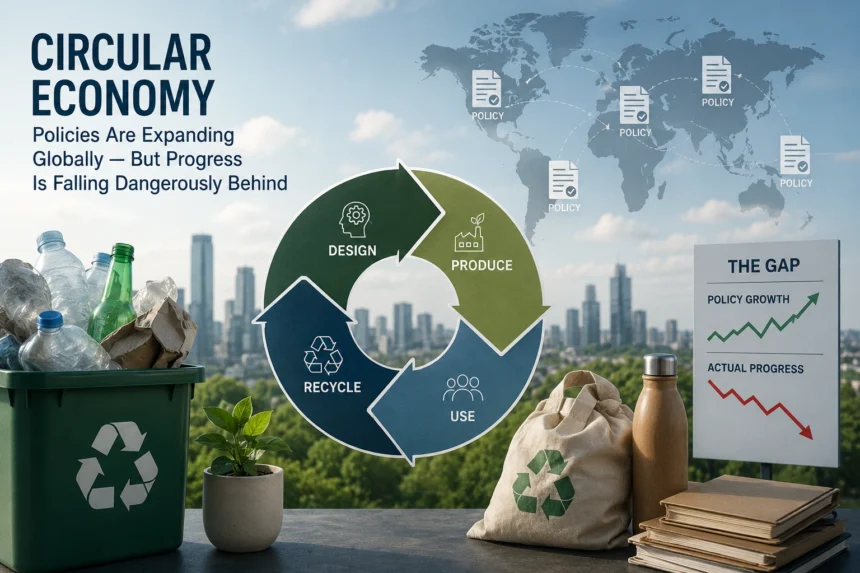
As the 2030 deadline for the UN Sustainable Development Goals draws closer, governments worldwide are ramping up circular economy frameworks. The policies are multiplying. The results, however, are not keeping pace — and the gap between ambition and action has never been more urgent to close.
What Is the Circular Economy — And Why Does It Matter Now?
The global economy currently consumes approximately 100 billion metric tons of resources every single year. To put that in perspective, that is the equivalent weight of more than 16,000 Great Pyramids of Giza — extracted, processed, consumed and, in the vast majority of cases, discarded. Approximately 75% of that total comes from non-renewable resources, and relentless mining, agricultural expansion and waste disposal are damaging ecosystems while fuelling growing concerns about long-term resource scarcity.
If current trajectories hold, global resource extraction is projected to surge by a staggering 150% by 2060. That is the trajectory of a linear economy — extract, produce, consume, dispose — and it is the dominant model the world still runs on.
The circular economy offers a fundamentally different framework. Rather than treating materials as single-use inputs destined for landfill or incineration, a circular model is built on maximising the value of resources for as long as possible. A circular economy is one where the value of materials is maximised and maintained for as long as possible; the input of materials and their consumption is minimised; and the generation of waste is prevented and negative environmental impacts are reduced throughout the life cycle of materials.
In practice, this means prioritising repair over replacement, reuse over disposal, refurbishment over re-manufacturing, and recycling over extraction. It means designing products to last, and designing systems that recover value when products reach the end of their useful life. It is less a single policy solution and more a wholesale redesign of how economies relate to physical materials.
With less than five years remaining before the United Nations’ 2030 deadline for the Sustainable Development Goals, a new wave of UN assessments and independent research is asking the same pressing question: are we moving fast enough?
The answer, by most measures, is no.
The Circularity Gap: A Declining Metric in a World of Rising Rhetoric
Perhaps the most telling indicator of where global progress actually stands comes from the Circularity Gap Report, an annual assessment published by Circle Economy in collaboration with Deloitte. When the series launched in 2018, it revealed for the first time that the world was just 9.1% circular — meaning fewer than one in ten units of material being used globally was recycled or reused rather than extracted fresh from natural resources.
That figure has not improved. It has deteriorated. The global circularity rate has continued to decline, falling from 7.2% to 6.9% as of the latest analysis. This means that only 6.9% of all the materials used globally are being reused or recycled. The rest — over 93% — are derived from new resources and eventually end up as waste or emissions.
The 2026 edition of the Circularity Gap Report introduces a new metric to capture the economic dimension of this failure. The “Value Gap” — which quantifies the economic losses of today’s linear economy — amounts to an estimated EUR 25.4 trillion, or around EUR 1 in losses for every EUR 3 of economic value created globally. These losses, occurring across production, consumption and end-of-life systems, are not inevitable. They are structurally embedded in an economic model that has not yet been redesigned. Conventional economic metrics such as GDP do not capture value loss to linearity, overlooking resource depletion, waste, underutilisation and stock depletion — meaning structural value loss remains largely invisible in economic decision-making.
That invisibility is a central part of the problem. When waste is not counted as a cost and resource depletion does not register in national accounts, the incentive to change is always competing against the inertia of an established system.
Government Action Is Accelerating — But Unevenly
Despite the troubling headline metrics, something genuinely significant is happening at the policy level. Across the world, national governments are developing circular economy strategies, legislative frameworks and action plans at a pace that would have been unimaginable a decade ago. The challenge is that policy momentum is not the same as systemic change — and the distance between the two is where most circular economy transitions currently find themselves.
The European Union: Setting the Benchmark
The European Union has positioned itself as the world’s most ambitious laboratory for circular economy regulation, and its policy architecture is extensive and evolving. The EU’s Circular Economy Act, due for adoption in 2026, aims to establish a single market for secondary raw materials, increase the supply of high-quality recycled materials and stimulate demand for these materials within the EU. Europe’s current circularity rate stands at around 12%, and the goal is to double it to 24% by 2030 — a target embedded in the EU’s Clean Industrial Deal.
Supporting that ambition is a web of specific regulations. The new Regulation on Packaging Waste entered into force in February 2025, replacing the previous directive and harmonising national measures to strengthen the internal market for secondary raw materials. The EU has also introduced deposit return systems in multiple member states, advanced ecodesign requirements for packaging and textiles, and launched a Critical Raw Materials Act that sets recycled content targets for strategic materials.
The EU’s binding targets require member states to increase municipal waste recycling to 55% by 2025, 60% by 2030 and 65% by 2035, alongside reducing landfill waste to 10% by 2035. However, performance against these targets is uneven. Eighteen EU countries are currently at risk of missing the 2025 municipal waste recycling target, and 19 countries are at risk of missing the plastic packaging recycling target of 50% by 2025.
Germany remains among the EU’s stronger performers, with structured recycling systems and extended producer responsibility frameworks that have served as models for other countries. But even Germany is operating within a system that has seen Europe’s overall recycling rate reach only 44% of waste generated as of 2022 — and where more focus is needed on recycling quality, not just quantity.
2025 was a year of structural progress for circularity in Europe — policies were reinforced, systems were approved and long-term infrastructure decisions were locked in. While outcomes have not yet caught up with ambition, the direction is now unmistakable. 2026 is the year where preparation must turn into execution.
The Developing World: Infrastructure as the Missing Link
Beyond Europe and a handful of high-income countries, the circular economy transition faces a different set of obstacles — ones that cannot be resolved by legislation alone. In low- and middle-income countries, the primary constraints are not regulatory ambiguity or corporate resistance. They are physical: inadequate recycling infrastructure, fragmented waste collection networks, limited technical capacity and insufficient investment.
The crisis of unsustainable consumption and production patterns worldwide is fuelling the ongoing triple planetary crisis of climate change, nature loss and pollution. Domestic material consumption and material footprint continue to rise, and stockpiles of e-waste steadily grow. For many developing nations, a significant proportion of waste is managed in the informal sector — by waste pickers and small-scale recyclers whose contribution to urban resource recovery is rarely counted in official statistics and rarely supported by policy.
The result is a global circular economy transition that is structurally two-speed: advanced economies developing sophisticated frameworks for product take-back and material recovery, while large portions of the developing world lack the foundational waste management infrastructure on which any circular system must be built.
The SDG Connection: More Than an Environmental Agenda
The circular economy is not merely a waste management strategy. Its implications cut across multiple dimensions of the United Nations’ Sustainable Development Goals — and understanding those connections is important for grasping the full urgency of accelerating the transition.
SDG 12 — Responsible Consumption and Production is the most direct link. There were 1.05 billion tons of food wasted in 2022, with 60% of waste coming from households, equating to more than one billion meals discarded daily. Reducing this kind of systemic waste through circular design — extended shelf life, reduced packaging, improved supply chain efficiency — is central to the SDG 12 agenda.
SDG 13 — Climate Action connects through the carbon embedded in material production. Manufacturing products from virgin materials is significantly more energy-intensive than manufacturing from recycled inputs. Expanding circular systems therefore reduces industrial carbon emissions — a benefit that is rarely quantified fully in climate policy discussions.
SDG 8 — Decent Work and Economic Growth is linked through the job creation potential of circular industries. Repair, remanufacturing, sorting and recycling operations are labour-intensive by nature. Reuse and recycling create local jobs and boost innovation, alleviate pressures on natural resources and reduce dependencies on imported raw materials — a combination of benefits that is especially relevant for economies seeking to reduce exposure to global commodity price volatility.
SDG 9 — Industry, Innovation and Infrastructure connects through the technological dimension of circularity. Recycling technologies continue to advance in 2026, with sensor-based sorting increasingly enhanced by deep learning and AI-driven digital services delivering higher purity, higher throughput and reduced reliance on manual intervention. These innovations are beginning to make circular systems economically competitive with linear alternatives — a development that could accelerate private sector adoption significantly.
Five Years to 2030: What Needs to Change
The consensus among researchers, policymakers and international organisations is that current rates of progress are insufficient to meet the targets embedded in the 2030 Agenda. A 2024 UN progress report found that the UNECE region is currently on track to achieve only 17% of its measurable SDG targets by 2030, with climate action and the circular economy transition among the areas most critically off track.
Closing that gap will require action on several fronts simultaneously.
Policy coherence is perhaps the most immediately actionable lever. Many countries have circular economy strategies that exist in isolation from fiscal policy, trade regulation and industrial strategy. When tax systems still effectively subsidise virgin material extraction, circular alternatives face a structural competitive disadvantage that no amount of recycling regulation can fully overcome.
Infrastructure investment — particularly in the developing world — is the physical foundation without which no circular economy policy can function. Collection systems, sorting facilities, material recovery infrastructure and reverse logistics networks require upfront capital that markets alone will not provide at the necessary scale or speed.
Extended producer responsibility (EPR) schemes, which require manufacturers to take financial or operational responsibility for the end-of-life management of their products, are among the most powerful tools available to drive circular design at scale. These schemes are expanding, but their coverage remains uneven and their ambition varies widely between jurisdictions.
Measurement and transparency are the enablers that make all other interventions more effective. As long as structural value loss remains largely invisible in economic decision-making, the business case for circularity will always be fighting against a system that doesn’t count what it wastes. Integrating circular economy metrics into national accounting, corporate reporting and investment analysis is essential for making the invisible visible.
The Bottom Line
The circular economy is no longer a niche concept or an aspirational framework. It is rapidly becoming the central organising principle of global resource policy — a response to the compounding pressures of resource scarcity, climate disruption, waste accumulation and the economic inefficiency of an industrial system that throws away EUR 1 for every EUR 3 it creates.
The policies are multiplying. The technologies are improving. The business cases are hardening. What is still missing — with less than five years to go before 2030 — is the speed and scale of implementation that the moment actually demands.
The gap between the world we are building and the world the SDGs describe is not a gap of knowledge or intention. It is a gap of execution. And in the decade that will define the trajectory of global sustainability for generations, that may be the most important distinction of all.
This article draws on data from the Circularity Gap Report 2025 and 2026 (Circle Economy / Deloitte), the UN SDG Progress Report 2025, the European Environment Agency, the European Commission Circular Economy framework, the World Resources Institute and UNCTAD SDG Pulse 2025.