

Governance | Global | 12 November 2026 | 6 min read
- Ninth Circuit SB 253 Ruling: What Has Changed?
- Scope 1 and Scope 2 emissions reporting remains in place
- Scope 3 reporting under SB 253 has been blocked
- SB 261 climate-risk disclosure also blocked
- Which Companies Are Affected by the California Climate Disclosure Ruling?
- Why the First Amendment Is Central to the Case
- What Happens Next in the California Climate Disclosure Case?
- Key Dates and Figures Businesses Should Know
- What the Ruling Means for Global ESG Reporting
A major legal development has reshaped the corporate climate-disclosure landscape in the United States. On 9 November 2026, a divided panel of the US Court of Appeals for the Ninth Circuit issued a ruling that partially limits California’s landmark climate-disclosure legislation.
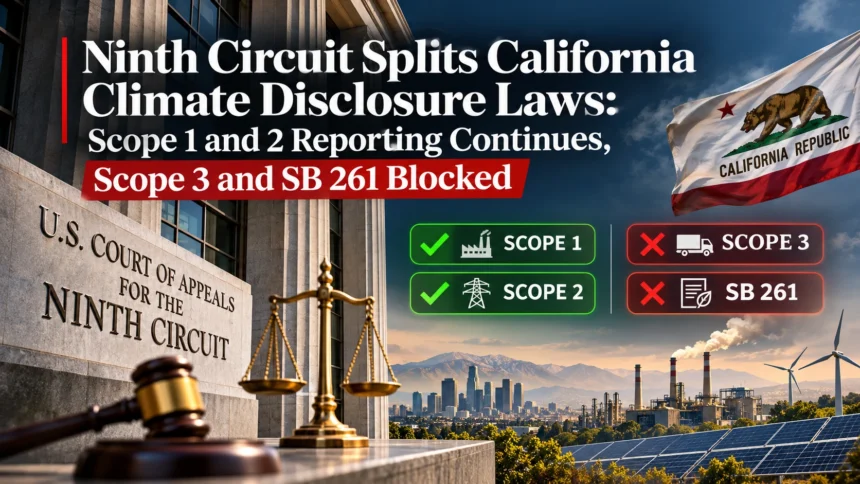
In Chamber of Commerce v. Sanchez, the court allowed reporting requirements covering Scope 1 and Scope 2 greenhouse gas emissions under California’s Climate Corporate Data Accountability Act, known as SB 253, to remain in effect. However, it found that the law’s Scope 3 emissions disclosure provisions and the separate climate-risk reporting requirements under SB 261 are likely to violate the First Amendment.
The 2–1 decision draws an important distinction between reporting measurable emissions generated by a company’s own operations and disclosing information involving wider supply chains or forward-looking assessments of climate-related financial risks.
For businesses operating in California, the ruling means that some reporting obligations remain active while others are temporarily blocked pending further legal proceedings.
Ninth Circuit SB 253 Ruling: What Has Changed?
The legal challenge examined whether California’s mandatory corporate climate-disclosure requirements compel businesses to communicate information in a manner that violates constitutional free-speech protections.
Rather than striking down or upholding the entire regulatory framework, the Ninth Circuit panel reached different conclusions for different categories of disclosure.
Scope 1 and Scope 2 emissions reporting remains in place
The court allowed the Scope 1 and Scope 2 reporting requirements under SB 253 to continue.
Scope 1 emissions cover direct greenhouse gas emissions from sources owned or controlled by a company. Scope 2 emissions relate to indirect emissions associated with purchased electricity, steam, heating and cooling.
The panel treated these disclosures as factual and verifiable information about a company’s own operations. It applied a more lenient commercial-speech standard, under which mandatory disclosure requirements are generally easier to justify.
As a result, the California Air Resources Board’s 10 November 2026 deadline for first-year Scope 1 and Scope 2 emissions reporting remained in effect.
Scope 3 reporting under SB 253 has been blocked
The court took a different approach to Scope 3 emissions.
These emissions arise across a company’s wider value chain, including suppliers, transportation, product use and other activities beyond its direct operational boundaries.
According to the panel’s reasoning, Scope 3 disclosures involve information about the activities of independent third parties rather than solely the reporting company’s own operations. This distinction makes the disclosure requirement more difficult to justify under the commercial-speech standard.
The court therefore found the Scope 3 requirement likely unconstitutional and blocked its implementation at this stage.
Scope 3 reporting had originally been scheduled to begin in 2027. Companies covered by the provision are not currently expected to comply while the preliminary injunction remains in place.
SB 261 climate-risk disclosure also blocked
California’s Climate-Related Financial Risk Act, SB 261, also faced a setback.
The law requires covered businesses to report climate-related financial risks and explain how they are addressing those risks.
The Ninth Circuit panel viewed these disclosures as involving forward-looking assessments and potentially subjective judgments, rather than simply reporting verifiable operational data.
It concluded that the requirements are likely to face a more demanding level of First Amendment scrutiny and are unlikely to survive that review at the preliminary stage.
Consequently, SB 261’s climate-risk reporting requirement has also been enjoined pending further proceedings.
Which Companies Are Affected by the California Climate Disclosure Ruling?
Both SB 253 and SB 261 were designed to cover companies with annual revenues exceeding $1 billion that do business in California.
The threshold captures a substantial number of large US and international businesses, including companies headquartered outside California.
The latest ruling creates a different compliance position for the three disclosure areas:
| Disclosure requirement | Position following the ruling |
|---|---|
| Scope 1 emissions under SB 253 | Reporting requirement remains in place |
| Scope 2 emissions under SB 253 | Reporting requirement remains in place |
| Scope 3 emissions under SB 253 | Temporarily blocked |
| Climate-risk reporting under SB 261 | Temporarily blocked |
For companies preparing their first-year reports, the distinction is particularly important. The November 10, 2026 deadline for Scope 1 and Scope 2 reporting was not suspended by the court’s decision.
Businesses should therefore continue to assess their obligations under the provisions that remain active, while monitoring further developments concerning the blocked requirements.
Why the First Amendment Is Central to the Case
The dispute raises a wider legal question about the extent to which governments can require companies to publish information about their environmental performance and climate exposure.
The Ninth Circuit panel’s reasoning distinguishes between factual disclosures about a company’s own activities and statements that may involve third-party conduct or subjective assessments.
Scope 1 and Scope 2 emissions are more directly connected to a company’s operations. Scope 3 reporting, by contrast, requires information about a much wider network of suppliers, customers and other value-chain participants.
Climate-risk disclosures under SB 261 can also involve judgments about future financial exposure, business strategy and potential climate scenarios.
This distinction could become important for other jurisdictions considering mandatory corporate sustainability and climate reporting requirements.
What Happens Next in the California Climate Disclosure Case?
The Ninth Circuit’s decision is a preliminary injunction ruling, not a final determination of the underlying constitutional dispute.
Further proceedings are expected to address whether the Scope 3 provision can be separated from the rest of SB 253 without undermining the wider legislation.
California may also pursue further appellate review, including a request for rehearing by the full Ninth Circuit or a petition to the US Supreme Court.
The next major legal milestone is the district court’s consideration of severability. Its decision could determine whether the blocked Scope 3 requirement can be treated independently or whether the wider structure of SB 253 could face additional uncertainty.
A rehearing petition deadline of 23 November 2026, absent an extension, is another date for companies and legal observers to monitor.
Key Dates and Figures Businesses Should Know
- 9 November 2026: Ninth Circuit panel issues its decision.
- 10 November 2026: California’s Scope 1 and Scope 2 first-year reporting deadline remains in effect.
- $1 billion: Annual revenue threshold for companies doing business in California under the laws.
- 2–1: Vote in the Ninth Circuit panel’s decision.
- 2027: Original start year for Scope 3 reporting, now blocked pending further proceedings.
- 23 November 2026: Rehearing petition deadline, absent an extension.
What the Ruling Means for Global ESG Reporting
The Ninth Circuit’s decision is significant beyond California because it introduces a new legal dimension to the debate over mandatory corporate climate disclosures.
For businesses operating across multiple jurisdictions, the ruling highlights the need to distinguish between reporting requirements that remain legally active and those subject to ongoing litigation.
It also raises questions for regulators seeking to make value-chain emissions and climate-risk assessments mandatory. As sustainability disclosure frameworks move from voluntary standards towards binding legal requirements, the balance between transparency, regulatory objectives and constitutional protections is likely to attract greater scrutiny.
Other jurisdictions, including those implementing broader corporate sustainability reporting frameworks, will be watching how the US legal challenge develops.
For now, companies should maintain their Scope 1 and Scope 2 reporting processes under California’s SB 253 requirements, while reviewing their approach to Scope 3 and SB 261 obligations in light of the injunction and seeking appropriate legal guidance.
The central takeaway: California’s climate-disclosure framework has not been entirely struck down. Scope 1 and Scope 2 reporting continues, but the future of mandatory Scope 3 and climate-risk disclosure now depends on further court proceedings.
ESG World News covers developments in environmental policy, corporate governance, sustainability regulation, climate finance and the global energy transition.
India Green Hydrogen Offtake Agreements Cross 5.55 Lakh Tonnes