

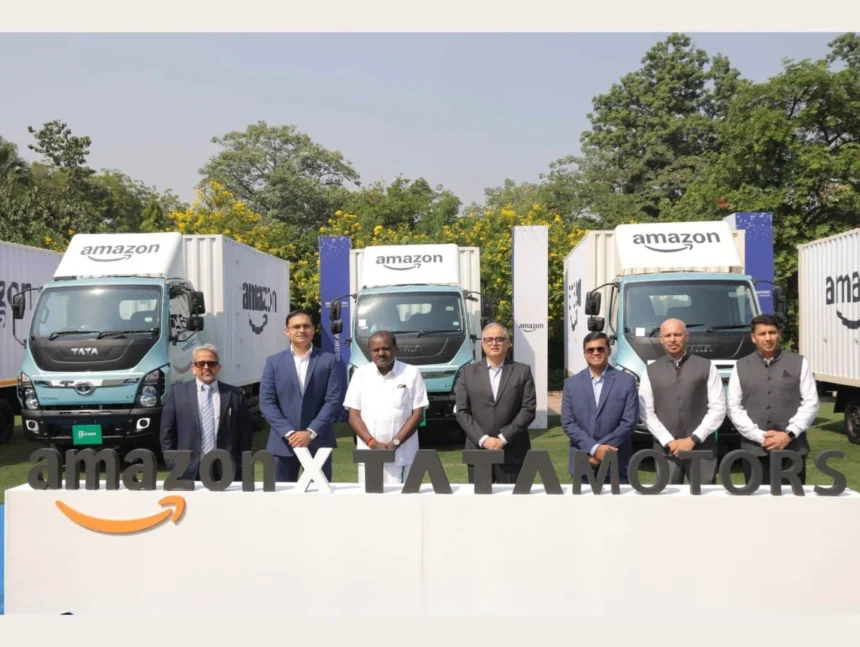
October 2026 , India – Amazon and Tata Motors are joining forces to deploy 3,000 electric trucks across India, marking a major step towards electrifying e-commerce logistics and reducing the carbon intensity of freight transportation. The initiative will extend electric mobility beyond last-mile deliveries to the middle-mile network that connects warehouses, fulfilment centres, cities and national highways.
- Amazon Expands Electric Mobility Beyond Last-Mile Delivery
- Electric Trucks Planned for the Delhi–Bengaluru–Chennai Corridor
- Government Backs India’s Electric Commercial Vehicle Transition
- Amazon’s Net-Zero Ambition Drives Logistics Electrification
- Tata Motors’ Electric Truck Technology Targets Fleet Efficiency
- Can Electric Trucks Reduce India’s Freight Emissions?
- What the Amazon–Tata Motors Partnership Means for India’s Green Logistics Market
The rollout represents the largest electric-truck deployment by an e-commerce company in India, according to the announcement. Tata Motors will supply the vehicles, while Amazon’s transportation partners will own and operate the trucks across the logistics network.
The collaboration combines Amazon’s large-scale freight requirements with Tata Motors’ vehicle engineering, manufacturing and after-sales service capabilities. It also reflects a broader shift towards electrifying commercial transportation, where heavy vehicle usage and long operating distances make infrastructure, reliability and operating economics critical to adoption.
The first batch of electric trucks was flagged off in Delhi by Union Minister for Heavy Industries and Steel H.D. Kumaraswamy, Delhi Minister Dr Pankaj Kumar Singh and senior representatives from both companies.
Amazon Expands Electric Mobility Beyond Last-Mile Delivery
Amazon has been expanding its electric vehicle fleet in India as part of its efforts to decarbonise its transportation operations. The deployment of 3,000 electric trucks represents a significant extension of that strategy into middle-mile logistics.
Unlike last-mile delivery vehicles, which typically transport parcels from local delivery stations to customers, middle-mile trucks move shipments between fulfilment centres, sorting facilities, distribution hubs and cities.
These routes are essential to e-commerce operations because they connect different stages of the supply chain. Electrifying them could help reduce tailpipe emissions from freight movement while creating demand for commercial electric vehicles designed for regular, high-utilisation operations.
The initial deployment will begin in Delhi during the festive season, when e-commerce companies typically experience higher shipment volumes and increased pressure on logistics networks.
Amazon plans to introduce light- and medium-duty electric trucks manufactured by Tata Motors across its middle-mile transportation operations.
The companies intend to expand the deployment progressively, using the initial rollout to support a wider transition across major freight routes.

Electric Trucks Planned for the Delhi–Bengaluru–Chennai Corridor
A key part of the expansion is the planned electrification of the approximately 2,800-kilometre Delhi–Bengaluru–Chennai corridor along National Highway 48 (NH48).
The route spans seven states and connects six major e-commerce regions, making it an important link in the movement of goods across India’s logistics network.
The corridor expansion will require more than the availability of electric trucks. Charging infrastructure, vehicle range, route planning, maintenance facilities and fleet utilisation will all influence how effectively electric freight vehicles can operate over long distances.
To support the rollout, charging infrastructure is being developed in collaboration with Yahhvi, a charging infrastructure provider.
Amazon has also developed 10 charging yards with Yahhvi, according to the announcement. Such facilities can support fleet charging operations and help logistics partners integrate electric vehicles into regular transportation schedules.
The scale and performance of the charging network will be important to determining how quickly electric trucks can move from selected routes to wider deployment across India.
Government Backs India’s Electric Commercial Vehicle Transition
The initiative aligns with India’s broader efforts to encourage electric mobility and strengthen domestic manufacturing.
Government programmes, including PM E-DRIVE, aim to support the adoption of electric vehicles, while production-linked incentive schemes for the automobile and advanced battery sectors are designed to strengthen domestic manufacturing capabilities.
Speaking at the flag-off event, Union Minister for Heavy Industries and Steel H.D. Kumaraswamy highlighted the role of domestic manufacturing in meeting the growing demand for cleaner transportation.
He said:
“India under the able leadership of Hon’ble Prime minister Shri Narendra Modiji, is accelerating towards electric mobility and the realisation of Viksit Bharat 2047.”
Kumaraswamy described the Amazon–Tata Motors collaboration as an example of demand from a nationwide logistics network being met by electric trucks manufactured in India. He also referred to government initiatives such as PM E-DRIVE, PLI Auto and PLI ACC in supporting the transition.
The partnership illustrates how large fleet operators can create demand for electric commercial vehicles, potentially encouraging manufacturers, charging providers and logistics companies to invest in the supporting ecosystem.
Delhi Minister Dr Pankaj Kumar Singh also highlighted the potential role of logistics electrification in reducing transport-related emissions and addressing the city’s air-quality challenges.
Amazon’s Net-Zero Ambition Drives Logistics Electrification
Amazon has committed to achieving net-zero carbon emissions across its business by 2040 under its Climate Pledge.
Electrifying transportation is one component of its wider decarbonisation strategy, particularly in India, where the growth of online commerce has increased the importance of efficient freight and delivery networks.
Abhinav Singh, Amazon’s Vice President of Operations for APAC, the Middle East, Africa and Turkey, said the company had already made progress in India through the deployment of electric vehicles.
He stated that more than 15,000 electric vehicles were operating across over 500 Indian cities.
The new electric-truck initiative extends this effort into commercial freight, where electrification can involve different operational and infrastructure requirements from those associated with smaller delivery vehicles.
Amazon has also supported initiatives aimed at accelerating the adoption of electric commercial vehicles. Its Laneshift programme, developed with C40 Cities, has piloted electric trucks on the Bengaluru–Chennai corridor.
In addition, The Climate Pledge has launched SUPEREV, a digital platform designed to connect commercial electric vehicle users with solutions covering vehicles, charging, financing and renewable energy.
Together, these initiatives address several barriers to adoption, including access to vehicles, infrastructure, capital and operational support.
Tata Motors’ Electric Truck Technology Targets Fleet Efficiency
For Tata Motors, the partnership provides an opportunity to deploy its electric commercial vehicle technology in a large-scale logistics operation.
Rajesh Kaul, Vice President and Business Head for Trucks at Tata Motors, said electric trucking was moving beyond pilot projects towards wider adoption.
He highlighted localisation, total cost of ownership, charging infrastructure and servicing as important considerations for scaling electric freight operations.
The Tata Ultra E.7 electric truck features several technologies intended to support commercial use, including:
- Integrated e-axle: Combines key electric drivetrain components to support an integrated vehicle architecture.
- CCS2 fast charging: Supports charging through compatible infrastructure.
- Regenerative braking: Recovers some energy during deceleration and braking.
- High-voltage safety systems: Designed to support the safe operation of electric vehicle components.
- Crash-tested cabin: Provides a structural safety feature for commercial vehicle operations.
These features are intended to support operating efficiency, safety and vehicle availability. Actual performance will depend on route conditions, payload, driving patterns, charging access and maintenance.
For logistics operators, the financial case for electric trucks extends beyond the purchase price. Electricity costs, vehicle utilisation, maintenance requirements, battery performance and downtime all influence the total cost of ownership.
A large deployment could provide valuable operational experience as manufacturers and fleet operators work to establish commercially viable models for electric freight transportation.
Can Electric Trucks Reduce India’s Freight Emissions?
Road freight plays an important role in India’s supply chains, connecting manufacturers, warehouses, retailers and consumers. Electrification offers a way to reduce direct emissions from vehicles while supporting the wider transition towards cleaner transportation.
Electric trucks produce no tailpipe emissions during operation. However, their overall environmental benefits depend on several factors, including the electricity used for charging, vehicle efficiency, battery manufacturing and end-of-life management.
Charging infrastructure is another important consideration. Long-distance freight operations require dependable charging access, while high vehicle utilisation means that charging schedules must be integrated into delivery and loading plans.
For Amazon and its transportation partners, the planned deployment of 3,000 electric trucks will therefore test both the technology and the operational systems required to support electric freight at scale.
The planned Delhi–Bengaluru–Chennai corridor could also help demonstrate how charging infrastructure and vehicle deployment can be coordinated along major freight routes.
What the Amazon–Tata Motors Partnership Means for India’s Green Logistics Market
The collaboration brings together three important elements of commercial vehicle electrification: sustained demand from a large fleet operator, domestic electric truck manufacturing and investment in charging infrastructure.
For Tata Motors, the initiative creates an opportunity to expand its presence in electric commercial vehicles. For Amazon, it supports the transition of its logistics operations towards lower-emission transportation. For charging infrastructure providers, it creates demand for solutions tailored to regular freight operations.
The wider market impact will depend on implementation, vehicle performance, charging availability and the economics of operating electric trucks over time.
If the rollout performs as intended, it could offer a model for other e-commerce companies, logistics providers and large fleet operators evaluating the electrification of their transportation networks.
India’s transition to cleaner freight will require continued coordination among vehicle manufacturers, fleet operators, charging providers, policymakers and energy companies. The Amazon–Tata Motors partnership represents a significant development in that process.
Conclusion
Amazon’s plan to deploy 3,000 Tata Motors electric trucks marks a major development in India’s electric freight and green logistics market. By extending electrification into middle-mile transportation and planning deployment along a major national freight corridor, the initiative goes beyond conventional last-mile delivery.
Its long-term significance will depend on how effectively the companies integrate electric vehicles, charging infrastructure and fleet operations into a high-volume logistics network.
As India works to expand electric mobility and strengthen domestic manufacturing, large-scale commercial deployments could play an important role in accelerating the adoption of cleaner freight transportation.
Exclusive Interview | From E-Waste to Resource Wealth: RLG India’s Vision for a Circular Economy