
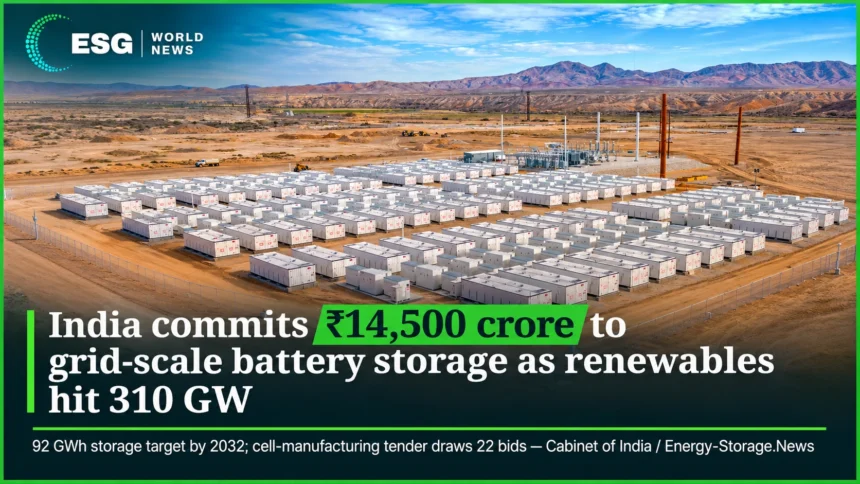
ENVIRONMENT | INDIA | ENERGY TRANSITION – India is accelerating its efforts to strengthen renewable energy storage, with two major policy developments bringing fresh momentum to the sector. The Union Cabinet has approved a ₹14,500-crore viability gap funding (VGF) scheme designed to support the development of 92 GWh of grid-scale energy storage capacity over five years. Separately, a Ministry of Heavy Industries tender for 10 GWh of advanced chemistry cell (ACC) manufacturing capacity has attracted 22 bids.
- Why India’s Battery Storage Scheme Matters Now
- ₹14,500-Crore VGF Scheme: 92 GWh Storage Target
- Battery Cell Manufacturing Tender Receives 22 Bids
- India’s Battery Storage Pipeline Is Also Expanding
- Key Numbers Behind India’s Energy Storage Push
- Why the Development Matters for India’s ESG and Energy Transition Goals
- What to Watch Next
The developments address two connected challenges facing India’s energy transition: building sufficient storage infrastructure to manage variable renewable generation and developing domestic manufacturing capacity for the batteries that will power these systems.
With India’s non-fossil power capacity crossing 310 GW, the ability to store electricity and dispatch it when demand rises is becoming increasingly important. The latest initiatives indicate a policy effort to strengthen both the infrastructure and industrial foundations required for a more reliable renewable-powered electricity system.
Why India’s Battery Storage Scheme Matters Now
India’s renewable energy capacity has expanded substantially over the past decade. Solar capacity has increased from approximately 2.8 GW to 171 GW, while wind power has grown from around 21 GW to 60 GW. The country’s total non-fossil power capacity has now crossed 310 GW.
However, renewable electricity generation varies according to weather conditions and time of day. Solar generation, for example, falls after sunset, while electricity demand can remain high or rise during evening hours. Without adequate storage and grid flexibility, this mismatch can create challenges for power system operators and limit the effective use of renewable generation.
Energy storage can help address this challenge by absorbing electricity when generation is available and releasing it when the grid needs additional supply. It can also support renewable energy integration, improve power availability and strengthen grid operations.
The Cabinet-approved VGF scheme is intended to make large-scale storage projects more financially viable and encourage investment in infrastructure that may otherwise face significant upfront costs.
₹14,500-Crore VGF Scheme: 92 GWh Storage Target
Approved on 4 November 2026, the scheme aims to facilitate the development of 92 GWh of energy storage capacity over five years. Its allocation covers three technology categories:
- 60 GWh: Pumped hydro storage (PSP).
- 30 GWh: Battery energy storage systems (BESS).
- 2 GWh: Emerging energy storage technologies.
The programme carries a total estimated project investment of approximately ₹97,600 crore, including private-sector co-investment, alongside the ₹14,500-crore government VGF support.
The scheme has several interconnected objectives:
- Increase the integration of renewable electricity into India’s power system.
- Improve the availability of electricity across different demand periods.
- Encourage domestic manufacturing and investment in energy storage.
- Reduce dependence on imported battery components.
By supporting project viability, the government aims to attract private capital into storage infrastructure while accelerating deployment across the country.
Battery Cell Manufacturing Tender Receives 22 Bids
The project-level storage initiative is being accompanied by a separate effort to expand India’s domestic battery manufacturing ecosystem.
A Ministry of Heavy Industries tender for 10 GWh of advanced chemistry cell manufacturing capacity, intended for grid-scale storage applications under the government’s production-linked incentive (PLI) framework, received 22 bids.
The response points to interest from industry participants in India’s emerging battery manufacturing market.
The distinction between the two initiatives is important. The VGF programme supports the development of energy storage projects, while the manufacturing tender focuses on expanding the supply of domestically produced battery cells.
Together, they address different parts of the same value chain. Storage projects create demand for batteries, while domestic cell manufacturing can help build the industrial capacity needed to supply those projects.
A stronger domestic supply chain could also help reduce exposure to imported components as India’s storage market expands.
India’s Battery Storage Pipeline Is Also Expanding
The latest government announcements come as activity across India’s battery energy storage sector gathers pace.
The country added approximately 8.2 GWh of battery storage capacity during the first half of calendar year 2026, according to the figures cited in industry reporting.
NTPC Green Energy has also invited global bids for lithium iron phosphate (LFP) battery containers and grid-forming power conversion systems for a proposed 10 GW/40 GWh BESS portfolio.
In a separate procurement exercise, the company has sought bids for a 250 MW/1,000 MWh battery storage project at Kayamkulam in Kerala.
Private-sector developers, including Adani Group and ACME, have also announced large-scale battery storage initiatives over the past year.
These developments suggest that the market is moving beyond smaller deployments towards projects that require greater technical capabilities, financing structures and operational reliability.
Key Numbers Behind India’s Energy Storage Push
| Indicator | Figure |
|---|---|
| Government VGF support | ₹14,500 crore |
| Targeted storage capacity | 92 GWh |
| Pumped hydro allocation | 60 GWh |
| Battery energy storage allocation | 30 GWh |
| Emerging storage technologies | 2 GWh |
| Estimated total project investment | ₹97,600 crore |
| Battery cell manufacturing tender | 10 GWh |
| Bids received for the manufacturing tender | 22 |
| India’s non-fossil power capacity | Over 310 GW |
| Solar power capacity | 171 GW |
| Wind power capacity | 60 GW |
| Battery storage capacity added in H1 2026 | Approximately 8.2 GWh |
Why the Development Matters for India’s ESG and Energy Transition Goals
India’s renewable energy expansion is increasingly shifting the policy conversation from how much clean electricity can be generated to how reliably it can be delivered.
Solar and wind capacity additions remain central to the country’s energy transition. But generation capacity alone cannot guarantee round-the-clock renewable electricity. Storage, transmission infrastructure and grid flexibility are essential to making clean power available when consumers and businesses need it.
The ₹14,500-crore VGF scheme could help mobilise private investment into infrastructure that supports this transition. At the same time, the 10 GWh cell manufacturing tender signals an effort to strengthen domestic industrial capacity.
For ESG-focused investors, developers and electricity consumers, these developments are relevant because they connect climate commitments with the infrastructure and manufacturing capabilities required to deliver them.
The long-term environmental contribution will depend on how quickly projects are commissioned, how effectively storage is integrated into the grid, and whether stored renewable electricity can displace fossil-fuel-based generation.
What to Watch Next
The next phase will be determined by execution.
The conversion of the 22 manufacturing tender bids into awarded capacity and operational manufacturing facilities will be an important indicator of progress. Equally significant will be the pace at which projects under the 92 GWh storage programme move from planning and approvals to construction and commissioning.
The technology mix will also require attention. The planned 60 GWh of pumped hydro, 30 GWh of battery storage and 2 GWh of emerging technologies will need to translate into projects that meet local grid requirements and commercial viability standards.
Developments at NTPC Green Energy’s proposed storage portfolio and Kayamkulam project will provide further indications of procurement trends, technology choices and the role of domestic manufacturing in upcoming deployments.
India has made considerable progress in renewable energy generation. The next challenge is ensuring that this electricity can be stored, managed and delivered reliably. The success of its battery storage and manufacturing initiatives could play a significant role in determining how effectively the country advances towards that objective.
ESG World News will continue tracking India’s energy storage policies, battery manufacturing investments and the infrastructure shaping the country’s clean energy transition.
Muthoot Finance Commits ₹1 Crore to School Sanitation Across India