

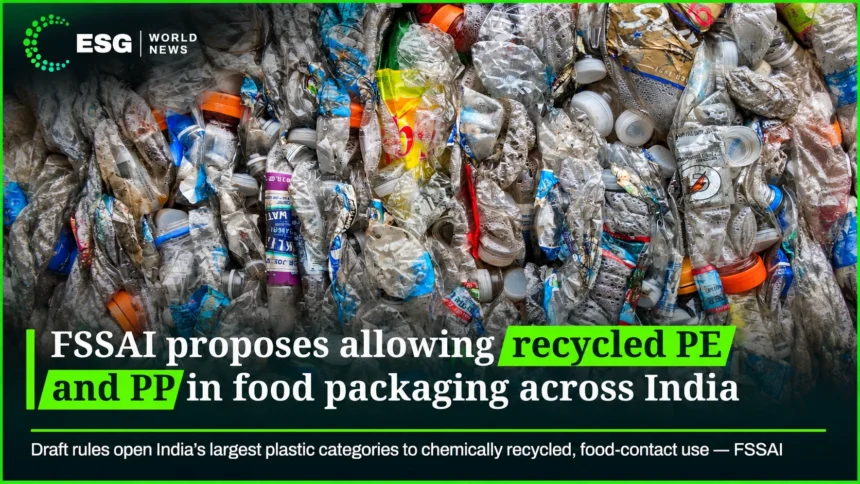
16 November 2026- ENVIRONMENT | INDIA | CIRCULAR ECONOMY – India could be preparing for a significant shift in how recycled plastic is used in food packaging. The Food Safety and Standards Authority of India (FSSAI) has proposed amendments to the Food Safety and Standards (Packaging) Regulations, 2018, that would permit the use of chemically recycled polyethylene (PE) and polypropylene (PP) in food-contact packaging, subject to specified safety requirements.
- What Does the FSSAI Draft Amendment Propose?
- Why Chemically Recycled PE and PP Matter
- How the Proposal Connects With India’s Plastic EPR Rules
- What the Proposed Rules Could Mean for India’s Recycling Industry
- Key Details of the FSSAI Draft Proposal
- Why It Matters for ESG and India’s Circular Economy
- What Happens Next?
The draft amendment, notified on 2 November 2026, marks a potential expansion of India’s existing framework for recycled plastic in food packaging. While recycled polyethylene terephthalate (PET) is already permitted for certain food-contact applications, the proposal seeks to extend the regulatory pathway to two other widely used packaging polymers.
If adopted, the changes could influence India’s food and beverage packaging industry, plastic recycling businesses and companies working towards recycled-content targets under the country’s Extended Producer Responsibility (EPR) framework.
The regulator has invited comments and suggestions over a 60-day period beginning 3 November 2026. The proposal is therefore still under consultation and has not yet become a final regulation.
What Does the FSSAI Draft Amendment Propose?
The proposed amendment would allow chemically recycled PE and PP to be used in food-contact packaging, provided the recycled material meets safety standards equivalent to those applicable to virgin plastic.
The draft also proposes a specific allowance for recycled polymers obtained exclusively from food-grade packaging materials. These materials could be used in the outermost layer of multilayer food packaging, subject to the proposed conditions.
This provision is particularly relevant to packaging formats such as multilayer pouches and wrappers, which are widely used across the food industry.
The proposed framework does not amount to unrestricted approval for all recycled plastics. It focuses on chemically recycled materials and sets safety conditions intended to control contamination risks and protect consumers.
Manufacturers, packaging companies, recyclers and other stakeholders can submit their feedback during the consultation period. The comments received will help inform the regulator’s consideration of the final provisions.
Why Chemically Recycled PE and PP Matter
Polyethylene and polypropylene are among the most widely used plastics in packaging. They are found in flexible packaging, food wrappers, pouches and several other consumer applications.
Their inclusion in food-contact applications could therefore have implications beyond the existing recycled PET market.
The distinction between mechanical and chemical recycling is important. Mechanical recycling generally processes plastic waste through physical operations such as sorting, washing and reprocessing. Depending on the waste stream and process, contaminants from previous use may remain a concern.
Chemical recycling uses processes that transform plastic materials at a chemical level. Depending on the technology, this can involve breaking polymers down into smaller molecules or feedstock that can be processed further.
The FSSAI proposal specifically refers to chemically recycled PE and PP rather than opening food packaging applications to every form of recycled material.
The intention is to establish a route through which recycled polymers can be used in food packaging while meeting the necessary safety and quality requirements.
How the Proposal Connects With India’s Plastic EPR Rules
The proposed FSSAI amendment comes as India strengthens its Extended Producer Responsibility framework for plastic packaging.
Under the Plastic Waste Management (Amendment) Rules, 2026, the regulatory framework includes category-specific recycled-content obligations for producers, importers and brand owners.
The supplied regulatory details indicate that rigid plastic packaging under Category I is subject to a recycled-content requirement of 30% in 2025–26, increasing to 60% by 2028–29.
These obligations are intended to encourage greater use of recycled materials and strengthen the market for recovered plastic.
However, food packaging presents an additional challenge because recycled materials used in contact with food must meet food-safety requirements. This can limit the range of recycled polymers that manufacturers can use in particular applications.
By proposing a pathway for chemically recycled PE and PP, FSSAI could help address part of this gap. If the amendment is finalised, food and beverage companies may have access to a wider range of recycled materials for packaging formats that rely heavily on these polymers.
The proposed change could therefore connect two regulatory priorities: increasing recycled plastic consumption and ensuring that food-contact materials meet appropriate safety standards.
What the Proposed Rules Could Mean for India’s Recycling Industry
For India’s recycling sector, the proposal could create an opportunity to move towards higher-value recycling applications.
Food-contact-grade recycled plastic requires stringent controls over material quality, processing, contamination and traceability. Companies capable of meeting these requirements may be able to serve a new segment of demand from food and beverage manufacturers.
If the rules are finalised, potential industry implications include:
- Investment in chemical recycling: Recyclers may explore additional processing capacity for PE and PP intended for food-contact applications.
- Higher-value recycled materials: Food-grade applications could create opportunities beyond conventional recycled plastic markets.
- Expanded packaging options: Food and beverage companies could gain access to additional recycled polymer categories, subject to regulatory approval.
- Stronger supply-chain traceability: Manufacturers and recyclers may need more robust systems to demonstrate material origin, processing standards and compliance.
- Support for circular-economy goals: More plastic could potentially be recovered and redirected into packaging applications rather than lower-value uses.
The scale of these opportunities will depend on the final regulatory requirements, the availability of suitable waste streams, technology costs and the ability of recyclers to consistently meet food-safety standards.
Key Details of the FSSAI Draft Proposal
| Parameter | Details |
|---|---|
| Regulator | Food Safety and Standards Authority of India |
| Draft notification date | 2 November 2026 |
| Relevant regulation | Food Safety and Standards (Packaging) Regulations, 2018 |
| Proposed materials | Chemically recycled PE and PP |
| Proposed application | Food-contact packaging, subject to conditions |
| Additional provision | Recycled polymers from food-grade packaging materials in the outermost layer of multilayer packaging |
| Consultation period | 60 days from 3 November 2026 |
| Expected comment deadline | Early January 2027 |
| Related policy framework | Plastic Waste Management and EPR rules |
Why It Matters for ESG and India’s Circular Economy
The proposed amendment highlights an important issue in India’s sustainability transition: increasing recycling rates is only one part of building a circular economy. Recovered materials also need viable markets and regulatory pathways that allow them to return to productive use.
For packaging companies, the ability to incorporate recycled content into food-contact applications could influence material sourcing, product design and sustainability strategies.
For recyclers, the proposal could encourage investment in technologies that produce higher-quality recycled polymers. For investors, it may create opportunities across chemical recycling, waste processing, material recovery and packaging supply chains.
However, environmental benefits will depend on the actual performance of the recycling technologies adopted. Energy consumption, emissions, process efficiency, feedstock quality and the ability to recover materials at scale will all matter when assessing the sustainability of chemical recycling.
The proposal also underlines the importance of credible ESG reporting. Companies should distinguish between recycled material targets, actual recycled content used, and the amount of plastic successfully recovered and processed into compliant products.
What Happens Next?
The next important milestone is the conclusion of the FSSAI consultation process.
The regulator’s 60-day window, beginning 3 November 2026, gives industry participants and other stakeholders an opportunity to submit objections, recommendations and technical feedback.
Food safety organisations may focus on contamination testing, traceability and the evidence required to demonstrate that chemically recycled materials are safe for food contact. Packaging manufacturers and recycling companies may seek clarity on eligible technologies, permitted applications and compliance procedures.
The final regulatory notification will determine the scope of permitted applications and the requirements businesses must meet.
The market response will also be worth monitoring. Investment announcements for food-contact-grade PE and PP recycling capacity could indicate whether companies are preparing to scale up in anticipation of the proposed changes.
For India, the proposal could represent an important step towards connecting plastic waste management with food packaging demand. But its success will depend on maintaining a clear balance between circularity, commercial viability and consumer safety.
ESG World News will continue tracking developments in India’s plastic waste regulations, recycling industry and circular-economy policies.
Sources
- TaxGuru — FSSAI proposes recycled PE and PP use in food packaging under draft 2026 regulations.
- ThePrint — Recycled plastic likely to find its way into food packaging as FSSAI proposes new draft safety rules.
- Sustainability Middle East & Africa — India proposes wider recycled plastic use in food packaging.
- The South First — FSSAI proposes allowing chemically recycled plastic in food packaging and sets safety conditions.