

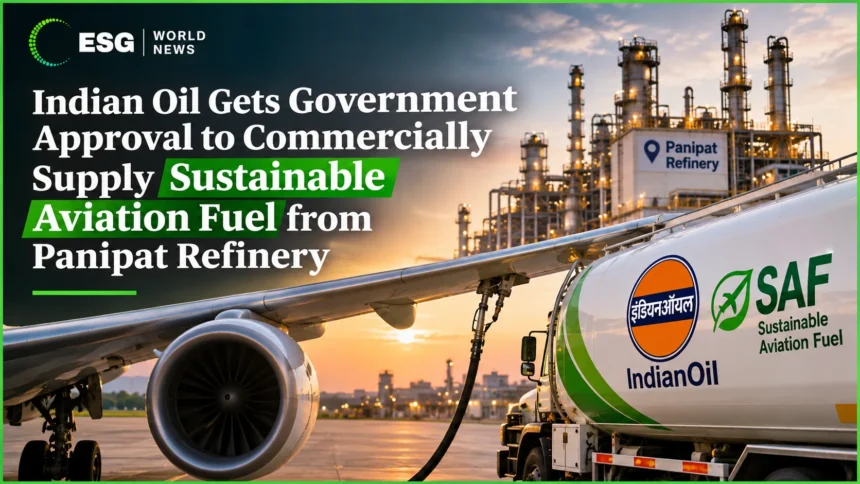
Date: 18 November 2026 | Reading time: 6 minutes – India’s efforts to reduce emissions from the aviation sector have received a significant boost, with Indian Oil Corporation (IOC) securing government and Directorate General of Civil Aviation (DGCA) approval to commercially supply Sustainable Aviation Fuel (SAF) from its Panipat refinery in Haryana.
- Why India’s Sustainable Aviation Fuel Approval Matters
- Inside Indian Oil’s Panipat SAF Production Facility
- India’s SAF Policy: Connecting Production with Blending Targets
- Key Numbers: Indian Oil’s SAF Expansion at Panipat
- What the Approval Means for India’s Aviation Industry
- Why Sustainable Aviation Fuel Matters for ESG and Climate Goals
- What to Watch Next
Confirmed on 17 November 2026, the approval clears the way for commercial supplies from what is being positioned as India’s first certified commercial domestic SAF production facility.
The development comes ahead of India’s proposed SAF blending requirement for international flights from 2027. It provides the country’s aviation industry with an important domestic supply option as regulators and fuel producers prepare for the transition towards lower-carbon aviation.
For Indian Oil, the clearance also represents progress in its broader strategy to develop alternative aviation fuels and strengthen its position in the emerging sustainable fuel market.
Why India’s Sustainable Aviation Fuel Approval Matters
Aviation remains one of the more difficult sectors to decarbonise because conventional aircraft engines continue to depend heavily on liquid fuels.
While electric and hydrogen-powered aircraft technologies are developing, their commercial application across large commercial aviation operations remains limited. Sustainable Aviation Fuel is therefore emerging as an important near-term option for reducing emissions from existing aircraft fleets.
SAF can be produced using renewable or waste-based feedstocks and is designed to be compatible with existing aviation fuel infrastructure when it meets the applicable technical and sustainability requirements.
India has been working towards introducing phased SAF blending requirements, beginning with international flights in 2027. However, achieving these targets will require reliable fuel production, certification systems, distribution infrastructure and long-term procurement arrangements.
Indian Oil’s Panipat approval provides an important domestic production milestone. It also strengthens the possibility of developing an Indian SAF supply chain rather than relying entirely on imported sustainable aviation fuel.
Inside Indian Oil’s Panipat SAF Production Facility
The approved Panipat facility uses a co-processing approach that incorporates used cooking oil into an existing refinery processing stream to produce sustainable aviation fuel.
The feedstock can be collected from hotels, restaurants and other food-service businesses, creating a potential link between waste-oil collection and the production of lower-carbon aviation fuel.
The co-processing unit has an estimated SAF production capacity of approximately 35,000 tonnes annually.
Indian Oil has also secured ISCC CORSIA certification for the fuel output. The certification is relevant to the aviation sector because it aligns with internationally recognised sustainability requirements associated with the Carbon Offsetting and Reduction Scheme for International Aviation (CORSIA).
This gives airlines and other aviation stakeholders a recognised framework for assessing the sustainability credentials of the fuel.
According to the supplied company disclosures, the refinery has already produced its first commercial batches. IOC Chairman Arvinder Singh Sahney described the development as an important validation of the co-processing route.
Panipat’s Two SAF Projects: Understanding the Difference
Indian Oil’s Panipat SAF programme includes two distinct production pathways. They should not be confused when assessing the refinery’s future capacity.
1. Used cooking oil co-processing facility
- Approximate annual SAF capacity: 35,000 tonnes.
- Feedstock: Used cooking oil.
- Status: Cleared for commercial supply.
- Role: Provides the immediate domestic production capability.
2. Alcohol-to-Jet (ATJ) facility
- Planned annual capacity: 860,000 tonnes.
- Feedstock: Ethanol.
- Target commissioning: 2027-28.
- Status: Under development, according to the supplied project information.
The planned ATJ facility is considerably larger than the currently approved co-processing unit. If delivered as scheduled, it could significantly expand Indian Oil’s ability to supply sustainable aviation fuel in the coming years.
India’s SAF Policy: Connecting Production with Blending Targets
India’s sustainable aviation fuel ambitions require coordination between fuel producers, airlines, regulators and policymakers.
The government has been working towards a broader SAF policy framework that reports describe as having three key components:
- Production support: Encouraging domestic manufacturing capacity and investment in sustainable aviation fuel.
- Blending requirements: Introducing phased SAF blending targets for the aviation sector.
- Certification and procurement: Establishing mechanisms to ensure fuel meets recognised sustainability standards and can be commercially supplied to airlines.
The proposed blending requirement for international flights from 2027 makes the development of domestic production facilities particularly important.
Without sufficient certified supply, airlines could face greater dependence on imported SAF, potentially increasing procurement costs and limiting the development of domestic manufacturing capabilities.
Indian Oil’s commercial clearance gives the policy framework an important operational reference point.
The company has reportedly invested approximately ₹1,000 crore across its Panipat SAF projects, including the approved co-processing facility and the larger ATJ project under development.
Key Numbers: Indian Oil’s SAF Expansion at Panipat
| Project metric | Details |
|---|---|
| Current co-processing SAF capacity | 35,000 tonnes per year |
| Planned ATJ SAF capacity | 860,000 tonnes per year |
| Approximate investment across Panipat SAF projects | ₹1,000 crore |
| Proposed SAF blending target | 1% |
| Proposed blending timeline | 2027 |
| Commercial supply approval | 17 November 2026 |
| Planned ATJ commissioning | 2027-28 |
The figures highlight the difference between Indian Oil’s existing commercial production capability and its longer-term expansion ambitions.
What the Approval Means for India’s Aviation Industry
The commercial clearance could have implications across India’s aviation and energy value chains.
For airlines, access to a certified domestic SAF supplier creates an additional procurement option as blending requirements approach. It may also help reduce dependence on overseas suppliers as the domestic market develops.
For fuel producers, the project demonstrates how existing refinery infrastructure can be adapted to incorporate alternative feedstocks and support lower-carbon fuel production.
For investors, the development highlights the growing role of established public-sector energy companies in India’s transition towards cleaner fuels.
The used cooking oil supply chain could also create opportunities for waste collection, processing and feedstock aggregation businesses, linking urban waste management with industrial decarbonisation.
However, the long-term impact will depend on production economics, feedstock availability, certification requirements and the pace at which SAF blending policies are implemented.
Why Sustainable Aviation Fuel Matters for ESG and Climate Goals
Aviation is widely regarded as a hard-to-abate sector because reducing emissions requires changes not only to aircraft technology but also to fuel production and supply chains.
SAF offers a pathway to lower lifecycle emissions compared with conventional aviation fuel, subject to the feedstock, production pathway and applicable sustainability accounting methodology.
Indian Oil’s Panipat development is significant because it brings together waste-based feedstock, existing refinery infrastructure and internationally recognised certification.
It also illustrates how traditional energy companies can participate in the energy transition by adapting existing assets and developing alternative fuel technologies.
For India’s climate and industrial strategy, the next challenge will be moving beyond pilot-scale and early commercial production towards dependable supply volumes that can support the aviation sector over the long term.
What to Watch Next
Several developments will determine how quickly India’s SAF industry scales:
1. Used cooking oil availability: Whether Indian Oil can establish a consistent feedstock collection network to support production at Panipat.
2. ATJ project progress: Whether the planned 860,000-tonne-per-year alcohol-to-jet facility meets its 2027-28 commissioning target.
3. SAF blending policy: How the proposed 2027 blending requirement is implemented and whether future targets increase progressively.
4. Airline procurement: Whether domestic and international airlines operating in India enter into long-term agreements with certified SAF suppliers.
5. Industry participation: Whether other major refiners, including BPCL, HPCL and Reliance, expand their sustainable aviation fuel programmes.
Indian Oil’s Panipat approval marks an important step in turning India’s sustainable aviation ambitions into commercial activity. The next phase will depend on scaling production, securing feedstock and building a reliable market for lower-carbon aviation fuels.
SEBI BRSR Core Rules Expand to India’s Top 1,000 Listed Companies in FY2026-27