

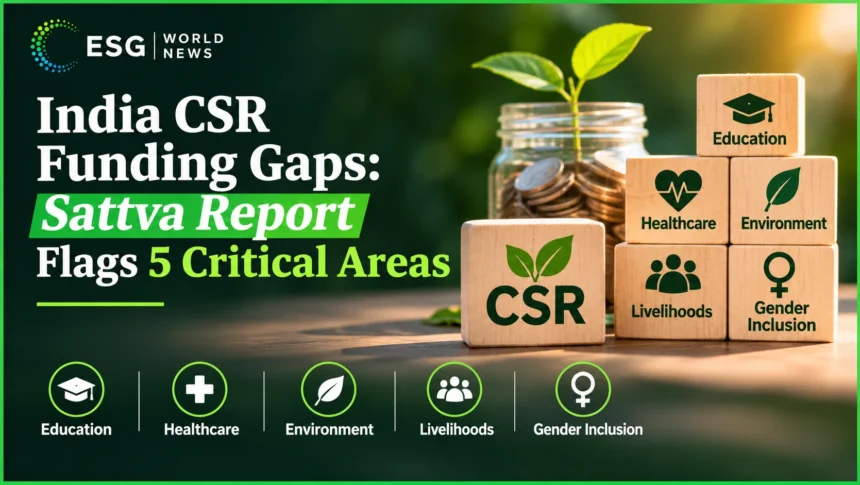
19th, Novenber, 2026 – India’s corporate social responsibility (CSR) spending has reached ₹40,794 crore in FY2024-25, reflecting significant growth in corporate participation in social development. However, a new report by Sattva Consulting suggests that the distribution of this funding does not always match the country’s most pressing developmental challenges.
- India’s CSR Spending Has Grown, but Funding Priorities Need to Evolve
- Five Critical Gaps in India’s CSR Funding Priorities
- 1. Non-Communicable Diseases: Cardiovascular Health Receives Less Funding
- 2. Graduate Employability: The Missing Link Between Education and Jobs
- 3. Women’s Economic Participation: Moving Beyond Skilling Programmes
- 4. Groundwater Conservation: Funding Does Not Match Regional Water Stress
- 5. Research and Innovation: A Small Share of CSR Capital
- Key Statistics from the Sattva CSR Report 2026
- Why India’s CSR Funding Gaps Matter for ESG and Corporate Strategy
- The Way Forward: Making CSR More Catalytic
- What to Watch Next
The eighth annual report, titled Catalytic CSR: Where Focused Capital Can Move India’s Developmental Needle, released on 19 November 2026, examines how corporate CSR funding compares with measurable social and economic needs across India.
The findings identify five areas where funding allocation and development priorities remain misaligned: non-communicable diseases, graduate employability, women’s economic participation, groundwater resilience, and research and innovation.
The report argues that India’s next phase of CSR development should focus not only on increasing expenditure but also on directing capital towards areas where it can generate meaningful and measurable outcomes.
India’s CSR Spending Has Grown, but Funding Priorities Need to Evolve
Since the introduction of mandatory CSR requirements for qualifying companies in 2014, corporate contributions have become an important source of funding for India’s social development ecosystem.
According to Sattva Consulting, CSR spending reached ₹40,794 crore in FY2024-25 and has grown at an estimated compound annual growth rate of approximately 15% over the past decade.
However, the report highlights a fundamental challenge: funding often flows towards established programmes that are relatively straightforward to implement, monitor and report.
Sattva’s analysis compares corporate CSR allocations with external indicators covering disease prevalence, employment, groundwater conditions and national research investment.
The objective is to identify whether corporate funding is reaching the areas where the gap between existing needs and available resources is greatest.
Srikrishna Sridhar Murthy, co-founder and CEO of Sattva Consulting, summarised the next phase of CSR development with the observation that CSR has brought scale and predictability to funding, but now needs greater agility.
Five Critical Gaps in India’s CSR Funding Priorities
The Sattva Consulting CSR report identifies five development areas where targeted corporate investment could make a greater contribution.
1. Non-Communicable Diseases: Cardiovascular Health Receives Less Funding
Non-communicable diseases (NCDs) account for approximately 60% of deaths in India, compared with 45% during 2004-06, according to the figures cited in the report.
Despite the growing disease burden, CSR funding directed towards NCDs remains unevenly distributed.
Cancer accounts for approximately 62% of identifiable NCD-related CSR funding, while cardiovascular diseases receive just 12%.
The report highlights this imbalance as an opportunity for companies and philanthropic institutions to broaden their healthcare funding priorities.
Greater investment in cardiovascular health, prevention, early diagnosis and long-term disease management could help address an important gap in India’s healthcare response.
2. Graduate Employability: The Missing Link Between Education and Jobs
India’s graduate unemployment rate stands at 25.9%, compared with 8.8% among individuals with higher-secondary education, according to the report’s cited employment data.
The findings highlight a significant challenge in converting educational qualifications into employment opportunities.
For every rupee of CSR funding directed towards academic and skilling support, only 24 paise is allocated to work exposure and placement-related interventions.
This suggests that investment in education and training is not always matched by sufficient support for the transition into employment.
The report points towards greater attention to internships, industry exposure, workplace readiness, career guidance and placement support as important areas for CSR investment.
3. Women’s Economic Participation: Moving Beyond Skilling Programmes
Women’s economic participation is another area where CSR funding could address broader structural challenges.
The report identifies ₹1,122.8 crore, representing 29% of relevant identifiable CSR funding, directed towards this theme.
However, approximately 77% of this funding is concentrated in skilling and livelihood programmes.
While these initiatives remain important, the report highlights the need to address wider barriers that affect women’s participation in the workforce.
These include access to employment opportunities, workplace conditions, mobility, care responsibilities and institutional support.
The report also references India’s position of 144th among 148 economies on the World Economic Forum’s economic-participation sub-index, underscoring the wider challenge.
4. Groundwater Conservation: Funding Does Not Match Regional Water Stress
Groundwater resilience is one of the most significant environmental gaps highlighted by the report.
Punjab, Rajasthan and Haryana together account for nearly 49% of India’s critical or over-exploited groundwater assessment units. Yet these states receive only around 7% of identifiable groundwater-focused CSR funding.
The report also identifies an imbalance in the type of interventions receiving financial support.
Approximately 95% of groundwater-focused CSR funding is directed towards recharge projects, while only 5% supports demand management and water-quality interventions.
This distribution raises questions about whether current programmes sufficiently address the underlying causes of groundwater depletion.
The findings point to the need for more comprehensive investment in water-use efficiency, sustainable agricultural practices, groundwater governance and water-quality management.
5. Research and Innovation: A Small Share of CSR Capital
Research and innovation represent another area where corporate funding remains limited.
Sattva’s analysis estimates that CSR spending on innovation and research totalled approximately ₹298 crore between FY2022-23 and FY2024-25.
No individual industry allocated more than 1.2% of its CSR expenditure to this category.
The report places this finding against India’s broader research and development investment, estimated at 0.84% of GDP, compared with the 2.5%-5% range cited for leading innovation economies.
Greater corporate participation in research, technology development and innovation could help support long-term economic competitiveness and address complex development challenges.
Key Statistics from the Sattva CSR Report 2026
| Indicator | Report finding |
|---|---|
| India’s CSR spending in FY2024-25 | ₹40,794 crore |
| Estimated CSR spending growth over the decade | 15% CAGR |
| Share of deaths attributed to NCDs | 60% |
| Graduate unemployment rate | 25.9% |
| Higher-secondary unemployment rate | 8.8% |
| Share of groundwater stress units in Punjab, Rajasthan and Haryana | 49% |
| Share of groundwater CSR funding received by these states | 7% |
| CSR funding for research and innovation, FY2022-23 to FY2024-25 | ₹298 crore |
| Maximum industry allocation to research and innovation | 1.2% |
Why India’s CSR Funding Gaps Matter for ESG and Corporate Strategy
The findings have implications for corporate foundations, CSR leaders, sustainability teams, policymakers and impact investors.
For businesses, the report provides a framework for reviewing whether CSR budgets are addressing the most significant development challenges or primarily supporting established programme categories.
For example, expanding healthcare initiatives beyond cancer-focused interventions, connecting vocational training with actual employment opportunities, and supporting groundwater demand management could help address gaps identified by the research.
The findings also raise questions about how CSR impact is measured.
Projects that deliver easily quantifiable outputs may be more straightforward to communicate and report. However, some complex development challenges require longer-term interventions, collaboration across institutions and outcome-based assessment.
For India’s ESG ecosystem, this distinction is important. The amount of money allocated to CSR is only one measure of corporate contribution. The effectiveness, geographical distribution and long-term outcomes of that investment are equally relevant.
The Way Forward: Making CSR More Catalytic
The Sattva report highlights an opportunity for India’s corporate sector to move towards more strategic and evidence-led CSR allocation.
Companies could consider reviewing their existing portfolios against regional development indicators, identifying underserved areas and supporting programmes that address structural challenges rather than isolated symptoms.
Potential priorities include stronger cardiovascular healthcare programmes, employment-linked skilling, interventions supporting women’s workforce participation, integrated groundwater management and greater investment in research and innovation.
Collaboration between companies, government institutions, civil society organisations and research bodies will also be important in addressing challenges that cannot be solved through individual projects.
What to Watch Next
An important measure of the report’s influence will be whether corporate foundations begin incorporating these five funding gaps into their future CSR strategies.
The next reporting cycle could reveal whether companies are diversifying their allocations, increasing support for underserved development priorities and adopting stronger outcome-based evaluation frameworks.
For India, the challenge is no longer simply mobilising larger amounts of CSR funding. It is ensuring that this capital reaches the development challenges where it can make a meaningful difference.
As India’s CSR spending continues to expand, the next phase will be defined by how effectively corporate capital translates into measurable social, economic and environmental progress.
India Bans Battery Black Mass Exports to Boost Domestic Critical Minerals Recycling