

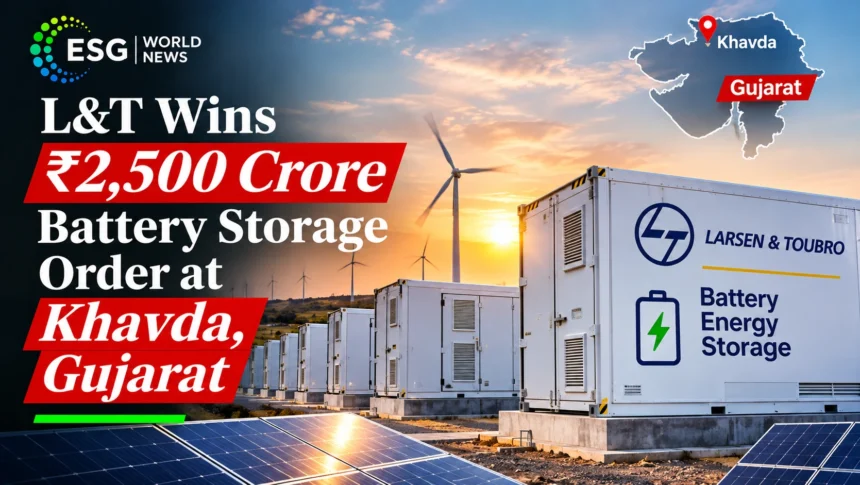
ESG World News Desk – Larsen & Toubro (L&T) has secured an order valued between ₹1,000 crore and ₹2,500 crore for the development of a 300 MW/900 MWh Battery Energy Storage System (BESS) at the Khavda Renewable Energy Park in Gujarat’s Kutch district.
- L&T to Combine Renewables and Electronic Products Businesses for Project Execution
- Why Battery Storage Is Important for Khavda’s Renewable Energy Development
- Liquid-Cooled Battery Technology: What Makes It Significant?
- India’s Battery Energy Storage Market Gains Momentum
- Key Project Details: L&T’s Khavda Battery Storage Order
- Why the Khavda BESS Project Matters for India’s Energy Transition
- What to Watch Before Commissioning in 2027
- Conclusion
The project will be jointly executed by L&T’s Renewables business and its Electronic Products & Systems division (LTEPS). The installation is scheduled to be commissioned by December 7, 2027.
The proposed system will use liquid-cooled battery technology and have a storage duration of three hours. It is designed to store surplus renewable electricity during periods of high generation and release power when demand increases, particularly during evening and night-time peak periods.
The project adds to the growing role of large-scale battery storage in India’s renewable energy infrastructure, as the country works to balance variable solar and wind generation with electricity demand.
L&T to Combine Renewables and Electronic Products Businesses for Project Execution
The Khavda battery storage order brings together two L&T business verticals: its Renewables business and L&T Electronic Products & Systems.
Their combined involvement will support the execution of the utility-scale storage installation, which is planned within the Khavda Renewable Energy Park.
The project has a power capacity of 300 MW and an energy storage capacity of 900 MWh. This translates into a three-hour discharge duration at its rated power capacity.
The system will use liquid-cooled battery technology, which L&T identifies as offering advantages such as higher power density, improved safety margins and longer operating life compared with air-cooled alternatives.
The project is expected to play a role in managing renewable electricity generation and supporting grid operations as more variable renewable capacity comes online.
Why Battery Storage Is Important for Khavda’s Renewable Energy Development
The Khavda Renewable Energy Park, located in Gujarat’s Kutch district, is part of India’s major solar and wind energy development landscape.
However, renewable electricity generation does not always coincide with the periods when consumers need power.
Solar generation is generally strongest during daylight hours, while electricity demand can rise during the evening. Without sufficient storage, surplus renewable electricity may be difficult to use when it is generated, while additional power sources may be needed when solar output declines.
A battery energy storage system can help address this timing gap.
The proposed 300 MW/900 MWh installation is designed to:
- Store surplus renewable electricity during periods of high generation.
- Discharge stored power during evening and night-time demand peaks.
- Support the integration of solar and wind energy into the electricity grid.
- Provide grid operators with additional flexibility in managing electricity supply and demand.
Locating storage within a renewable energy park also creates an opportunity to manage generation and storage infrastructure within the same broader energy development area.
Liquid-Cooled Battery Technology: What Makes It Significant?
Battery temperature management is an important consideration for large-scale energy storage installations.
Battery cells generate heat during charging and discharging. If temperatures are not managed effectively, performance, degradation rates and operational safety can be affected.
Liquid-cooled battery systems use circulating coolant to manage heat within battery racks and maintain more consistent operating temperatures.
Compared with conventional air-cooling arrangements, liquid cooling can offer several potential advantages:
Improved thermal management: Circulating coolant helps regulate temperatures across battery modules.
Higher power density: More compact battery arrangements can support higher storage capacity within a given footprint.
Operational performance: Consistent temperature management can help support battery performance and longevity.
Safety considerations: Thermal management is an important part of managing operational risks in large battery installations.
For a project with 900 MWh of storage capacity, these considerations are particularly relevant to system design, operational efficiency and long-term performance.
L&T has identified liquid cooling as a feature of the Khavda installation, reflecting the increasing importance of advanced thermal-management systems in utility-scale battery storage.
India’s Battery Energy Storage Market Gains Momentum
The L&T order comes amid growing interest in energy storage across India.
As renewable energy capacity expands, grid planners and developers are increasingly examining different storage technologies to manage fluctuations in electricity generation.
Battery energy storage systems and pumped-storage hydropower are two important approaches in this evolving market.
Battery systems can respond to changes in electricity supply and demand by charging and discharging stored energy. Pumped-storage projects use water reservoirs at different elevations to store energy and generate electricity when required.
Recent developments, including SJVN’s allocation of 2,000 MW of pumped-storage projects, highlight the growing attention being given to storage infrastructure.
For engineering, procurement and construction companies such as L&T, the expansion of the storage market creates opportunities to participate in the development of large-scale energy infrastructure.
Key Project Details: L&T’s Khavda Battery Storage Order
| Project parameter | Details |
|---|---|
| Company | Larsen & Toubro |
| Project location | Khavda Renewable Energy Park, Kutch, Gujarat |
| Project type | Battery Energy Storage System |
| Power capacity | 300 MW |
| Energy storage capacity | 900 MWh |
| Storage duration | 3 hours |
| Order value | ₹1,000 crore–₹2,500 crore |
| Technology | Liquid-cooled battery system |
| Executing businesses | L&T Renewables and L&T Electronic Products & Systems |
| Scheduled commissioning | December 7, 2027 |
Why the Khavda BESS Project Matters for India’s Energy Transition
The project represents another development in India’s efforts to build storage capacity alongside renewable electricity generation.
For grid operators, battery storage can help manage the mismatch between renewable generation patterns and electricity demand. The ability to store surplus solar power and release it later can improve the flexibility of electricity systems with growing renewable energy contributions.
For the renewable energy sector, large-scale storage installations can support the development of projects that combine generation and energy management infrastructure.
For L&T, the order expands its participation in India’s emerging battery storage market and brings together its renewable energy and electronic systems capabilities in a single utility-scale project.
The project also reinforces Gujarat’s role in India’s renewable energy development, with Khavda emerging as an important location for large-scale clean energy infrastructure.
What to Watch Before Commissioning in 2027
The next major milestone will be the execution and commissioning of the 300 MW/900 MWh installation by the scheduled date of December 7, 2027.
Other developments worth following include the project’s battery-cell supplier, manufacturing origin and detailed technology configuration. These details will be relevant to understanding the project’s supply chain and technology choices, particularly as India seeks to strengthen domestic battery manufacturing and critical-mineral capabilities.
The project’s commissioning and operating performance will also provide a clearer picture of how large-scale battery storage can support renewable energy integration at major generation hubs.
Conclusion
L&T’s order for a 300 MW/900 MWh battery energy storage system at Khavda marks another step in the expansion of India’s grid-scale energy storage infrastructure.
With an order value of up to ₹2,500 crore, liquid-cooled battery technology and a scheduled commissioning date in December 2027, the project is expected to support the management of renewable electricity generated in Gujarat’s major energy development zone.
As India’s solar and wind capacity grows, projects such as Khavda will be important to the broader effort to make renewable electricity more flexible, reliable and available when demand is highest.
About ESG World News
ESG World News covers developments in renewable energy, climate action, sustainability, environmental policy, corporate governance and the global energy transition.
Sources:
- Business Standard – L&T Wins Order Worth Up to ₹2,500 Crore for Battery Storage Project in Gujarat
- SolarQuarter – L&T Secures 300 MW/900 MWh Battery Storage Project in Gujarat
- Shanghai Metals Market – L&T Jointly Wins 300 MW/900 MWh BESS Project in Khavda
- Power Peak Digest – L&T Wins 900 MWh BESS Order at Khavda
Project specifications, order value and timeline are based on the supplied source material. The final project performance will depend on execution and commissioning.
SBI Foundation Launches ₹10 Crore CSR Projects in Andaman & Nicobar