

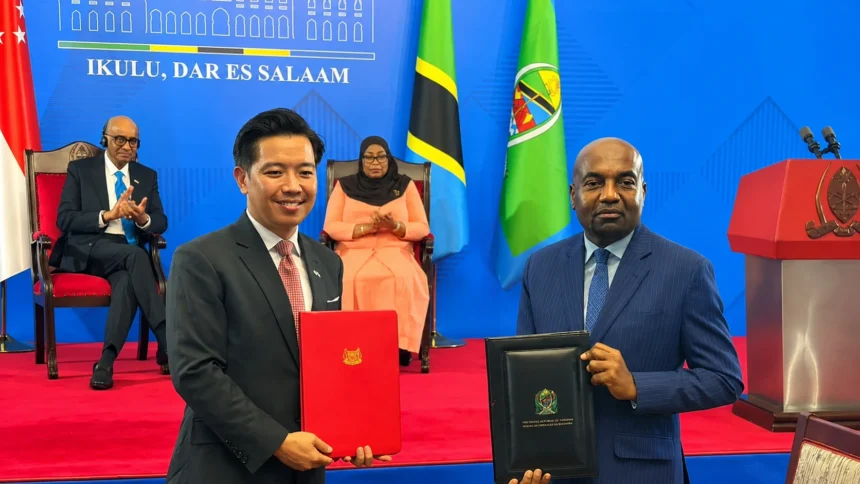
Singapore and Tanzania have signed a Memorandum of Understanding (MoU) to explore collaboration on carbon credits under Article 6 of the Paris Agreement, marking another step in Singapore’s strategy to expand international carbon market partnerships and accelerate global climate action.
- Strengthening International Carbon Market Cooperation
- What Article 6 of the Paris Agreement Means
- Path Toward a Legally Binding Carbon Credit Agreement
- Supporting Climate Finance and Green Growth
- Singapore Expands Global Carbon Market Leadership
- Tanzania’s Potential in Carbon Credit Development
- Growing Momentum for Carbon Markets
- Outlook
The agreement was signed during the official state visit of Singapore President Tharman Shanmugaratnam to Tanzania and is expected to pave the way for future carbon credit transactions that support emissions reductions and sustainable development initiatives in both countries.
The signing ceremony was witnessed by President Tharman Shanmugaratnam and Tanzanian President Samia Suluhu Hassan, highlighting the growing importance of international cooperation in achieving climate goals.
Strengthening International Carbon Market Cooperation
The Memorandum of Understanding was signed by:
- Alvin Tan, Singapore’s Minister of State for Trade and Industry and National Development
- Hamad Yussuf Masauni, Tanzania’s Minister of State for Union Affairs and Environment
Under the agreement, Singapore and Tanzania will explore opportunities to cooperate on carbon markets through mechanisms established under Article 6 of the Paris Agreement.
The partnership aims to facilitate investment in climate-related projects while creating pathways for the generation and transfer of high-quality carbon credits.
By leveraging carbon market mechanisms, both countries hope to unlock additional financing for emissions reduction projects, environmental conservation initiatives, and sustainable development programs.
What Article 6 of the Paris Agreement Means
Article 6 of the Paris Agreement provides a framework that allows countries to cooperate in achieving their climate targets through the international transfer of carbon credits and emissions reductions.
The mechanism enables:
- Cross-border carbon credit trading
- Climate finance mobilization
- Emissions reduction project development
- Support for national climate commitments
- Greater efficiency in achieving global climate goals
Many governments view Article 6 as a critical tool for scaling climate action while directing investment toward developing economies with significant emissions reduction opportunities.
Path Toward a Legally Binding Carbon Credit Agreement
Following the MoU, Singapore and Tanzania will begin discussions to establish a legally binding implementation agreement that would enable the approval, issuance, and international trading of carbon credits under Article 6.
As part of the framework, both countries plan to:
- Identify eligible climate projects
- Ensure alignment with Nationally Determined Contributions (NDCs)
- Verify environmental integrity
- Promote transparency and accountability
- Support sustainable economic development
The future agreement will seek to ensure that carbon credit projects generate measurable climate benefits while contributing to local communities and broader development goals.
Supporting Climate Finance and Green Growth
According to Singapore’s Minister of State Alvin Tan, the partnership reflects both nations’ commitment to building transparent, credible, and effective carbon markets.
He noted that international cooperation on carbon markets can help attract investment into emissions reduction initiatives while creating new opportunities within the emerging green economy.
Experts increasingly view carbon markets as an important mechanism for directing private capital toward climate mitigation projects, particularly in developing countries where financing gaps often limit project deployment.
Singapore Expands Global Carbon Market Leadership
The Tanzania agreement forms part of Singapore’s broader effort to strengthen its position as a regional hub for carbon services and climate finance.
The announcement follows Singapore’s recent commitment of US$15 million (approximately S$19.2 million) to the Global Green Growth Institute’s Carbon Transaction Facility, an initiative focused on supporting the development of Article 6 carbon markets worldwide.
The facility aims to:
- Strengthen international carbon trading systems
- Support project development
- Build institutional capacity
- Enhance market transparency
- Facilitate cross-border carbon transactions
With its contribution, Singapore became the first Asian nation to join the facility, alongside countries including:
- United Kingdom
- New Zealand
- Norway
- Sweden
The move reinforces Singapore’s growing role in shaping the future of global carbon markets and climate finance.
Tanzania’s Potential in Carbon Credit Development
Tanzania possesses significant potential for carbon credit generation through projects focused on:
- Forest conservation
- Renewable energy deployment
- Sustainable land management
- Biodiversity protection
- Climate-smart agriculture
International partnerships such as this can help attract investment into these sectors while supporting Tanzania’s long-term climate and development objectives.
By leveraging carbon finance mechanisms, the country can access additional resources to fund environmental projects while contributing to global emissions reduction efforts.
Growing Momentum for Carbon Markets
As countries work toward achieving net-zero emissions and meeting their Paris Agreement commitments, carbon markets are becoming an increasingly important component of global climate strategies.
Well-designed Article 6 partnerships can help:
- Accelerate climate action
- Increase climate finance flows
- Improve project viability
- Promote sustainable development
- Encourage private sector participation
The Singapore-Tanzania agreement reflects a broader global trend of governments seeking collaborative approaches to address climate change while creating economic opportunities through carbon market development.
Outlook
The signing of the Memorandum of Understanding marks the beginning of a potentially significant partnership in the international carbon market landscape.
As Singapore and Tanzania move toward a formal implementation agreement, the collaboration could serve as a model for future Article 6 partnerships that combine climate action, sustainable development, and economic growth.
With global demand for high-integrity carbon credits expected to increase in the coming years, strategic partnerships like this are likely to play a crucial role in scaling climate finance and supporting the transition to a low-carbon economy.