

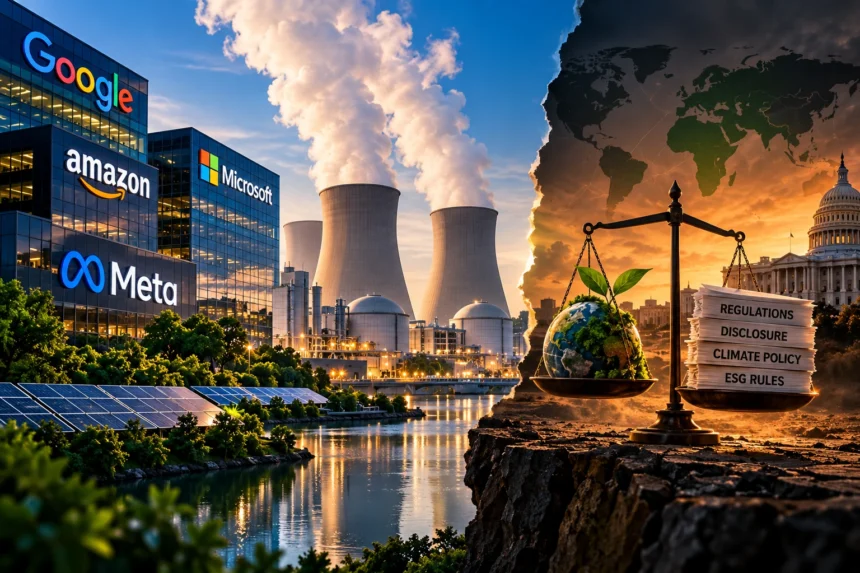
Wednesday, 28 October 2026 – Amazon and Google are expanding their nuclear energy strategies to meet rising electricity demand, while changes to climate disclosure rules highlight an increasingly fragmented global approach to sustainability regulation.
- Big Tech Turns to Nuclear Energy to Power AI Growth
- Governments Reassess Nuclear Power and Energy Security
- Climate Disclosure Rules Take a Different Direction
- Corporate Sustainability Investment May Continue Despite Regulatory Changes
- Carbon Removal Remains Part of the Corporate Climate Toolkit
- Five Key Figures Shaping the ESG Debate
- What Businesses and ESG Investors Should Watch Next
- 1. The direction of climate disclosure regulation
- 2. The relationship between AI growth and energy investment
- 3. The quality of corporate climate claims
- The Bigger Picture: Capital and Regulation Are Moving at Different Speeds
The global energy transition is entering a complicated new phase. Technology companies are committing capital to low-carbon electricity, governments are reconsidering how nuclear power fits into their energy strategies, and regulators are taking different approaches to corporate climate reporting.
Two developments illustrate this divide. Major technology companies are pursuing nuclear energy to support the growing electricity requirements of artificial intelligence (AI) and data centres. At the same time, changes to climate disclosure policies in some markets are raising questions about the future of mandatory corporate sustainability reporting.
For businesses, investors and sustainability professionals, the emerging challenge is understanding how these trends interact. Corporate investment in the energy transition may continue to grow even when regulatory requirements change, but inconsistent reporting standards could make it harder to compare progress across companies and markets.
Big Tech Turns to Nuclear Energy to Power AI Growth
The rapid expansion of AI infrastructure is increasing pressure on technology companies to secure dependable electricity supplies. Data centres require substantial amounts of power, and their demand can continue around the clock, making reliable low-carbon generation an increasingly important consideration.
Against this backdrop, Amazon and Google are strengthening their interest in nuclear energy. According to the figures in the supplied reporting, the companies contracted more than one gigawatt of additional nuclear capacity within a ten-day period.
The reported commitments illustrate how electricity procurement is becoming a strategic priority for technology businesses. Instead of treating energy primarily as an operating expense, companies are increasingly considering access to dependable power as a factor in their long-term competitiveness.
Nuclear energy offers several potential advantages. Unlike wind and solar generation, which depend on weather conditions, nuclear plants can provide electricity continuously, subject to operational and maintenance requirements. This makes nuclear power an attractive option for companies seeking to balance decarbonisation objectives with the reliability needs of large digital infrastructure operations.
However, nuclear projects also face challenges, including lengthy development timelines, high capital requirements, regulatory approvals and questions about long-term waste management. Existing reactors, plant upgrades and advanced reactor technologies therefore represent different pathways, each with its own investment and implementation risks.
Why Nuclear Power Matters for Data Centres
The expansion of AI workloads is changing how companies evaluate their energy strategies.
Three considerations are becoming particularly important:
- Reliable electricity: AI training and inference infrastructure requires dependable power, increasing interest in generation sources that can operate continuously.
- Carbon reduction: Nuclear power can provide low-carbon electricity during operation, potentially supporting corporate emissions-reduction goals.
- Energy security: Long-term power arrangements can help businesses manage exposure to electricity shortages, price volatility and grid constraints.
The significance extends beyond technology companies. Their energy procurement decisions could influence investment in generation capacity, transmission infrastructure, storage and emerging energy technologies.
Governments Reassess Nuclear Power and Energy Security
The renewed interest in nuclear energy also reflects a wider policy shift. Governments are increasingly considering how to combine reliable electricity supply, industrial competitiveness and emissions reduction.
The supplied draft cites a reported US federal commitment of $4.2 billion towards reactor upgrades. If implemented as described, such investment would reinforce the role of existing nuclear infrastructure in meeting future electricity demand.
Upgrading existing reactors can be important because extending the operating life of established facilities may help preserve low-carbon generation capacity. Nevertheless, the economic case depends on project costs, safety requirements, licensing decisions and the condition of individual plants.
South Korea’s reported $747 billion K-GX energy transition plan through 2035 points to another dimension of the transition: the scale of investment required to reshape national energy systems. The programme’s precise scope and funding commitments should be confirmed against official government documentation before the figures are treated as established facts.
Elsewhere, green financing instruments are being used to channel capital towards sustainability-related projects. The supplied material also cites HK$20 billion in digital green bonds in Hong Kong, highlighting the potential role of financial innovation in supporting environmental investment.
These developments demonstrate why energy transition analysis must look beyond renewable energy capacity alone. Nuclear generation, grid infrastructure, energy efficiency, sustainable finance and emerging technologies can all influence the pace and cost of decarbonisation.
Climate Disclosure Rules Take a Different Direction
While businesses are making long-term energy decisions, the regulatory landscape for sustainability reporting remains in flux.
The United Kingdom’s Financial Conduct Authority (FCA) is described in the supplied reporting as having dropped mandatory climate disclosure requirements for listed companies. This specific regulatory claim requires confirmation against the FCA’s official announcements and applicable rules before publication.
The broader policy debate, however, is significant. Regulators are weighing the benefits of comparable climate information against concerns about reporting costs, implementation complexity and the burden placed on businesses.
Climate disclosure frameworks are intended to help investors assess how companies manage climate-related risks and opportunities. Depending on the applicable rules, reporting may cover greenhouse gas emissions, transition plans, exposure to physical climate risks and the financial implications of changing energy systems.
Changes to mandatory reporting requirements can affect both companies and investors. Businesses may gain flexibility in how they communicate sustainability performance, while investors could face greater difficulty comparing organisations if reporting practices become less consistent.
A Fragmented Global ESG Regulatory Landscape
The international picture is not uniform. Different jurisdictions are reviewing, implementing or developing their own approaches to corporate sustainability reporting.
The European Union continues to shape its sustainability reporting framework, including changes and implementation questions surrounding the Corporate Sustainability Reporting Directive (CSRD). New Zealand has also considered how its climate reporting requirements align with international standards, while Japan has continued developing its sustainable finance and transition policy framework.
The details and status of individual measures can change, so companies operating across borders need to monitor the rules applicable to each jurisdiction.
For multinational businesses, the practical challenge is managing multiple reporting expectations without losing consistency in internal data collection and governance.
A company could face different requirements depending on where it is listed, where it operates and which reporting obligations apply to its business. That complexity can increase compliance costs and create uncertainty for investors seeking comparable information.
Corporate Sustainability Investment May Continue Despite Regulatory Changes
A central question is whether weaker or less consistent disclosure requirements will slow corporate climate action.
The answer is not necessarily straightforward.
Companies invest in decarbonisation for reasons beyond regulatory compliance. Energy costs, supply security, customer expectations, access to capital, operational resilience and long-term competitiveness can all influence investment decisions.
For technology companies, securing electricity for AI infrastructure is an immediate business concern. For manufacturers, energy efficiency and dependable power can influence production costs. For financial institutions, climate-related risks can affect lending decisions, insurance exposure and portfolio management.
The supplied draft states that 78% of companies increased sustainability investment in 2026. That statistic should be published only after its original survey, sample size, geographical coverage and methodology have been verified.
Even without relying on a single headline figure, the underlying commercial drivers remain important. A business may continue investing in energy efficiency, low-carbon electricity or industrial modernisation because the projects support its operations and long-term financial performance.
However, investment announcements alone do not establish environmental impact. The amount of capital committed, the capacity contracted, the emissions avoided and the projects actually delivered are different measures and should not be treated as interchangeable.
Carbon Removal Remains Part of the Corporate Climate Toolkit
Alongside energy procurement, companies continue to explore ways to remove carbon dioxide from the atmosphere.
The supplied material references a reported Google arrangement with Working Trees involving the removal of 270,000 tonnes of CO₂ through a silvopasture project in Brazil. The specific agreement, its delivery timeline and the basis for the stated removal volume should be checked against the parties’ original announcements.
Silvopasture integrates trees with livestock and pasture management. Depending on how a project is designed and monitored, it can contribute to carbon storage while supporting soil health, biodiversity and land management.
Nevertheless, carbon removal projects require careful evaluation. Buyers and investors need to understand how carbon benefits are measured, how long the carbon is expected to remain stored, whether the claimed impact is additional, and how risks such as fire, land-use change or measurement uncertainty are addressed.
Carbon removal should also be distinguished from reducing emissions at their source. For companies pursuing credible climate strategies, direct emissions reductions and clean energy procurement remain important, while removals may play a complementary role.
Five Key Figures Shaping the ESG Debate
The figures highlighted in the supplied reporting illustrate the range of issues influencing sustainability investment and policy.
- More than 1 GW: Reported nuclear capacity contracted by Amazon and Google over ten days.
- $4.2 billion: Reported US federal commitment towards reactor upgrades.
- $747 billion: Reported scale of South Korea’s K-GX energy transition plan through 2035.
- 270,000 tonnes of CO₂: Reported removal volume associated with Google’s Brazil silvopasture arrangement.
- 78%: Reported share of companies that increased sustainability investment in 2026.
These figures cover different types of commitments and outcomes. Nuclear capacity is measured in power-generation terms, financial commitments describe capital allocation, and carbon removal is an environmental outcome that depends on measurement and verification. They should therefore be assessed individually rather than combined into a single measure of progress.
What Businesses and ESG Investors Should Watch Next
Three developments could shape the next phase of the global sustainability transition.
1. The direction of climate disclosure regulation
Businesses should monitor changes to reporting requirements in major markets, particularly where regulatory revisions could affect compliance obligations or investor access to comparable climate information.
Companies with international operations may need reporting systems that can accommodate multiple frameworks without duplicating data collection unnecessarily.
2. The relationship between AI growth and energy investment
As AI infrastructure expands, technology companies are likely to continue evaluating a combination of nuclear energy, renewables, storage, grid agreements and efficiency measures.
The important question will be whether new capacity is delivered on time, at an acceptable cost and with credible environmental benefits.
3. The quality of corporate climate claims
Investors and sustainability teams will need to distinguish between announced investments, signed contracts, operational projects and verified emissions reductions.
This distinction matters for nuclear procurement, renewable energy agreements, carbon removal projects and transition finance alike.
Sustainable aviation fuel is another area worth monitoring. The supplied draft cites a forecast that the global SAF market could reach $84.5 billion by 2035, with a projected compound annual growth rate of 35.2% from 2026. Because market estimates depend on definitions, assumptions and policy scenarios, this forecast should be checked against its original research before publication.
The Bigger Picture: Capital and Regulation Are Moving at Different Speeds
The emerging ESG landscape is not simply a story of climate ambition increasing or declining. It is a story of different forces moving at different speeds.
Technology companies are responding to immediate energy needs, governments are reassessing infrastructure priorities, financial markets are developing sustainability-related instruments, and regulators are adjusting disclosure frameworks.
These developments can reinforce one another, but they can also move in opposite directions.
Corporate investment in nuclear power may strengthen access to low-carbon electricity, yet the environmental benefits depend on project delivery and the wider energy system. Meanwhile, changes in climate reporting rules may reduce certain compliance requirements but could also make it more difficult to compare corporate performance.
For businesses and investors, the priority is to look beyond headlines and examine what is being funded, what is being delivered and how results are measured.
The defining question for global ESG in 2026 is not simply whether companies are spending more on the transition. It is whether that investment produces measurable environmental progress in a world where the rules for reporting it are increasingly fragmented.
ESG World News will continue tracking developments in climate policy, sustainable finance, clean energy and corporate decarbonisation.
Is Clean Air the New Luxury in India? 15 Numbers That Show Who Gets to Breathe