

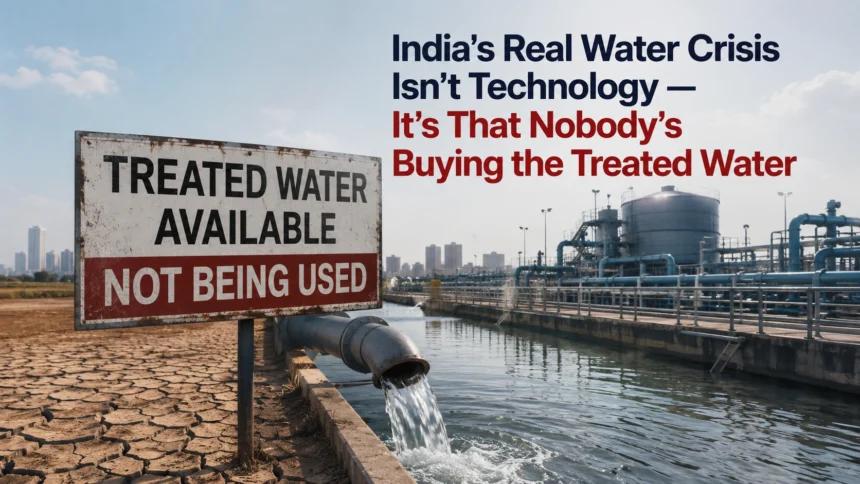
India treats barely a third of the 72,000+ million litres of sewage it generates daily — and even less of that treated water ever gets reused. Here’s the data behind India’s water reuse demand gap, state-by-state.
The Problem Isn’t Treatment Capacity. It’s What Happens After.
For two decades, India’s water conversation has been framed as a supply crisis — not enough rivers, not enough groundwater, not enough rain. That framing isn’t wrong. But it’s incomplete. Sit through enough conversations with water utilities and industrial procurement teams, and a different problem comes into focus: India isn’t primarily short on water treatment technology. It’s short on buyers for the water it already treats.
The scale of the underlying gap is significant on its own. According to the Central Pollution Control Board (CPCB), India generates roughly 72,368 million litres of sewage per day (MLD) — enough to fill close to 30,000 Olympic-size swimming pools every single day. Of that, installed sewage treatment plant (STP) capacity covers only around 37-44% nationally, and actual treated volume is lower still: various CPCB-based estimates put it at roughly 20,000-26,000 MLD actually treated, meaning somewhere between 56% and 72% of India’s daily sewage goes untreated, discharged into rivers, groundwater, or soil.
Where It Gets Worse: Even Treated Water Often Goes Unused
Here’s the part the “water crisis” headlines usually skip. Even the water that does get treated — cleaned, tested, and brought up to discharge standards — frequently never gets a second life as an industrial or agricultural input. It’s released rather than reused. This is the gap that matters most for India’s medium-term water security, because reused treated water is the cheapest, fastest-to-deploy new water source the country has, and it’s currently one of the most underutilized.
The state-level breakdown shows just how uneven this picture is:
- Tamil Nadu treats around 58% of its 5,800 MLD of urban sewage, backed by 112 functional STPs — one of the better-performing states nationally
- Uttar Pradesh generates roughly 8,300 MLD but treats only about 23%, leaving an estimated 6,400 MLD flowing untreated into rivers
- Maharashtra generates around 7,400 MLD, treating roughly 4,100 MLD — yet Mumbai alone reportedly discharges over 2,100 MLD of raw sewage into creeks
- Lucknow generates about 2,000 MLD and treats around 600 MLD — a 70% treatment gap
- Five states — Maharashtra, Gujarat, Uttar Pradesh, Delhi, and Karnataka — together account for roughly 60% of India’s total installed STP capacity, while six states and Union Territories, including Arunachal Pradesh, Manipur, Meghalaya, and Nagaland, reportedly have no sewage treatment plants installed at all
Why This Is a Commercial Problem, Not an Engineering One
The technology to close this loop already exists and runs in India today — membrane bioreactors, reverse osmosis, UV disinfection, and tertiary treatment systems are neither new nor unproven. Plants get built. Plants get run. Effluent meets discharge standards. What consistently doesn’t happen at scale is the next step: finding an industrial buyer willing to sign a long-term offtake agreement, agreeing on a price that beats or matches freshwater, and building enough institutional trust that a factory manager is comfortable replacing freshwater intake with treated municipal wastewater in a cooling tower or process line.
That’s a demand-and-market-design problem — not a filtration problem. And the economics already exist to make it work: tertiary-treated water meeting bathing-quality standards (BOD under 10 mg/L) can be produced cheaply, while fully potable-grade reuse water, with additional reverse osmosis and UV treatment achieving under 1 mg/L TDS, has been estimated at roughly ₹35-40 per 1,000 litres — often cheaper than securing new freshwater sources in water-stressed cities.
The Policy Response Is Starting to Catch Up
Government programs have begun explicitly targeting reuse rather than just treatment capacity:
- AMRUT 2.0 aims for 100% sewage management across 500 cities, with roughly ₹1.4 lakh crore allocated, and an explicit goal of recycling treated wastewater to meet 20% of urban water demand and 40% of industrial water demand at the state level
- Odisha’s Policy on Reuse of Treated Used Water (2026) targets 100% collection and treatment of used water by 2030, with at least 20% reuse by 2030
- Uttar Pradesh’s Safe Reuse of Treated Water Policy (2026) targets full reuse of treated water by 2035
- The National Mission for Clean Ganga (NMCG) added roughly 538 MLD of new treatment capacity across Ganga basin states in FY2026 alone
- A new Urban Challenge Fund, launched in 2026, is designed to pull in private capital to catalyze investment in urban water and sanitation infrastructure, alongside a broader shift toward PPP structures, hybrid annuity models, and performance-based contracts for water utilities
Why the Urgency Is Real
India’s per-capita water availability has declined from around 1,800 cubic metres in 2001 to nearly 1,400 cubic metres in 2025, and is projected to fall further to 1,200 cubic metres by 2050 — a trajectory that puts India on a path toward the internationally recognized threshold for “water stress.” At the same time, groundwater extraction remains among the highest in the world, with many urban centers increasingly dependent on groundwater and tanker-based supply to bridge the gap between demand and available freshwater.
Against that backdrop, treated wastewater isn’t a secondary environmental nicety — it’s one of the few large-scale water sources India can unlock without waiting on new dams, new aquifers, or new monsoons. The infrastructure to treat it, largely, already exists or is being built. What’s missing is the commercial architecture: long-term offtake contracts, credible pricing benchmarks against freshwater, and enough trust in water quality consistency for industrial buyers to commit.
The Bottom Line
India’s next decade of water security won’t be won by whoever builds the most efficient membrane or the most advanced treatment process — those problems are largely solved. It will be won by whoever builds the commercial mechanisms that make treated water something industry actively chooses to buy, rather than something municipalities are stuck disposing of. The country has spent years funding treatment capacity. The bigger unlock now is funding demand.
Frequently Asked Questions
How much sewage does India generate every day? India generates approximately 72,368 million litres of sewage per day (MLD), according to CPCB data — equivalent to roughly 30,000 Olympic-size swimming pools daily.
What percentage of India’s sewage is actually treated? Estimates vary by source and year, but CPCB-based figures suggest installed treatment capacity covers only around 37-44% of total sewage generated, with actual treated volume closer to 28-37%, leaving well over half of India’s daily sewage untreated.
Why doesn’t India reuse more of its treated wastewater? The core barriers are commercial, not technical: a lack of long-term industrial offtake agreements, unclear or uncompetitive pricing versus freshwater, and limited buyer trust in the consistency of treated water quality — not a shortage of proven treatment technology.
Which Indian states treat the highest and lowest share of their sewage? Tamil Nadu treats around 58% of its urban sewage, among the better-performing states, while Uttar Pradesh treats only about 23% of a much larger sewage volume, leaving thousands of MLD flowing untreated into rivers.
What government policies target treated water reuse in India? Key initiatives include AMRUT 2.0 (targeting 20% of urban and 40% of industrial water demand from recycled wastewater), Odisha’s 2026 Reuse of Treated Used Water Policy, Uttar Pradesh’s 2026 Safe Reuse of Treated Water Policy, and the 2026 Urban Challenge Fund aimed at mobilizing private capital for water infrastructure.
Data compiled from the Central Pollution Control Board (CPCB), IndiaSpend, Down To Earth, Statista, and Indian Infrastructure magazine reporting (2025-2026).