
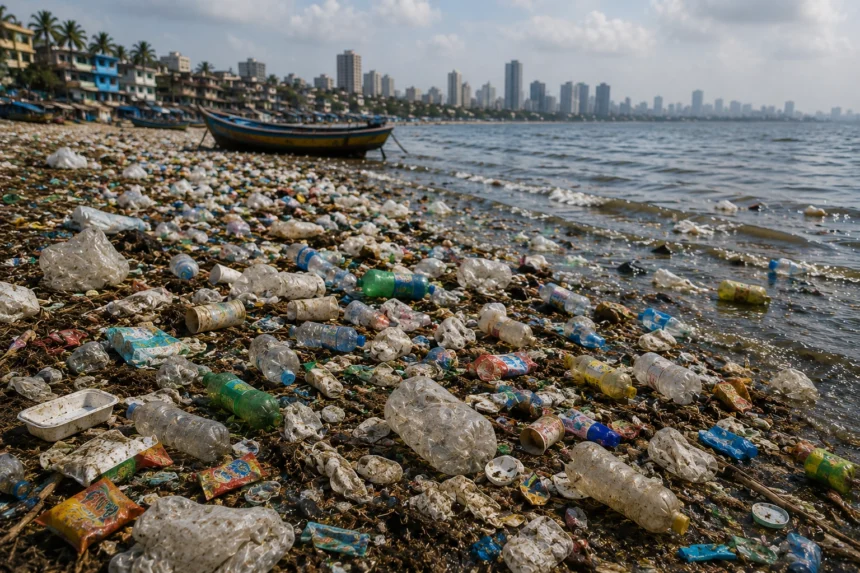
Walk along almost any beach in the world — from the coast of Kerala to the shores of California — and the litter you encounter will look remarkably similar. A plastic bottle. A snack wrapper. A bottle cap. Perhaps a crumpled bag.
That is not a coincidence. It is a pattern, and a new study has now confirmed it at global scale for the first time.
Research published in the journal One Earth on May 20, 2026 — drawing on more than 5,300 shoreline surveys across 112 countries — has established that food and beverage-related plastics are the dominant form of marine litter worldwide. They rank among the top three most abundant items on shorelines in 93 percent of all countries studied, spanning seven continents, nine ocean systems, and 13 regional seas representing 86 percent of the world’s population.
The implications stretch far beyond environmentalism. For companies, investors, policymakers, and ESG professionals, this research changes the terms of the debate around plastic pollution — and who bears responsibility for it.
The Data: What Is Actually Washing Up on Our Shores
The study, led by researchers at the University of Plymouth, used a rank-based methodology combining survey data with Monte Carlo statistical analysis to produce what it describes as the first confidence-weighted global assessment of marine litter.
Across the 112 countries analysed, 22 distinct plastic item types appeared among the top three most prevalent forms of debris. The breakdown is striking:
- Plastic food packaging was a top-three item in 53 percent of countries and 45 percent of individual studies
- Bottle caps and lids ranked in the top three in 51 percent of countries
- Plastic bottles appeared in the top three in 51 percent of countries
- Plastic bags featured in 40 percent of countries
- Cigarettes appeared in 38 percent of countries
- Fishing and shipping gear showed up in 34 percent of countries
The consistency of this data across vastly different geographies, income levels, and waste management systems is what makes the findings so significant. It is not a developing-world problem or a coastal infrastructure failure. It is a global production problem — one that begins at the factory, not the beach.
India: A Country of Scale, a Crisis of Enforcement
The study specifically includes India among the world’s five most populated countries where food and beverage plastics dominate shoreline debris — alongside China, the United States, Indonesia, and Pakistan. Together, these five nations account for nearly half the world’s population. Their presence on this list is not incidental.
India’s relationship with plastic pollution is particularly complex. On paper, the country has made significant regulatory commitments. The government banned 19 categories of single-use plastics from July 2022 under the Plastic Waste Management Amendment Rules. As of July 2025, that framework has been tightened further — only plastic bags of 120 microns or above are now permitted, and fines for violations can reach ₹1 lakh per offence.
India’s Extended Producer Responsibility (EPR) framework has also been strengthened. In 2024, the CPCB introduced minimum recycled content requirements — 30 percent for rigid plastic packaging by 2025–26 — and enforcement data from the same year showed a 60 percent increase in seizures of banned single-use plastic items compared to 2022.
But the enforcement gap remains wide. Prohibited items continue to be found in use across Indian cities. India produces over 65 million tonnes of solid waste annually, of which only 25–28 percent of collected waste is properly processed. The rest takes the path of least resistance: rivers, drains, coastlines, ocean.
A pan-India beach litter study published in the Marine Pollution Bulletin found that plastic constituted 65 percent of all beach waste in 2019 and had risen to 74 percent by 2021 — suggesting that despite policy progress, the problem intensified during that period. India is also still in the process of formulating a dedicated National Marine Litter Policy, which does not yet exist as a standalone instrument.
Why Waste Management Alone Will Never Be Enough
One of the most important conclusions of the One Earth study is structural: the consistency of plastic litter types across countries with radically different waste management systems proves that collecting rubbish better is not the solution.
As Susan Jobling, Director of the PISCES project and co-author of the study, put it, the findings show that plastic pollution cannot be solved by waste management alone. The same short-lived food and beverage plastics repeatedly dominate shoreline pollution across very different national contexts. The solution must come from upstream — meaning production reduction, reuse systems, better packaging design, and stronger regulatory intervention at the source.
This reframes the conversation for the corporate sector. If the same products keep appearing on beaches regardless of what country they are found in, the responsibility shifts upstream to the companies that make and fill those packages — not just the governments that manage the waste.
The research forms part of the £3.8 million PISCES project, an international initiative led by Brunel University and funded by the Natural Environment Research Council, focused on addressing plastic pollution in Indonesia.
The UN Plastics Treaty: Progress Stalled, Stakes Rising
The study’s authors note that its findings could directly inform the emerging UN Global Plastics Treaty — specifically by identifying which products should be included in the treaty’s annexes of “problematic and avoidable plastic products.”
The treaty’s progress, however, has been deeply frustrating. Negotiations that were meant to conclude by December 2024 collapsed at the Busan summit. A resumed sixth session in Geneva in August 2025 also ended without agreement, with around 100 nations supporting binding production limits facing resistance from major oil-producing countries including Saudi Arabia and Russia, as well as the United States, which opposed production reduction measures.
In October 2025, the INC chair resigned. A one-day procedural session in Geneva in February 2026 elected a new chair — Julio Cordano of Chile — but held no substantive negotiations. The treaty text remains unfinished. Substantive talks are expected to resume later in 2026, though no date has been confirmed.
The political deadlock is costly. By 2060, the total accumulation of plastic in the ocean is projected to reach 145 million metric tonnes — a number that will continue to climb for every year that binding production limits remain absent from international law.
What This Means for ESG and Corporate Accountability
For the investment and corporate communities, the One Earth study introduces a new level of evidence-based accountability. The research identifies, at national and global scale, exactly which product categories are most responsible for marine pollution. That makes it significantly harder for companies in the food and beverage sector — and their packaging suppliers — to claim that plastic litter is a consumer behaviour or waste management problem.
Several implications are worth noting for ESG-focused professionals:
For companies: Plastic packaging is increasingly a material risk — regulatory, reputational, and operational. The EU’s packaging regulations, the UK’s plastic packaging tax, and India’s EPR mandates are all moving in the same direction. Brands that continue to rely on single-use formats for food and beverage products face growing exposure.
For investors: ESG ratings agencies and proxy advisers are watching plastic commitments more closely. Voluntary pledges are no longer sufficient without credible reduction targets, verifiable packaging redesign commitments, and supply chain transparency.
For Indian companies specifically: India’s BRSR framework requires listed companies to disclose their environmental impact, including plastic usage and waste management. As global scrutiny of plastic pollution intensifies — and as the UN treaty inches toward a final form — BRSR disclosures on plastics will face increasing investor and regulatory attention.
For policymakers: The study’s authors are explicit that its findings are intended to guide which items should be prioritised under the UN treaty’s annexes. Food packaging, caps and lids, and plastic bottles are named by the evidence. That makes them likely targets for inclusion in future binding international obligations.
The Path Forward
The researchers are clear on what action looks like. Professor Richard Charles Thompson of the University of Plymouth, a co-author of the study, called actions on food and beverage related plastics “a key priority across 93 per cent of nations worldwide.” The measures needed are upstream — production reduction strategies targeting high-volume, single-use items, and a shift toward reuse and better packaging design.
For India, this means accelerating the formulation of a National Marine Litter Policy, strengthening EPR enforcement beyond paper commitments, and using the BRSR framework to create genuine corporate accountability on packaging. It also means engaging more assertively in UN treaty negotiations, where India’s position — supportive of the treaty in principle but resistant to caps on primary plastic production — will need to evolve if the country is to lead on this issue rather than follow.
The beaches are telling us something we already know. The difference is that now the evidence is global, quantified, and impossible to attribute to anything other than the products we keep making.
Sources: Kelly et al. (2026), One Earth; UNEP; MoEFCC; CPCB; InfluenceMap; Mongabay India.
ESG World News covers sustainability, environmental policy, and corporate ESG developments across India and the world. Explore our Environmental and India Focus sections for more.