

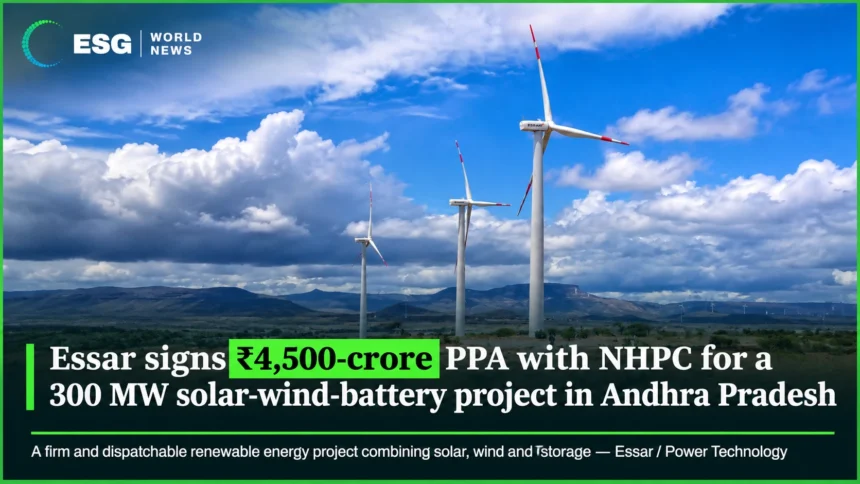
Author: ESG World News Desk, 16 November 2026 – India’s renewable energy market is seeing a growing shift towards projects that can deliver electricity more reliably throughout the day. Adding to this momentum, Essar Renewables Limited has signed a power purchase agreement (PPA) with state-owned NHPC Limited for a 300 MW firm and dispatchable renewable energy (FDRE) project in Andhra Pradesh.
- What Is the Essar-NHPC Renewable Energy Project?
- ₹4,500-Crore Investment Supports Essar’s Energy Expansion
- Why NHPC Is Procuring Solar, Wind and Battery Storage
- What Makes Firm and Dispatchable Renewable Energy Important?
- Andhra Pradesh’s Role in India’s Renewable Energy Expansion
- Key Numbers Behind the Essar-NHPC Agreement
- Why the Project Matters for India’s Energy Transition
- What to Watch Next
The project involves a planned investment of approximately ₹4,500 crore (around US$475 million) and will combine solar power, wind generation and battery energy storage systems. The integrated approach is designed to provide a more predictable electricity supply than conventional standalone solar or wind projects.
The agreement, signed on 4 November 2026, represents another step in Essar’s renewable energy expansion and supports the company’s broader ambition to develop a diversified 5 GW energy portfolio.
What Is the Essar-NHPC Renewable Energy Project?
Under the agreement, Essar Renewables, the renewable energy arm of Essar Power, will develop a 300 MW FDRE project in Andhra Pradesh.
Unlike conventional renewable projects that depend on the immediate availability of sunlight or wind, FDRE projects combine multiple generation technologies with energy storage to provide electricity according to a planned delivery schedule.
The proposed Essar project will integrate three components:
- Solar power: To generate renewable electricity during daylight hours.
- Wind power: To add generation from wind resources, which may complement solar production.
- Battery energy storage: To store electricity and support scheduled power delivery when renewable generation is unavailable or insufficient.
The combination is intended to improve the consistency and dispatchability of renewable electricity supplied to NHPC.
For power buyers, this model can offer a more structured supply arrangement than relying exclusively on the variable output of individual solar or wind plants.
₹4,500-Crore Investment Supports Essar’s Energy Expansion
Essar Power plans to invest approximately ₹4,500 crore in the Andhra Pradesh project as part of its wider energy portfolio strategy.
The company has outlined plans for a diversified 5 GW energy portfolio spanning renewable, thermal and gas-based generation.
The strategy reflects the importance of balancing growth in clean energy with the reliability requirements of India’s electricity system.
The NHPC agreement also follows two earlier renewable energy awards secured by Essar Renewables from NHPC and SJVN. According to the supplied project information, the three recent awards together represent approximately 1 GW of aggregate awarded renewable capacity.
These developments indicate the company’s growing participation in India’s utility-scale renewable procurement market.
Why NHPC Is Procuring Solar, Wind and Battery Storage
NHPC has traditionally been associated with hydropower development and generation. However, India’s changing electricity requirements are encouraging power-sector companies to expand their renewable energy portfolios.
Solar and wind power are important to India’s clean energy ambitions, but their output varies with weather and time of day. This creates a need for technologies that can support electricity supply when renewable generation is lower.
By procuring FDRE capacity from a private developer, NHPC can add a combination of renewable generation and storage to its portfolio.
The arrangement also illustrates the role of public-sector power buyers in supporting the development of integrated renewable energy projects through long-term procurement agreements.
For developers, agreements with established power-sector buyers can provide a commercial framework around which large infrastructure investments can be planned.
What Makes Firm and Dispatchable Renewable Energy Important?
The expansion of solar and wind power has increased the importance of grid flexibility and electricity storage.
A conventional solar project produces power primarily during daylight hours, while wind generation depends on local wind conditions. Neither technology, on its own, guarantees electricity delivery at every hour.
FDRE projects seek to address this limitation by combining generation technologies with storage and scheduling capabilities.
Their potential benefits include:
- More predictable electricity supply: Combining solar and wind can diversify generation patterns.
- Improved use of renewable power: Battery storage can retain surplus electricity for later use.
- Greater grid flexibility: Stored energy can support electricity delivery during periods of lower renewable generation.
- Reduced dependence on standalone generation: Integrated projects can provide a more structured supply profile for buyers.
The commercial and technical success of these projects depends on factors such as battery capacity, generation profiles, storage costs, transmission access and contractual delivery requirements.
Andhra Pradesh’s Role in India’s Renewable Energy Expansion
Andhra Pradesh is emerging as an important destination for large-scale renewable energy investments.
Projects combining solar, wind and battery storage require suitable land, access to renewable resources and reliable grid connectivity. The development of integrated facilities can therefore contribute to the state’s renewable energy infrastructure while supporting India’s wider clean power ambitions.
The 300 MW Essar-NHPC project adds to the growing pipeline of utility-scale renewable energy developments in the state.
Once implemented, the project could demonstrate how multiple renewable technologies and storage infrastructure can operate together under a single power procurement arrangement.
Key Numbers Behind the Essar-NHPC Agreement
| Project indicator | Details |
|---|---|
| Developer | Essar Renewables Limited |
| Power buyer | NHPC Limited |
| Project location | Andhra Pradesh |
| Contracted project capacity | 300 MW |
| Planned investment | ₹4,500 crore |
| Approximate US dollar value | US$475 million |
| Project technology | Solar, wind and battery storage |
| Project model | Firm and dispatchable renewable energy |
| PPA signing date | 4 November 2026 |
| Essar’s broader portfolio ambition | 5 GW |
| Aggregate awarded renewable capacity across three recent PSU awards | Approximately 1 GW |
Why the Project Matters for India’s Energy Transition
India’s renewable energy strategy is increasingly focused on more than adding generation capacity. The ability to deliver clean electricity when consumers need it is becoming equally important.
The Essar-NHPC agreement reflects this shift towards integrated renewable energy projects that combine solar, wind and battery storage.
For the renewable energy industry, FDRE procurement can create opportunities for developers with the technical and financial capabilities to deliver more complex projects.
For ESG-focused investors and energy buyers, it also highlights the importance of storage infrastructure in supporting the transition to a lower-carbon electricity system.
However, the project’s long-term contribution will depend on successful execution. Construction progress, storage integration, operational performance and actual electricity delivery will determine how effectively the planned capacity supports grid reliability and renewable energy use.
What to Watch Next
The next milestones will involve translating the signed PPA and planned investment into an operational project.
Key developments to monitor include the project’s construction schedule, solar and wind generation capacity configuration, battery storage specifications, financing arrangements and commissioning timeline.
Essar’s progress towards its wider 5 GW diversified energy portfolio will also be important. Future renewable energy awards from central public-sector companies, state utilities or private power buyers could provide further insight into the company’s growth strategy.
More broadly, the performance of projects such as this will help determine whether FDRE becomes a scalable model for India’s next phase of renewable energy procurement.
The Essar-NHPC agreement highlights a changing priority in India’s energy transition: moving beyond renewable generation capacity towards clean electricity that can be delivered more predictably and reliably.
ESG World News will continue tracking India’s renewable energy investments, battery storage developments and policies shaping the country’s energy transition.
Sources
- Millennium Post — Essar inks PPA with NHPC for 300 MW green energy project.
- Essar — Essar signs PPA with NHPC for 300 MW renewable energy project, to invest ₹4,500 crore.
- Power Technology — NHPC and Essar announce renewable project in Andhra Pradesh.
- India CSR — Essar signs PPA with NHPC for 300 MW renewable energy project.