
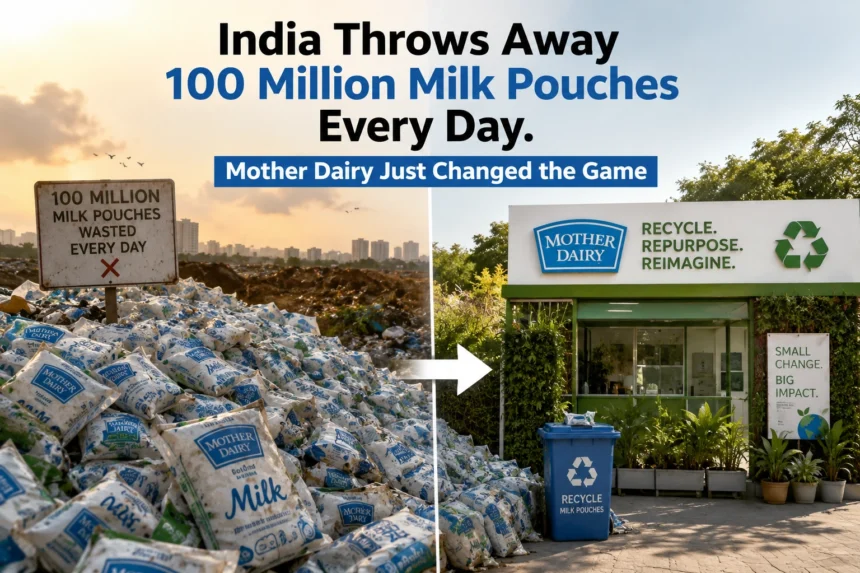
Every morning, across hundreds of millions of Indian households, a small ritual plays out: tear open the milk pouch, pour, and throw the wrapper in the bin — or, more often, wherever is nearest. That discarded slip of plastic, weighing just 4 to 5 grams, seems inconsequential. Multiply it across an entire country, and the numbers become staggering.
India discards an estimated 100 to 120 million plastic milk pouches every single day — nearly 36 to 44 billion pouches annually — generating between 1.5 and 2 lakh tonnes of low-density polyethylene (LDPE) plastic waste every year. Most of it is technically recyclable. Most of it never gets recycled. Instead, it blocks drains, litters coastlines, and persists in the environment for centuries.
On June 2, 2026, Mother Dairy stepped into that problem with what it described as a first in Indian packaging history.
What Mother Dairy Launched — and How the Technology Works
Mother Dairy unveiled India’s first naturally degradable milk pouch in soil at a press conference in New Delhi, with a rollout beginning June 5, 2026 — World Environment Day — through its Cow Milk variant across Delhi-NCR.
The technology itself is unlike conventional biodegradable plastics, which often require industrial composting conditions to break down. Mother Dairy’s new packaging is designed to degrade naturally in soil rather than persisting for decades or centuries. The material first converts into a bioavailable wax, which is then broken down by naturally occurring soil microbes into natural elements.
In other words: no industrial facility needed, no special disposal instructions for consumers, and — according to the company — no trace of plastic left behind.
The innovation was developed after more than four years of research, and is designed to naturally degrade in soil within a few years rather than centuries — and importantly, without any impact on consumer milk prices.
Crucially, the new pouches remain completely recyclable, while maintaining identical shelf life, taste profiles, and strict quality control standards. Consumers will not need to change how they store, handle, or dispose of their milk. The upgrade is entirely on the manufacturer’s side.
5 Numbers That Put This Innovation in Context
100 million — plastic milk pouches discarded in India every single day.
4+ years — the research and development period Mother Dairy invested before commercial launch.
55 lakh litres — the volume of milk Mother Dairy sells per day across Indian states, making the scale of potential impact significant if the technology is eventually rolled out beyond Delhi-NCR.
₹20,300 crore — Mother Dairy’s annual turnover, underlining that this is a commercially serious company making a commercially consequential bet on sustainable packaging.
₹24,000 crore — the company’s revenue target for FY27, a 20% growth ambition it intends to pursue while absorbing the costs of this packaging transition without passing them to consumers.
Why This Matters Beyond One Company
Mother Dairy is not a startup making a sustainability gesture. It is a wholly owned subsidiary of the National Dairy Development Board (NDDB), India’s premier dairy development institution, and one of the country’s largest fresh milk suppliers. When it moves on packaging, the industry watches.
The dairy sector is one of the more difficult areas of India’s plastic problem to address. Milk pouches are sold at extremely low margins, making any cost increase in packaging sensitive. They are used by consumers across every income segment. And because they are small, lightweight, and often wet when discarded, they are notoriously difficult to collect and recycle in practice — what the industry calls “fugitive plastic.”
Mother Dairy’s Managing Director Jayatheertha Chary said the innovation is specifically aimed at addressing the problem of fugitive plastic and supporting a cleaner ecosystem — language that directly acknowledges the gap between recyclability in theory and recycling in practice.
That gap matters enormously. Conventional milk pouches are classified as recyclable under India’s Plastic Waste Management Rules. But recyclability is only meaningful if collection infrastructure exists and if the economics of recycling work. For a 4-gram LDPE pouch soiled with milk residue, they often do not.
A packaging material that degrades naturally in soil bypasses that infrastructure dependency entirely — which is precisely what makes this technology structurally different from existing approaches.
The ESG Angle: What FMCG Companies and Investors Should Watch
For ESG professionals, this launch raises questions that go beyond the press release.
On the BRSR front: India’s top 1,000 listed companies are now required to report their environmental impact under SEBI’s Business Responsibility and Sustainability Reporting framework. Plastic packaging is a material disclosure area. Companies that can demonstrate verifiable reductions in packaging plastic — not just recyclability claims but actual reduction in plastic that persists in the environment — are positioned to make stronger BRSR disclosures. Mother Dairy has just set a new benchmark for what that looks like in the dairy sector.
On EPR obligations: India’s Extended Producer Responsibility framework for plastic packaging has been tightening. In 2024, the CPCB introduced verified recycled content requirements and stricter audit norms. A pouch that degrades naturally in soil, rather than requiring collection and reprocessing, creates a different kind of compliance story — one that may influence how EPR rules evolve for the food and beverage sector.
On greenwashing risk: The company has made strong claims — “no trace of plastic,” degradation “within a few years.” Independent verification of these claims at scale will matter. The broader ESG community will be watching whether third-party certification or soil degradation testing data is published to back up the marketing language. Credibility in sustainable packaging claims has been eroded globally by products that perform in lab conditions but not in real-world soil environments.
On competitive pressure: If the technology performs as claimed, rival dairy companies — Amul, Nandini, Parag, Heritage Foods — will face growing pressure to respond, either by licensing similar technology, developing alternatives, or explaining to investors why they have not. A government-backed entity launching India’s first degradable dairy pouch on World Environment Day is an explicit challenge to the sector.
The Delhi-NCR Pilot: A High-Stakes Test
The launch will begin with Mother Dairy’s popular Cow Milk variant in the Delhi-NCR market, coinciding with a refreshed pack design on June 5, 2026, World Environment Day.
Delhi-NCR is a logical first market. It is Mother Dairy’s home territory, the company has deep distribution infrastructure there, and the urban consumer base is more likely to respond positively to a visible sustainability move. But it is also a demanding test environment — high volumes, high temperatures, and the full range of disposal conditions from organised collection to open dumping.
The pilot’s success or failure will be closely watched by the packaged foods industry. If the pouches perform as described — degrading in soil without issues of odour, contamination, or accelerated degradation during product use — the case for national rollout becomes compelling. If there are operational problems, the company will need to address them before competitors begin positioning against the technology’s credibility.
India’s Dairy Sector Is at a Sustainability Crossroads
India is the world’s largest milk producer, accounting for over 23% of global milk output. The sector supports the livelihoods of more than 70 million dairy farmers. And it generates an almost unfathomable volume of packaging waste every year.
NDDB Chairman Dr. Meenesh Shah said the innovation reflects the dairy sector’s responsibility to balance growth with sustainability, noting that India’s dairy sector stands as a testament to scale, inclusivity, and responsibility.
That balance — between keeping dairy affordable and making it sustainable — has historically been used as a reason to defer innovation on packaging. Mother Dairy’s launch, with its explicit commitment that prices will not rise, is a direct rebuttal to that logic.
Whether the technology delivers on its environmental promises at scale will determine whether this is a genuine turning point for Indian dairy packaging, or a well-timed announcement that fades quietly after World Environment Day. The evidence will be in the soil — literally.
Sources: Mother Dairy press release; The Tribune; News9Live; Outlook Business; AgriMoon; India CSR; CPCB.
ESG World News covers sustainability, ESG policy, and corporate responsibility across India and the world. For more on India’s BRSR framework and FMCG sector ESG disclosures, explore our India Focus and Environmental sections.