

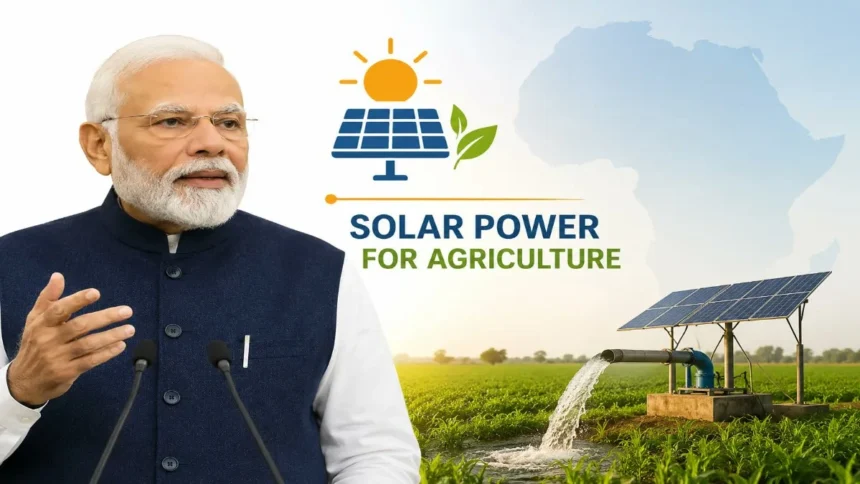
Prime Minister Narendra Modi has highlighted India’s solar-powered agriculture model as a potential blueprint for improving food security, agricultural productivity, and rural livelihoods across Africa.
Drawing attention to an article authored by Union Minister Pralhad Joshi and Ashish Khanna, Director General of the International Solar Alliance (ISA), the Prime Minister emphasized how the integration of renewable energy into agriculture can help address some of the most pressing challenges facing developing economies, including energy access, irrigation, and climate resilience.
India’s experience with solar-powered farming, particularly through initiatives such as the Pradhan Mantri Kisan Urja Suraksha evam Utthaan Mahabhiyan (PM-KUSUM) scheme, is increasingly being viewed as a successful model that can be replicated in regions facing similar agricultural and energy challenges.
Solar Energy Transforming Agriculture in India
Over the past decade, India has significantly expanded the use of renewable energy within its agricultural sector, enabling farmers to access reliable and affordable power for irrigation and other farming activities.
The PM-KUSUM programme, recognized as one of the world’s largest distributed solar initiatives for agriculture, has already facilitated the installation of approximately 2.7 million solar-powered irrigation pumps across the country.
The government has set an ambitious target of deploying an additional 5 million solar pumps by 2030, further strengthening rural energy access while reducing dependence on diesel-powered irrigation systems.
The programme has delivered multiple benefits for farmers, including:
- Reliable daytime electricity for irrigation
- Reduced fuel and energy costs
- Increased agricultural productivity
- Improved crop diversification
- Enhanced farm incomes
- Lower carbon emissions
By combining clean energy with agricultural development, India has demonstrated how renewable technologies can support both economic growth and environmental sustainability.
Africa Presents a Major Opportunity for Solar Irrigation
The article highlighted significant differences in irrigation access between India and Africa, underscoring the potential impact of solar-powered farming solutions.
India currently irrigates nearly 55% of its agricultural land, while irrigation coverage across Sub-Saharan Africa remains at approximately 4%.
Limited irrigation infrastructure continues to be a major barrier to agricultural productivity in many African countries, leaving farmers heavily dependent on seasonal rainfall and vulnerable to climate-related disruptions.
Solar-powered irrigation systems offer a practical and sustainable alternative by providing farmers with reliable access to water without relying on expensive diesel generators or underdeveloped electricity networks.
Industry experts believe that widespread adoption of solar irrigation could significantly improve food production, strengthen rural economies, and enhance climate resilience across the continent.
Mission 300 to Support Renewable Energy Expansion in Africa
The article identified Mission 300, a joint initiative led by the World Bank and the African Development Bank, as a key platform for accelerating the deployment of solar-powered agriculture solutions across Africa.
The initiative aims to expand electricity access throughout the continent while supporting sustainable economic development.
By integrating renewable energy technologies into agriculture, Mission 300 could help millions of farmers gain access to reliable irrigation and modern farming infrastructure, ultimately contributing to greater food security and economic stability.
Policy Support and Financing Remain Critical
The success of India’s solar agriculture model has been supported by a combination of policy incentives, financing mechanisms, and institutional support.
According to the article, replicating similar success in Africa will require:
- Supportive government policies
- Accessible financing solutions for farmers
- Capacity building and skill development programmes
- Public-private partnerships
- Technology transfer and knowledge sharing
The International Solar Alliance is expected to play a significant role in facilitating collaboration, investment, and deployment of solar-powered agricultural solutions across developing countries.
India Emerges as a Global Renewable Energy Leader
India’s ability to showcase its solar agriculture success is underpinned by its remarkable progress in renewable energy deployment.
The country’s installed solar energy capacity has expanded from just 2.8 GW in 2014 to more than 157 GW today, making India one of the fastest-growing solar markets in the world.
Meanwhile, India’s total renewable energy capacity has surpassed 282 GW, reflecting the country’s commitment to accelerating the clean energy transition while supporting sustainable development goals.
These achievements have strengthened India’s position as a global leader in renewable energy innovation and climate-focused development strategies.
A Blueprint for Sustainable Growth
As countries worldwide seek solutions that address food security, climate change, and energy access simultaneously, India’s solar-powered agriculture model offers a compelling example of how clean energy can drive rural transformation.
The combination of solar irrigation, farmer-centric policies, and renewable energy infrastructure has demonstrated tangible economic and environmental benefits, creating a framework that can be adapted across emerging economies.
With international organizations, governments, and development institutions increasingly focusing on sustainable agriculture and climate resilience, India’s experience is likely to play an important role in shaping future renewable energy and food security strategies globally.
The growing collaboration between India, the International Solar Alliance, and African nations highlights the potential for clean energy partnerships to support inclusive growth, strengthen agricultural systems, and build a more sustainable future.