

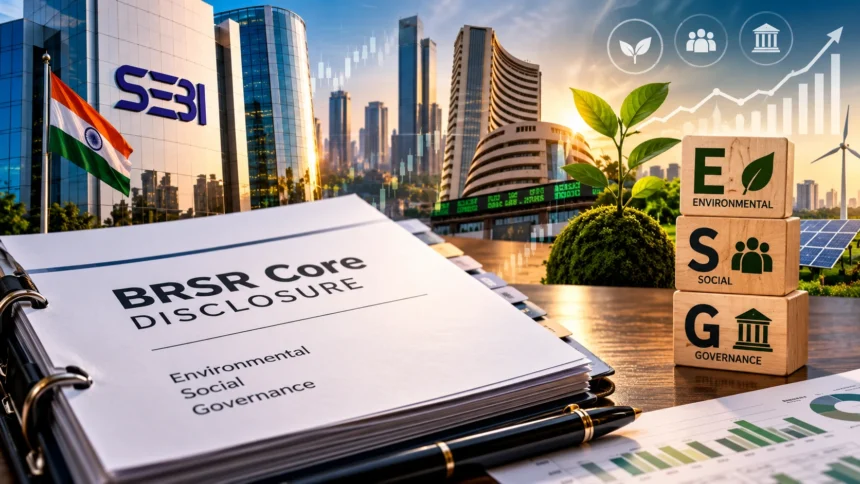
29 October 2026 – India is expanding its sustainability reporting framework, bringing more listed companies under BRSR Core assessment or assurance requirements while encouraging greater transparency across corporate value chains.
- What Is SEBI’s BRSR Core Framework?
- BRSR Core Timeline: Which Companies Are Covered?
- Value-Chain ESG Reporting: Why Suppliers Matter
- Why BRSR Core Is Becoming a Governance Priority
- How Companies Should Prepare for BRSR Core Compliance
- 1. Review the Applicable SEBI Requirements
- 2. Establish Clear Ownership of ESG Data
- 3. Strengthen Data Collection and Validation
- 4. Engage Suppliers and Business Partners
- 5. Integrate ESG Reporting into Governance
- What BRSR Core Means for India’s Corporate Sector
- The Road Ahead for ESG Reporting in India
Environmental, social and governance (ESG) reporting in India is moving towards greater consistency, accountability and data quality. The Securities and Exchange Board of India (SEBI) is progressively expanding its Business Responsibility and Sustainability Report (BRSR) Core framework, requiring more of the country’s largest listed companies to substantiate their sustainability disclosures.
The next major milestone arrives in financial year 2026–27, when the phased BRSR Core assessment or assurance requirement extends to the top 1,000 listed entities by market capitalisation.
For businesses, this means sustainability reporting is becoming more than a communications exercise. Companies increasingly need reliable data, clear internal controls and coordination across finance, procurement, human resources, operations and governance teams.
Value-chain reporting adds another dimension. Although the relevant disclosures and assessments remain voluntary under the current framework, companies that prepare early may be better positioned to respond to future regulatory developments and investor expectations.

What Is SEBI’s BRSR Core Framework?
The Business Responsibility and Sustainability Report is India’s framework for corporate sustainability disclosures by listed entities within its scope.
BRSR Core is a focused subset of the broader BRSR framework. It identifies key performance indicators and metrics across nine ESG attributes to support more consistent reporting and independent evaluation.
These indicators cover areas relevant to environmental performance, social responsibility and business conduct. They include measures relating to emissions, energy and resource use, workforce-related outcomes, responsible business practices and governance.
The framework is designed to improve the reliability and comparability of reported information. Rather than relying exclusively on broad sustainability statements, stakeholders can examine specific indicators and the methodologies used to calculate them.
For investors, this can make it easier to evaluate corporate performance. For companies, it creates a stronger need to document the sources of sustainability data and establish clear accountability for reporting.
BRSR Core Timeline: Which Companies Are Covered?
SEBI has adopted a phased approach based on market capitalisation, gradually extending the BRSR Core assessment or assurance requirement to a larger group of listed entities.
The implementation schedule is as follows:
| Financial year | Companies covered by BRSR Core assessment or assurance |
|---|---|
| FY 2023–24 | Top 150 listed entities |
| FY 2024–25 | Top 250 listed entities |
| FY 2025–26 | Top 500 listed entities |
| FY 2026–27 | Top 1,000 listed entities |
The framework allows for assessment or assurance under the applicable requirements. Assessment refers to third-party evaluation conducted according to the relevant standards, while assurance follows the applicable assurance approach.
Companies should consult SEBI’s latest master circulars and applicable stock-exchange requirements to establish their precise obligations.
The broader BRSR reporting requirement already applies to the top 1,000 listed entities. The phased timeline above specifically concerns the BRSR Core assessment or assurance requirement, not the initial introduction of sustainability reporting itself.
Value-Chain ESG Reporting: Why Suppliers Matter
A company’s environmental and social footprint can extend well beyond its own offices, factories and direct operations.
Suppliers, distributors, logistics providers and other business partners can influence emissions, resource consumption, labour practices and responsible sourcing. This makes value-chain information an important part of understanding a company’s wider sustainability performance.
SEBI has introduced provisions for value-chain ESG disclosures under the BRSR Core framework.
Under the framework described in SEBI’s regulatory materials, a listed entity’s value chain encompasses relevant upstream and downstream partners. The earlier framework described the partners in terms of those cumulatively accounting for 75% of purchases and sales by value, respectively. Companies should check the current applicable provisions before determining their reporting scope.
An important distinction: ESG disclosures for the value chain are voluntary for the top 250 listed entities by market capitalisation from FY 2025–26. Assessment or assurance of those value-chain disclosures is voluntary from FY 2026–27.
These provisions should not be confused with the phased BRSR Core assessment or assurance requirement for the top 1,000 listed entities.
Why Voluntary Value-Chain Reporting Still Matters
Even where reporting remains voluntary, companies can benefit from developing reliable supplier data.
First, value-chain information can reveal environmental and social risks that are not visible in a company’s direct operations. Second, customers and investors may increasingly request credible information about suppliers and business partners. Third, establishing reporting systems early can reduce the pressure of implementing new requirements at short notice.
Procurement teams therefore have an important role to play. Sustainability data should not remain isolated within a corporate ESG department; it needs to be integrated into supplier engagement, vendor evaluation and risk management.
Why BRSR Core Is Becoming a Governance Priority
Sustainability reporting depends on more than measuring emissions or documenting environmental initiatives. It also requires clear responsibility for the accuracy, completeness and consistency of reported information.
Companies may collect ESG data from facilities, HR systems, procurement teams, contractors and external service providers. Without standardised definitions and appropriate controls, the resulting information can contain gaps or inconsistencies.
Governance helps address these challenges through clear ownership, documented processes, internal review and appropriate oversight.
The importance of governance is also reflected in the Oxford-GlobeScan Global Corporate Affairs Survey 2026. The survey identifies governance as the leading ESG-related reputational risk, with 45% of respondents ranking it first in the relevant assessment.
For Indian companies, this finding reinforces the need to treat sustainability reporting as a governance responsibility rather than simply an annual disclosure task.
Boards and senior management need visibility into the processes used to generate ESG information, the risks associated with missing data and the controls used to validate material claims.
How Companies Should Prepare for BRSR Core Compliance
Organisations approaching the expanded FY 2026–27 requirement should consider five practical steps.
1. Review the Applicable SEBI Requirements
Identify whether the company falls within the relevant market-capitalisation category and determine which BRSR and BRSR Core requirements apply for the reporting year.
Companies should also distinguish mandatory requirements from voluntary value-chain disclosures and consult the latest regulatory guidance.
2. Establish Clear Ownership of ESG Data
Assign responsibility for individual indicators to the relevant teams.
For example, facilities and operations may manage energy consumption, HR may provide workforce data, procurement may coordinate supplier information, and finance may support reporting controls and review.
A defined ownership structure reduces the risk of inconsistent calculations and last-minute data collection.
3. Strengthen Data Collection and Validation
Companies should document the sources of their ESG information, calculation methods, reporting boundaries and assumptions.
Where estimates are used, the methodology and relevant limitations should be transparent. Appropriate review procedures can help identify discrepancies before information is included in formal disclosures.
4. Engage Suppliers and Business Partners
Companies seeking to improve value-chain transparency can begin by identifying important suppliers and customers, evaluating available data and explaining their information requirements.
Supplier engagement should be proportionate to the company’s reporting objectives and applicable requirements. Businesses may also need to consider confidentiality, data quality and the practical ability of smaller suppliers to provide consistent information.
5. Integrate ESG Reporting into Governance
ESG reporting should connect with risk management, internal controls and board-level oversight.
Periodic reviews can help management identify reporting gaps, clarify accountability and address potential discrepancies before publication.
A well-designed process also creates a stronger foundation for responding to investor questions and future regulatory changes.
What BRSR Core Means for India’s Corporate Sector
SEBI’s phased approach signals the increasing importance of consistent sustainability information in India’s capital markets.
For large listed companies, the expanding BRSR Core requirement creates a stronger incentive to improve reporting systems and demonstrate that published indicators are supported by appropriate processes.
For suppliers and other business partners, the growth of value-chain reporting may create opportunities to strengthen their own sustainability data and meet the expectations of larger corporate customers.
However, the pace and scope of these changes will depend on applicable regulatory requirements, market expectations and the readiness of companies to collect reliable information.
The distinction between mandatory BRSR Core assessment or assurance and voluntary value-chain disclosures remains important. Businesses should base their compliance decisions on the current regulatory framework rather than assume that every proposed or voluntary element is compulsory.
The Road Ahead for ESG Reporting in India
India’s sustainability reporting framework is evolving towards greater consistency, stronger data governance and improved transparency.
The FY 2026–27 expansion of BRSR Core assessment or assurance to the top 1,000 listed entities marks an important stage in that progression. At the same time, voluntary value-chain reporting gives companies an opportunity to build more complete visibility into the environmental and social effects of their business relationships.
The organisations best prepared for this shift will be those that treat ESG reporting as an integrated business process, supported by reliable data, clear accountability and effective governance.
For Indian companies, the next phase of ESG reporting is not simply about publishing more information. It is about making sustainability information more credible, comparable and useful for business decisions.
ESG World News will continue tracking SEBI regulations, sustainability reporting, corporate governance and India’s evolving ESG landscape.
Big Tech’s Nuclear Power Push Exposes a Growing Divide in Global ESG Policy