

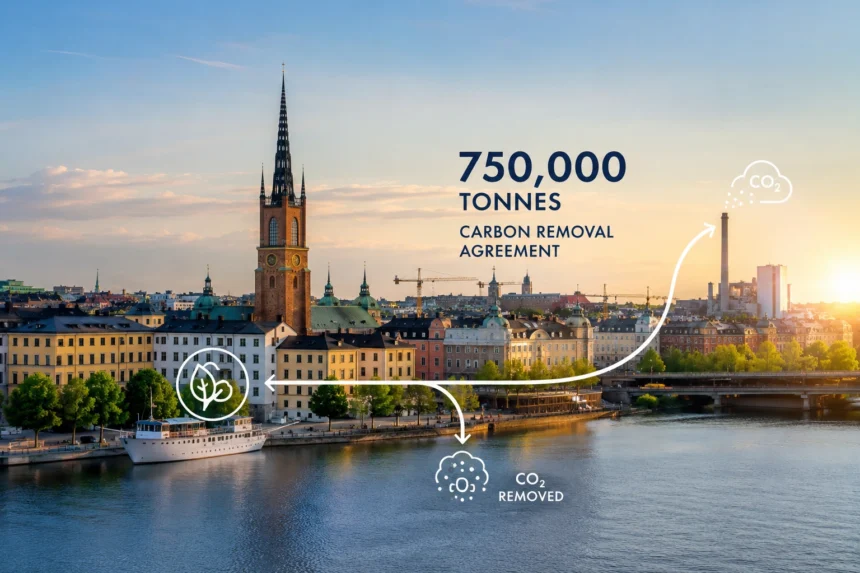
The City of Stockholm has signed a long-term carbon removal agreement with Swedish energy company Stockholm Exergi, securing the removal of 750,000 tonnes of carbon dioxide over the next 15 years and positioning itself among the world’s largest buyers of permanent carbon removal credits.
- Stockholm Commits to Long-Term Carbon Removal Strategy
- Stockholm Exergi Advances Major BECCS Project
- How the BECCS Facility Works
- Following a Record-Breaking Carbon Removal Agreement
- Supporting Stockholm’s Climate-Positive Goals
- City Leaders Highlight Importance of Carbon Removal
- Carbon Removals Gain Momentum in Global Climate Strategies
The landmark agreement strengthens Stockholm’s climate leadership ambitions and supports its goal of becoming climate positive by 2030 and completely fossil fuel-free by 2040.
Stockholm Commits to Long-Term Carbon Removal Strategy
Under the agreement, Stockholm will purchase approximately 50,000 tonnes of permanent carbon removals annually from Stockholm Exergi’s Bioenergy with Carbon Capture and Storage (BECCS) project.
The carbon removals will be generated through a large-scale carbon capture facility currently under development at Stockholm Exergi’s bio-cogeneration plant located in Värtan, Stockholm.
With a total commitment of 750,000 tonnes over 15 years, the Swedish capital becomes the fifth-largest buyer of permanent carbon removals globally, reflecting the growing role of carbon removal technologies in achieving net-zero and climate-positive targets.
Stockholm Exergi Advances Major BECCS Project
Stockholm Exergi, jointly owned by the City of Stockholm and Ankhiale, has already begun construction of the BECCS facility.
Once operational, the project is expected to capture and permanently store approximately 800,000 tonnes of carbon dioxide annually, making it one of Europe’s largest carbon removal initiatives.
Commercial operations are anticipated to begin around 2028.
The project combines renewable bioenergy generation with advanced carbon capture and storage technology to create permanent negative emissions.
How the BECCS Facility Works
The BECCS project integrates Stockholm Exergi’s existing bioenergy-powered combined heat and power plant with a carbon capture system designed to remove carbon dioxide from flue gases generated during energy production.
The facility uses biomass residues sourced from:
- Forestry operations
- Sawmills
- Pulp and paper manufacturing
Captured carbon dioxide is then cooled, compressed into liquid form, and transported for permanent geological storage beneath the North Sea.
Over time, the stored carbon dioxide mineralizes within sedimentary rock formations, ensuring long-term carbon sequestration and preventing emissions from re-entering the atmosphere.
Following a Record-Breaking Carbon Removal Agreement
The latest agreement follows Stockholm Exergi’s high-profile carbon removal deal with Microsoft signed in 2025.
That agreement covered more than five million tonnes of permanent carbon removals and was described by the companies as the largest carbon removal purchase agreement globally at the time.
The growing demand from governments and corporations highlights increasing confidence in engineered carbon removal technologies as a critical component of global climate strategies.
Supporting Stockholm’s Climate-Positive Goals
The City of Stockholm has outlined ambitious climate targets through its Environmental Programme and Climate Action Plan.
The municipality aims to:
- Become climate positive by 2030
- Achieve fossil fuel-free status by 2040
- Reduce territorial greenhouse gas emissions significantly within city boundaries
- Remove more carbon dioxide than it emits
City officials view carbon removals as a complementary strategy alongside aggressive emissions reductions.
The purchased removals will help offset emissions that remain difficult or expensive to eliminate entirely, including emissions associated with:
- Construction materials
- Urban infrastructure projects
- Wastewater treatment operations
- Other hard-to-abate sectors
City Leaders Highlight Importance of Carbon Removal
Commenting on the agreement, Anders Egelrud, Chief Executive Officer of Stockholm Exergi, said the partnership demonstrates how municipalities can combine emissions reductions with investments in permanent carbon removals to accelerate climate action.
He emphasized that the agreement not only supports climate objectives but also helps create a new market for negative emissions technologies and strengthens the emerging carbon removal industry.
Meanwhile, Karin Wanngård, Mayor of Stockholm, described the deal as an important milestone in the city’s climate strategy.
She noted that the agreement places Stockholm among the world’s leading cities in carbon removal procurement and sends a strong signal about the need to accelerate the green transition to address the climate crisis.
Carbon Removals Gain Momentum in Global Climate Strategies
As governments, corporations, and cities pursue net-zero and climate-positive targets, carbon removal solutions are increasingly being recognized as a necessary complement to emissions reduction efforts.
While renewable energy deployment, energy efficiency improvements, and electrification remain central to decarbonization strategies, experts believe carbon removal technologies will play a critical role in addressing residual emissions that cannot be eliminated through conventional measures alone.
The Stockholm-Stockholm Exergi agreement represents one of the largest municipal carbon removal commitments globally and highlights the growing importance of BECCS technology in achieving long-term climate goals.
With large-scale projects entering development and demand for verified carbon removals continuing to rise, the transaction further positions Sweden as a leader in carbon capture, carbon storage, and climate innovation.
UAE Solar Power Capacity Reaches 6.7 GW in 2025, Set to Surpass 20 GW by 2030