

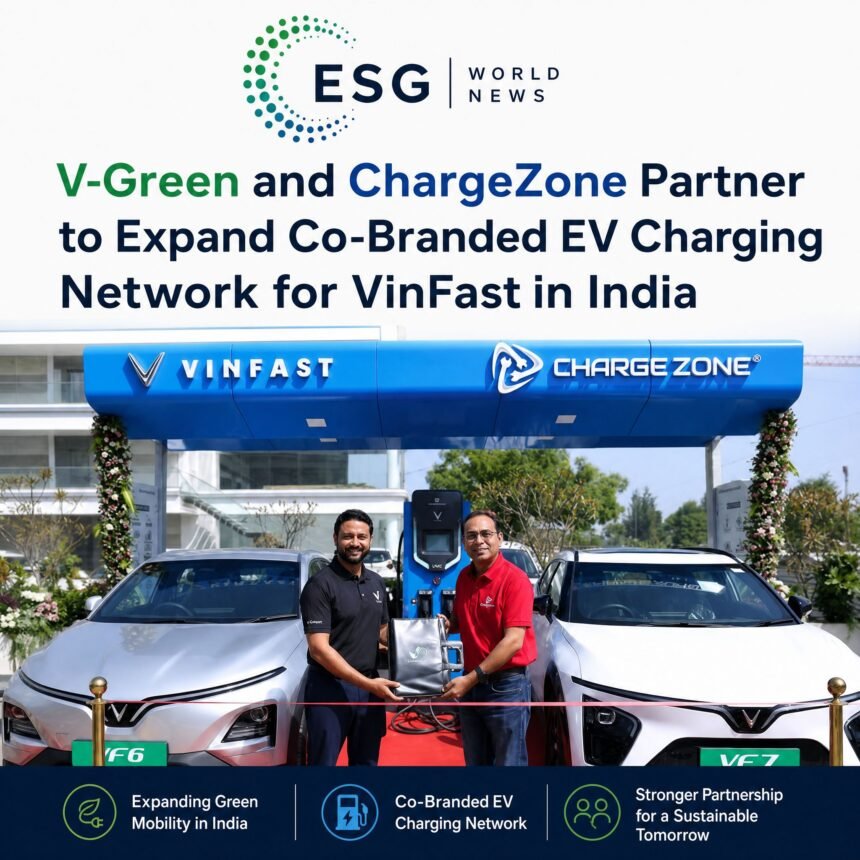
The rapid expansion of India’s electric vehicle (EV) ecosystem is driving deeper integrations between vehicle manufacturers and energy infrastructure providers. In a major step forward, V-Green, the specialized EV charging infrastructure arm of the global Vingroup ecosystem, has entered into a strategic partnership with Indian EV charging network ChargeZone.
The collaboration marks a significant milestone: it is VinFast’s very first co-branded charging partnership with a Charge Point Operator (CPO) in India. Together, the companies aim to develop dedicated charging infrastructure and seamless ecosystem support specifically tailored for VinFast customers across the country.
Operational Structure: Merging Global Assets with Local Expertise
V-Green operates as a key pillar within the broader Vingroup ecosystem, which also includes the rapidly expanding electric vehicle manufacturer VinFast and the electric mobility platform GSM. This partnership leverages V-Green’s global mobility framework alongside ChargeZone’s extensive domestic network.
Under the terms of the agreement, the responsibilities are divided to maximize efficiency:
-
V-Green will spearhead site identification, strategic deployment planning, and alignment with VinFast’s localized vehicle distribution network.
-
ChargeZone will retain end-to-end operational ownership of all co-branded charging stations, leveraging its established technology backbone to guarantee a consistent, high-uptime charging experience.
First Station Live in Vadodara
The inaugural co-branded charging station has officially been launched at the Mangla Trade Hub in Vadodara. Strategically situated adjacent to a VinFast dealership for maximum customer convenience, the site features a 60 kW DC fast charger equipped with dual-gun capability, allowing two electric vehicles to power up simultaneously.
Proving the speed of execution, the first 15 charging stations under this alliance have already been commissioned and are fully operational.
Rapid Scale-Up: 100 Stations in Six Months
The initial rollouts serve as the foundation for an aggressive near-term expansion strategy. V-Green and ChargeZone have announced plans to deploy nearly 100 additional co-branded fast-charging stations over the next six months, targeting high-traffic corridors and key metropolitan hubs nationwide.
This rapid expansion directly tackles range anxiety, providing continuous infrastructure support that extends well beyond the initial point of purchase.
Leadership Perspectives: Integrating Infrastructure into the Mobility Experience
The partnership underscores a shared philosophy that charging infrastructure must be treated as an inherent part of the vehicle ownership experience, rather than an afterthought.
Kartikey Hariyani, Founder and CEO of ChargeZone, highlighted the operational readiness behind the collaboration:
“This partnership with V-Green is a strong validation of the infrastructure model ChargeZone has built, where charging is planned as an integral part of the EV ownership and mobility experience,” Hariyani stated. “The co-branded charging network is designed to address one of the most important factors influencing EV adoption today: dependable and accessible charging infrastructure beyond the point of purchase. As EV adoption accelerates in India, partnerships like these will be critical.”
Nguyen Nam Tien, CEO of V-Green, emphasized the broader macroeconomic impact on India’s green transition:
“The partnership between V-Green India and ChargeZone marks a significant step in strengthening India’s EV ecosystem,” said Tien. “By expanding reliable charging touchpoints for VinFast customers and the wider EV community, we are enabling seamless mobility, accelerating EV adoption, and building confidence in sustainable transportation across the country.”
By aligning high-speed charging directly with dealership networks and primary transit routes, the V-Green and ChargeZone alliance establishes a highly scalable blueprint for international automakers entering India’s competitive EV landscape.
Building a New Model for Resilience: Inside Japan’s $134 Billion Disaster Management Overhaul