

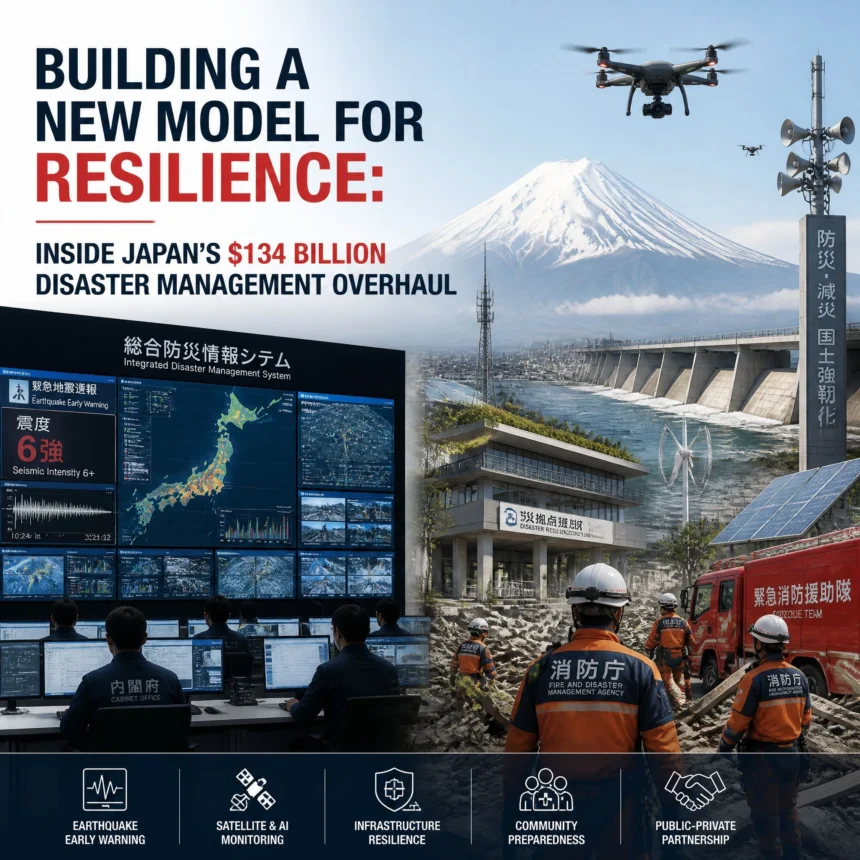
May 29, 2026 — According to insights and data presented by the World Economic Forum, Japan is radically shifting its approach to natural catastrophes. Rather than relying on traditional reactive emergency response systems, the nation is investing heavily to transition toward a data-driven, long-term preparedness model.
Between fiscal years 2026 and 2030, Japan will deploy over 20 trillion yen (approximately $134 billion) under its first national resilience implementation midterm plan. This massive capital injection is explicitly targeted at fortifying disaster resilience and repairing rapidly aging national infrastructure.
Anniversaries Fueling a New Urgency
Japan’s geographical reality makes it uniquely vulnerable to compounding seismic and atmospheric threats. This vulnerability was acutely highlighted on April 20, 2026, when a powerful magnitude 7.7 earthquake struck off the Sanriku coast, sending severe tremors across northeastern regions like Aomori Prefecture, triggering tsunami warnings, and shaking buildings as far as Tokyo—700 kilometers away. Just one week later, a separate magnitude 6.5 earthquake jolted Hokkaido.
The timing of these events coincides with critical national milestones:
-
15 years since the Great East Japan Earthquake
-
10 years since the Kumamoto earthquakes
-
2 years since the Noto Peninsula earthquake
These collective anniversaries have sparked immense political and social momentum, prompting the government to aggressively update its defensive frameworks.
Launching the Centralized Disaster Management Agency
The crown jewel of this national strategy is the official launch of a centralized Disaster Management Agency in November 2026.
Historically, frequent emergencies forced Japan’s leadership to prioritize immediate crisis control, leaving fewer resources and limited administrative bandwidth for forward-looking planning. The new centralized command body is structured to fix this structural bottleneck via three core functions:
1. Long-Term Strategy ──> Developing national plans based on long-term risk analysis.
          │
2. Prevention & Prep  ──> Accelerating preventive disaster infrastructure reinforcement.
          │
3. Integrated Command ──> Seamlessly coordinating workflows from the initial impact through recovery.
The agency’s ultimate mandate is to transition the country toward a disaster-resilient nation that firmly prioritizes human life and dignity.
Allocating the $134 Billion Budget
Preventive reinforcement during peacetime is vastly more cost-effective than post-disaster reconstruction. To achieve comprehensive resilience, the World Economic Forum outlines that Japan’s $134 billion budget will be carved out into highly specialized segments:
-
Lifeline Infrastructure ($67+ Billion): Roughly half of the total allocation is dedicated to the preventive maintenance and hardening of critical water and sewage networks.
-
Disaster Prevention Infrastructure (~$39 Billion / 5.8 Trillion Yen): Channeled into physical barriers, flood defenses, and seismic retrofitting.
-
Public-Private & Regional Collaboration (~$12 Billion / 1.8 Trillion Yen): Funding localized regional frameworks and joint corporate-government readiness protocols.
-
Emerging Technologies (~$2 Billion / 0.3 Trillion Yen): Specifically earmarked for integrating cutting-edge software and hardware into defense operations.
Advancing Resilience Through Digital Transformation (DX)
Japan’s Digital Agency is working hand-in-hand with commercial enterprises to pioneer Disaster Prevention DX. The overarching goal is simple: unify communication lines across national agencies, municipal offices, and public institutions to ensure instantaneous data sharing when a crisis strikes.
Key initiatives actively being deployed include:
-
Tailored Data-Sharing Systems: Helping displaced or at-risk residents receive localized, real-time support.
-
Procurement Streamlining: Digital service maps and online catalogs allowing municipal governments to swiftly acquire vetted disaster-response applications.
-
Shelter Digitization: Running pilot operations to modernize communication and resource tracking inside emergency evacuation shelters.
Furthermore, the Cabinet Office’s Disaster Prevention x Technology Public-Private Partnership Platform now acts as a digital matching ecosystem for roughly 3,000 registered local governments and technology providers, ensuring cutting-edge technology matches local operational needs.
AI and Private Sector Innovation
The private tech sector has emerged as a major force multiplier, developing AI-driven tools capable of automating damage assessment. Algorithms are now deployed for real-time flood forecasting, automated fire detection, and instant social media analysis.
For instance, platforms like Spectee Pro leverage AI to scrape, parse, and analyze text and crowd-sourced imagery uploaded to social media feeds during a disaster. By instantly weeding out noise and verifying situational updates, the software enables government analysts and corporate operators to understand the reality on the ground significantly faster than manual monitoring would ever permit.
Together, these structural investments and digital platforms show that Japan is building a highly sophisticated blueprint for climate and seismic resilience—one that the rest of the world will likely look to replicate as global climate risks escalate.
Global Carbon Pricing Now Covers Record 30% of Worldwide Emissions: World Bank 2026 Report