

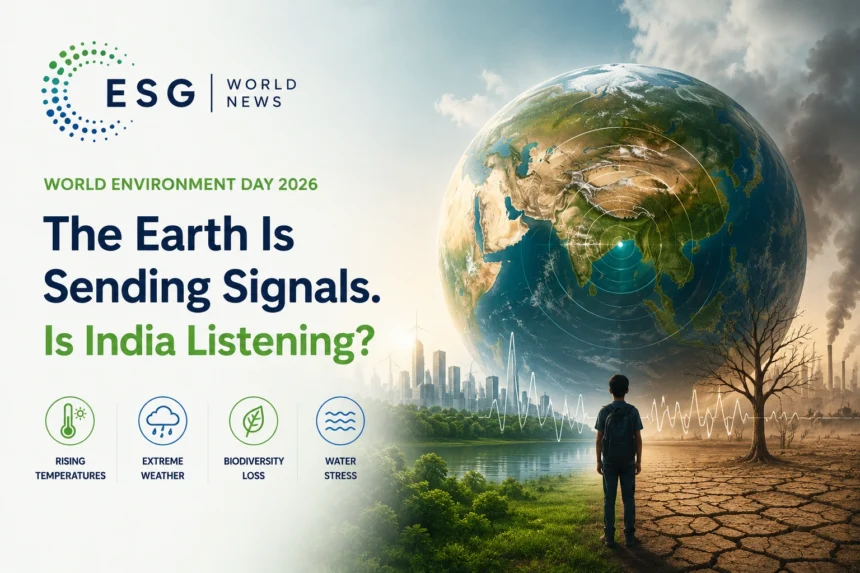
Today, June 5, 2026, is World Environment Day. ESG World News marks the occasion with this comprehensive, independently researched account of where India stands — the progress, the failures, and the urgency that no amount of celebration can obscure.
- The Theme: Now For Climate
- The Signals India Is Sending Back: What Changed in 2026
- What India Has Not Resolved: The Three Crisis Points
- 1. Air pollution: 1.72 million deaths, 9.5% of GDP
- 2. Heatwaves: more frequent, more deadly, more economically damaging
- 3. The renewable gap: ambition ahead of execution
- What India Is Doing Right: Five Policy Moves Worth Noting
- The ESG Dimension: From Awareness to Accountability
- Sources
The Theme: Now For Climate
World Environment Day 2026 focuses on climate change — on the urgent signals the Earth is sending and the signals we choose to send back. UNEP’s global campaign calls on all of us to step in, to move further, to steer a world already in motion. The question is no longer whether change is coming, but how humanity guides it and how fast.
The official theme is “Inspired by Nature. For Climate. For Our Future,” with the hashtag #NowForClimate. The 2026 edition recognises the interconnection between nature, climate, and biodiversity — placing nature-based solutions at the centre of climate action.
The Republic of Azerbaijan is hosting the official global commemoration in Baku, a significant choice given the country’s position at the intersection of fossil fuel dependency and green transition ambition. UN Secretary-General António Guterres stated plainly in his official message for the day: “The past eleven years have been the eleven hottest on record. Our task is to make that overshoot as small, as short, and as safe as possible — and rapidly bring temperatures back down.”
Without urgent action, exposure to air pollution beyond safe guidelines will increase by 50 per cent within the decade, and plastic waste flowing into aquatic ecosystems will nearly triple by 2040. These are not projections from a distant future. They are forecasts for the next fifteen years — within the working lifetime of every professional reading this.
The Signals India Is Sending Back: What Changed in 2026
India’s environmental record in 2026 is a genuinely mixed story — one that requires both honest acknowledgement of progress and unflinching assessment of what remains unresolved.
Renewable energy: a genuine breakthrough
The headline numbers are real and significant. As of February 2026, non-fossil fuel-based sources account for 52.57% of installed electricity capacity. India’s emissions intensity declined by 36% between 2005 and 2020.
The government announced in June 2025 that India had reached its NDC goal of 50% installed electric power capacity from non-fossil fuel sources — five years ahead of the committed 2030 timeline. This is a substantive achievement, not a paper one.
In March 2026, India took another major step. India’s updated NDC for 2031–2035 targets a 47% reduction in emissions intensity of GDP from 2005 levels by 2035, an increase in the share of non-fossil fuel-based installed electricity capacity to 60%, and a carbon sink of 3.5 to 4.0 billion tonnes of CO₂ equivalent through forest and tree cover by 2035.
India has also created a carbon sink of about 2.3 billion tonnes of CO₂ equivalent through forest and tree cover by 2021. And on installed capacity, India’s momentum is visible globally — per IRENA’s 2026 rankings, the country now holds the third position globally in renewable energy installed capacity, having surpassed Brazil, with 274.68 GW of renewables and 283.46 GW total non-fossil capacity as of March 2026.
During 2025 alone, 48,436 MW of renewable energy capacity was added — including 37,945 MW of solar power and 6,347 MW of wind power. These are the largest single-year additions in India’s history.
The CSE State of Environment report: a harder look
Released on the eve of World Environment Day, the State of India’s Environment 2026: In Figures report, published by the Centre for Science and Environment (CSE) and Down To Earth, used official government data to track trends across climate, extreme weather, public health, forests, biodiversity, water, air pollution, waste, and the performance of Indian states on key development indicators.
The report provides granular evidence that top-ranked states are still struggling. “Goa, the top-ranked state, has excelled due to its high share of new renewable sources in power generation,” said Kiran Pandey, programme director, environmental resources, CSE. “However, the state faces challenges like forest cover change, sewage treatment and management of polluted river stretches.”
Richard Mahapatra, managing editor of Down To Earth and co-author, pointed out that even the best-performing states show persistent gaps — a finding that challenges the narrative of a uniformly advancing green transition.
What India Has Not Resolved: The Three Crisis Points
1. Air pollution: 1.72 million deaths, 9.5% of GDP
The Lancet Countdown 2025 estimates 1.72 million deaths attributable to anthropogenic PM2.5 in India in 2022 alone, with an economic cost of $339.4 billion — equivalent to 9.5% of GDP. Every one of India’s 1.4 billion citizens breathes air that exceeds the World Health Organization’s PM2.5 guideline of 5 µg/m³.
The Air Quality Life Index (AQLI) 2025 calculates that particulate pollution reduces average Indian life expectancy by 3.5 years — more than twice the impact of malnutrition and five times that of unsafe water.
Progress under India’s National Clean Air Programme (NCAP) is real but insufficient. The CREA Tracing the Hazy Air 2026 report reveals that of 100 NCAP cities with sufficient data, 68 recorded PM10 reductions — but 29 recorded increases. Only 41 of 97 cities achieved the initial 20–30% NCAP target. Of the 68 cities that did show improvement, 61 still exceeded the National Ambient Air Quality Standards — meaning that even after improvement, the air in most NCAP cities remains officially unsafe.
In the Indo-Gangetic Plain, 74 of 76 monitored cities exceed NAAQS, and all 28 NCR cities exceed the standard. Sri Ganganagar, Rajasthan (236 µg/m³), Greater Noida (226 µg/m³), and Delhi (211 µg/m³) recorded the highest annual PM10 concentrations in 2024.
Thirteen of the 20 most polluted cities in the world are in India. That statistic has not changed meaningfully in a decade.
2. Heatwaves: more frequent, more deadly, more economically damaging
India’s extreme 2026 heatwave pushed temperatures in several major cities to over 45°C, exposing around 44 million people and $341 billion worth of economic activity to dangerous heat conditions.
India’s annual mean land surface air temperature in 2025 remained 0.29°C above the 1991–2020 average, making it among the warmest years since records began in 1901. India’s average humidity rose from 67.1% during 2015–2019 to 71.2% during 2020–2024. Rising humidity compounds the danger — it reduces the body’s ability to cool itself through perspiration, making the same temperature significantly more dangerous than a generation ago.
A May 2026 study published in Frontiers in Environmental Health, by researchers at UC Berkeley’s India Energy and Climate Center, estimates that a single day of extreme heat causes approximately 3,400 excess deaths nationally. A five-day heatwave causes nearly 30,000.
The 2025 India–Pakistan heatwave, which began in April 2025 and lasted until July, recorded a peak temperature of 48°C at Sri Ganganagar, Rajasthan, and caused 455 confirmed deaths in India. The 2026 heatwave arrived earlier and hit harder.
A Karolinska Institutet study published in Environment International in 2025 found that days with both high air pollution and extreme heat substantially raise the risk of death in Indian cities more than either factor alone — a compounding effect that India’s public health infrastructure is not equipped to manage at scale.
3. The renewable gap: ambition ahead of execution
The progress on installed capacity is real. But progress toward implementation of India’s National Electricity Plan 2023 targets has been slower than projected, with more than 100 GW of additional renewable capacity still needed by 2026–27 to meet interim milestones of approximately 350 GW.
India’s 2030 emissions under current policies are 8–11% higher than previous assessments, and overall emissions are still expected to rise beyond 2030. While renewables are playing a bigger role in meeting new demand, the sheer size of the existing fossil fuel base, coupled with continued fossil capacity growth, means the overall reliance on fossil power generation has not shifted.
Lauri Myllyvirta, Lead Analyst at the Centre for Research on Energy and Clean Air, said: “India’s new 2035 climate targets underestimate the country’s potential for transformative clean energy growth. Under current plans, the target of 60% clean power capacity will be achieved before 2030, rather than by 2035.” This reads as optimism but is also a critique: India is setting targets below what its own trajectory suggests is achievable.
What India Is Doing Right: Five Policy Moves Worth Noting
1. The updated NDC — India’s March 2026 climate plan is one of the most substantive updates any major economy has submitted since COP26. Targeting a 47% emissions intensity reduction and a 60% non-fossil capacity share by 2035 positions India firmly within the Paris Agreement’s ambition corridor.
2. Carbon markets — Aligned with international frameworks like the EU’s Carbon Border Adjustment Mechanism, India’s carbon trading mechanism, once formally launched, will attract climate finance and stimulate green innovation. India’s MoEFCC has identified 14 activities for carbon credit trading under Article 6.2 of the Paris Agreement.
3. Mission LiFE — The Mission LiFE initiative, launched by India in October 2022, focuses on seven core themes: saving water, conserving energy, reducing waste, managing e-waste, eliminating single-use plastics, promoting sustainable food systems, and adopting healthy lifestyles. Its reach is limited, but its framework is sound.
4. Nagar Van Yojana — The National Afforestation and Eco-development Board is implementing the Nagar Van Yojana scheme, envisaging 600 urban forests and 400 urban gardens during 2020–21 to 2026–27, aimed at enhancing green cover and biodiversity in urban and peri-urban areas.
5. Namami Gange — Between FY 2014–15 and FY 2025–26, the National Mission for Clean Ganga disbursed ₹21,024.84 crore to various agencies for projects and interventions aimed at rejuvenating the Ganga and its tributaries. River health remains a long-term project, but the investment is sustained and growing.
The ESG Dimension: From Awareness to Accountability
World Environment Day is, ultimately, a communications event. Its value lies not in what governments say on June 5, but in what businesses disclose and what investors demand on every other day of the year.
India’s SEBI-mandated Business Responsibility and Sustainability Reporting framework is the mechanism through which environmental accountability enters the corporate mainstream. As of 2026, India’s top 1,000 listed companies must disclose their energy consumption, emissions, water usage, plastic usage, and biodiversity impacts — for the first time in Indian corporate history at this scale.
The gap between what World Environment Day celebrates and what BRSR disclosures reveal is where ESG journalism has a role to play. Renewable energy milestones matter. So do the 1.72 million air pollution deaths that do not make press releases. So does the forest cover that declined even as tree count increased. So do the 44 million people exposed to dangerous heat this year.
The Earth is sending signals. The question, as UNEP framed it today, is what signal we choose to send in return.
Sources
This article draws on the following primary and secondary sources, all cited in the text:
- UNEP / World Environment Day 2026 — worldenvironmentday.global; unep.org/events/un-day/world-environment-day-2026
- United Nations — un.org/en/observances/environment-day
- Mongabay India — India’s updated NDC, March 2026
- Down To Earth / Centre for Science and Environment — State of India’s Environment 2026: In Figures, released June 4, 2026
- Climate Action Tracker — India country assessment, climateactiontracker.org
- Earth5R / Lancet Countdown 2025 — India air pollution data, February 2026
- CREA — Tracing the Hazy Air 2026 progress report
- Karolinska Institutet / Phys.org — Air pollution and extreme heat mortality study, April 2025
- Free Press Journal / ClimaMeter — India’s 2026 heatwave analysis, May 2026
- Frontiers in Environmental Health — Heatwave-induced excess mortality in India, Narang & Gadgil, May 2026
- Yale Program on Climate Change Communication — Heat and air pollution worry in India, January 2026
- ICLG — Environment & Climate Change Laws and Regulations 2026: India
- EY India — India’s Green Resolve, May 2026
- Parliament of India / PIB — Renewable energy capacity data, February 2026
- SankalpTaru / The Week / Business Standard — World Environment Day 2026 theme and significance
- IRENA 2026 / Ministry of New and Renewable Energy / PIB — India clean energy rankings and capacity data
ESG World News covers sustainability, climate policy, and corporate ESG developments across India and the world. This article was published on World Environment Day, June 5, 2026.