
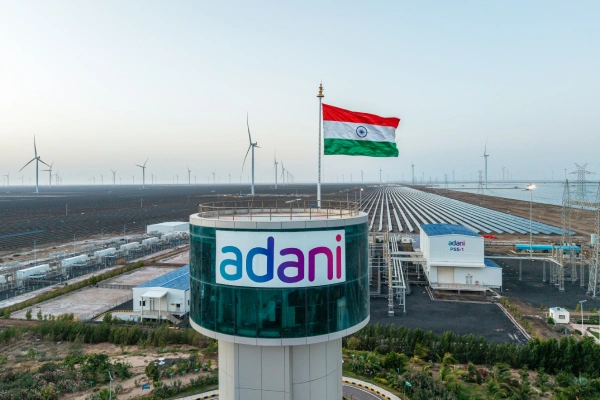
Adani Green Energy (AGEL) has commissioned a cumulative 3.37 Gigawatt-hour (GWh) Battery Energy Storage System (BESS) at Khavda, Gujarat, marking one of the world’s largest single-location battery storage deployments outside China.
- Major Milestone for India’s Renewable Energy Infrastructure
- AGEL Plans Massive Battery Storage Expansion
- Battery Storage Capacity Can Power Nearly One Million Homes
- Sagar Adani Highlights Role of Energy Storage in Clean Energy Transition
- Advanced Lithium-Ion Technology Integrated Into BESS Project
- Why Battery Energy Storage Systems Are Becoming Critical
- India Accelerates Renewable Energy and Storage Investments
- Conclusion
The company stated that the project was completed within just:
- 10 months of on-site construction
making it one of the fastest utility-scale battery energy storage deployments globally.
The latest commissioning includes:
- 1.37 GWh additional capacity added in March 2026
taking AGEL’s total operational BESS capacity at Khavda to:
- 3.37 GWh
Major Milestone for India’s Renewable Energy Infrastructure
The commissioning represents a significant development for India’s clean energy ecosystem as battery storage increasingly becomes critical for:
- Grid stability
- Renewable energy integration
- Peak-hour electricity supply
- Round-the-clock clean power delivery
Industry experts believe large-scale energy storage systems will play a central role in supporting India’s renewable energy expansion and long-term energy transition goals.
AGEL said the BESS infrastructure strengthens the reliability and flexibility of renewable-heavy electricity grids.
AGEL Plans Massive Battery Storage Expansion
According to the company, it plans to:
- Add over 10 GWh battery storage capacity in FY27
and further scale operations to:
- 50 GWh battery storage capacity over the next five years
The company’s growing investment in storage infrastructure aligns with increasing global demand for:
- Dispatchable renewable energy
- Utility-scale battery systems
- Flexible power management solutions
Battery Storage Capacity Can Power Nearly One Million Homes
AGEL stated that the 3.37 GWh battery storage system can store enough clean energy to:
- Power nearly one million homes for an entire day
The company added that the storage system can support electricity demand equivalent to:
- Cities such as Indore and Chandigarh
- The entire state of Goa
The BESS facility can also reportedly power:
- More than 12 million LED bulbs continuously for 10 hours
Industry observers say large-scale storage projects could significantly improve:
- Renewable power reliability
- Peak load management
- Energy availability during grid fluctuations
Sagar Adani Highlights Role of Energy Storage in Clean Energy Transition
Sagar Adani, Executive Director of Adani Green Energy, said battery storage infrastructure will become increasingly important as renewable energy capacity expands globally.
“Large-scale energy storage will play a defining role in the next phase of India’s clean energy transition. As renewable energy capacity scales rapidly, storage infrastructure becomes critical for delivering reliable, round-the-clock clean power,” he said.
He further added:
“With the commissioning of the 3.37 GWh BESS at Khavda, AGEL is strengthening the foundation for resilient, dispatchable and flexible energy systems. Our investments in battery storage reflect a long-term commitment to building future-ready clean energy infrastructure at global scale.”
Advanced Lithium-Ion Technology Integrated Into BESS Project
The company stated that the Khavda battery storage project integrates:
- Advanced energy management systems
- Lithium-ion battery technologies
to optimise:
- Grid responsiveness
- Operational efficiency
- Energy reliability
The project has been strategically developed at:
- Khavda, Gujarat
where AGEL is currently building what it describes as:
- The world’s largest renewable energy plant
The company plans to develop:
- 30 GW renewable energy capacity at Khavda by 2029
of which:
- 9.9 GW is already operational
Why Battery Energy Storage Systems Are Becoming Critical
As renewable energy generation increases globally, energy storage infrastructure is emerging as a key requirement for stable grid operations.
Renewable energy sources such as:
- Solar power
- Wind energy
often experience variability due to:
- Weather conditions
- Seasonal changes
- Time-of-day generation patterns
Battery Energy Storage Systems (BESS) help address these challenges by:
- Storing excess renewable energy
- Delivering electricity during peak demand
- Supporting frequency regulation
- Enhancing grid flexibility
Industry analysts believe battery storage will become one of the most important pillars of:
- Net-zero energy systems
- Renewable energy integration
- Decentralised power infrastructure
India Accelerates Renewable Energy and Storage Investments
India has been rapidly scaling investments in:
- Renewable energy infrastructure
- Battery storage systems
- Grid modernisation
- Energy transition technologies
The country has set ambitious targets including:
- 500 GW renewable energy capacity by 2030
Government policies and industry investments are increasingly focused on:
- Energy storage deployment
- Grid resilience
- Clean energy reliability
- Long-duration storage technologies
Conclusion
Adani Green Energy’s 3.37 GWh battery storage commissioning marks a major milestone for India’s clean energy infrastructure and utility-scale storage ecosystem.
As renewable energy adoption accelerates, large-scale battery systems are expected to play a critical role in transforming intermittent renewable generation into stable, dispatchable, and reliable power supply systems.
The Khavda project also highlights the growing importance of integrating battery storage with renewable energy infrastructure to support India’s long-term sustainability and net-zero ambitions.
CEEW, AIDA Collaborate on Smart Grids and Renewable Energy Integration