

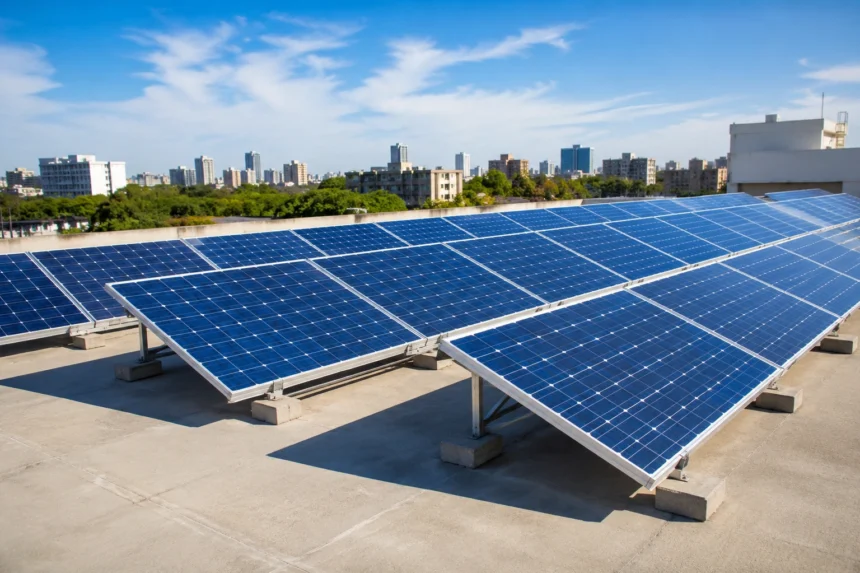
India is rapidly accelerating its infrastructure development to meet soaring domestic demand while simultaneously anchoring its long-term transition toward clean energy. According to the International Energy Agency’s (IEA) World Energy Investment 2026 report, India’s total energy investment is projected to reach an unprecedented $170 billion in 2026.
Over the last five years, capital flowing into the nation’s energy ecosystem has expanded at a robust average annual rate of 11%. This growth is primarily underpinned by a dual strategy: aggressively scaling up solar photovoltaic (PV) deployment and reinforcing fossil fuel infrastructure through oil refining.
Solar and Refining: The Dual Engines of Growth
The IEA highlights that solar PV and oil refining investments collectively drove roughly 25% of the total increase in India’s energy spending over the past half-decade.
-
Solar PV Expansion: Capital channeled into solar energy has grown by an impressive 25% annually.
-
Oil Refining Boost: Investments in refining capacity climbed 23% per year during the same timeframe. This financial surge puts India on track to expand its overall refining capacity by nearly 15% by 2030, a vital cushion given the country’s continuing reliance on imported crude oil.
Conversely, upstream oil and gas exploration has experienced structural contraction, dropping by an average of 7% annually since 2020. In response, the Indian government has introduced a modernized licensing regime designed to draw fresh global capital back into exploration and domestic production.
The Power Sector and the Non-Fossil Milestone
Power sector infrastructure commands approximately half of India’s aggregate energy expenditures. The dividends of this targeted spending became highly apparent when India achieved its Nationally Determined Contribution (NDC) target—sourcing 50% of its installed power generation capacity from non-fossil fuel sources—five years ahead of its initial 2030 schedule, pushed along by a $20 billion solar investment wave.
The transition within power generation economics over the last decade shows a stark shift in priorities:
[2021] Renewables-to-Fossil Investment Ratio ──> $1.50 vs $1.00
[2026] Renewables-to-Fossil Investment Ratio ──> $3.00 vs $1.00
Concurrently, direct investment in new coal-fired power plants has steadily retreated, falling to roughly 40% of the peak levels recorded in 2010.
Grid Modernization and the 100 GWh Battery Boom
Because solar and wind power now comprise more than half of India’s total installed generation capacity, managing the natural intermittency of renewable energy has become a core priority for grid operators. To avoid curtailment, the country is ramping up capital allocations for transmission upgrades, grid modernization, and dispatchable energy storage systems.
Investment in transmission and distribution is anticipated to touch $26 billion in 2026, following a steady 15% annual climb over the last five years. A key driver is the government’s Green Energy Corridor initiative. Supported by a financing structure of 30% equity and 70% debt from commercial lenders and multilateral development banks, the initial phase has successfully integrated over 3,000 kilometers of high-voltage transmission lines into national and state grids, with subsequent deployment phases currently underway.
The Rise of Energy Storage Systems (ESS)
To back up this variable wind and solar power, India has actively promoted storage capacity additions via pure Energy Storage Systems (ESS) and Wind-Solar Hybrid (WSH) projects. Backed by a financial viability-gap funding mechanism from the Power System Development Fund, battery storage projects have scaled at an extraordinary pace:
-
Tender Volume: Project tenders crossed a massive 100 GWh, with battery storage making up 60 GWh of that volume. This represents a twofold increase over the previous year and a tenfold jump compared to 2023 levels.
-
Cost Deflation: As scale increased, discovered battery storage tariffs collapsed from $14,700 per MW/month in 2023 to less than $3,000 per MW/month.
Coal Production and the Nuclear Deregulation Shift
Despite massive green energy growth, coal remains the primary baseline pillar dominating India’s energy mix for both heavy industrial manufacturing and baseline power generation. India currently stands as the world’s second-largest investor in coal supply, with its financial commitments tripling over the last ten years. Total spending in coal supply is expected to hover around $13 billion, as the country aims to scale up domestic coal production from roughly 1 billion tonnes today to 1.5 billion tonnes by 2030 to ensure absolute energy security.
Simultaneously, the dispatchable clean energy portfolio is being diversified through hydro and nuclear infrastructure, where capital deployment has tripled since 2020.
India has established a long-term target of achieving 100 GW of nuclear capacity by 2047, up from its current baseline of 9 GW. To kickstart this ambitious pipeline, the state dissolved its historic nuclear monopoly, passing reforms that permit private corporations with up to 49% foreign equity ownership to construct and operate standard nuclear reactors alongside Small Modular Reactors (SMRs).
ACME Solar Signs 300 MW Peak Renewable Power Agreement With Seci