

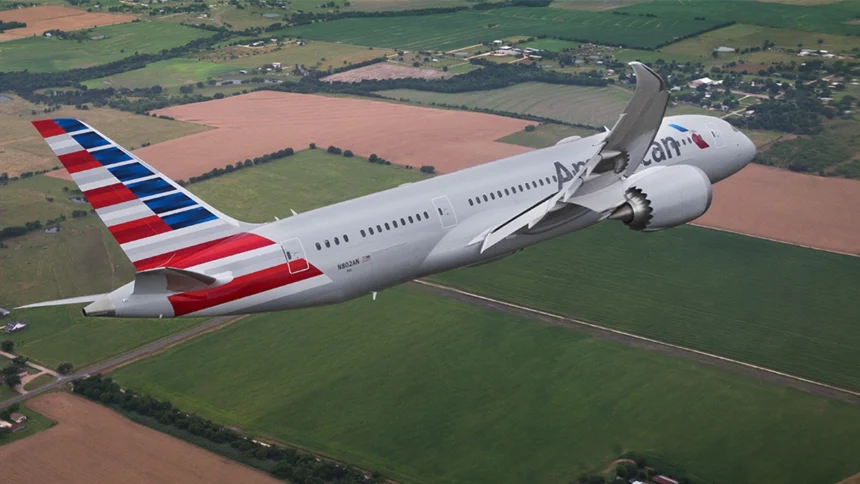
In a major milestone for aviation decarbonization, American Airlines and Google have announced the largest publicly disclosed Sustainable Aviation Fuel certificate (SAFc) agreement between an airline and a single corporate customer to date.
- How the Agreement Works
- Supporting Growth of Sustainable Aviation Fuel
- Google Strengthens Sustainable Travel Strategy
- Illinois Emerges as a Sustainable Aviation Fuel Hub
- Why Sustainable Aviation Fuel Matters
- Industry Faces Challenge of Scaling SAF Production
- Beyond SAF: Contrail Reduction Initiative
- Growing Momentum for Sustainable Aviation
The long-term partnership will support the deployment of 35 million gallons (132 million liters) of Sustainable Aviation Fuel (SAF) over the next three years, helping avoid nearly 300,000 metric tons of carbon dioxide equivalent (CO₂e) emissions.
The agreement underscores the growing role of corporate partnerships in accelerating the adoption of low-carbon aviation fuels and supporting the transition to more sustainable air travel.
How the Agreement Works
Under the arrangement, American Airlines will purchase and receive physical SAF at Chicago O’Hare International Airport (ORD) using existing fuel infrastructure.
The sustainable fuel will be produced from waste-based feedstocks, including:
- Used cooking oil
- Waste fats
- Other renewable waste materials
Google will receive the associated environmental benefits through the SAFc Registry, a transparent book-and-claim system that allows companies to account for sustainable aviation fuel usage without physically transporting the fuel to every flight route.
The initiative will help Google reduce emissions associated with employee business travel while supporting broader efforts to scale the global SAF market.
Supporting Growth of Sustainable Aviation Fuel
The long-term commitment from Google enabled American Airlines to secure a new sustainable aviation fuel offtake agreement with Valero Marketing and Supply Company, strengthening fuel supply certainty and supporting future production capacity.
According to Jill Blickstein, Chief Sustainability Officer at American Airlines, the partnership represents an important step in reducing aviation-related emissions.
The agreement also sends a strong market signal to fuel producers and investors, encouraging additional investment in SAF production facilities and infrastructure.
Google Strengthens Sustainable Travel Strategy
Google continues to expand its climate and sustainability initiatives across operations and business travel.
According to Kate Brandt, Chief Sustainability Officer at Google, the partnership demonstrates how large corporations can work together to accelerate deployment of critical climate technologies.
By committing to long-term SAF demand, Google is helping create greater market certainty for fuel producers while advancing its own sustainability objectives.
The company has increasingly focused on reducing emissions associated with travel, operations, and data center infrastructure as part of its broader climate strategy.
Illinois Emerges as a Sustainable Aviation Fuel Hub
The agreement was supported by Illinois’ recently enacted Sustainable Aviation Fuel tax credit, which was introduced by Governor JB Pritzker and the Illinois General Assembly.
The incentive aims to encourage SAF production, attract clean energy investments, and strengthen Illinois’ position as a leading aviation and transportation hub.
State officials believe the policy will help attract future sustainable fuel projects while supporting job creation and economic development.
Why Sustainable Aviation Fuel Matters
The aviation industry remains one of the most challenging sectors to decarbonize.
Globally, aviation:
- Supports more than 86.5 million jobs
- Generates over $4 trillion in economic activity annually
- Accounts for approximately 2–3% of global carbon dioxide emissions
Sustainable Aviation Fuel is widely viewed as one of the most effective near-term solutions for reducing aviation emissions.
Compared with conventional jet fuel, SAF can reduce lifecycle greenhouse gas emissions by up to 80%, depending on feedstock sources and production methods.
Unlike alternative propulsion technologies that remain in development, SAF can be used in existing aircraft and airport infrastructure, making it a practical drop-in solution for airlines today.
Industry Faces Challenge of Scaling SAF Production
Despite growing demand, sustainable aviation fuel currently represents only a small fraction of global aviation fuel consumption.
Industry experts note that significant investment is still needed to:
- Expand production capacity
- Reduce costs
- Improve supply chain infrastructure
- Increase feedstock availability
Partnerships between airlines and corporate buyers are increasingly viewed as a critical mechanism for creating the demand certainty needed to scale production and lower costs over time.
American Airlines and its oneworld alliance partners have continued investing in technologies and initiatives designed to increase access to affordable SAF while minimizing broader environmental impacts.
Beyond SAF: Contrail Reduction Initiative
The airline’s sustainability efforts extend beyond fuel innovation.
In 2025, American Airlines collaborated with Google, Contrails.org, and Flightkeys on a 16-week trial focused on reducing aircraft contrails—high-altitude condensation trails that contribute to atmospheric warming.
The project integrated contrail avoidance into flight planning systems and achieved a 62% reduction in contrail formation, demonstrating another potential pathway for reducing aviation’s climate impact.
Growing Momentum for Sustainable Aviation
The record-breaking agreement highlights increasing collaboration between airlines, technology companies, fuel suppliers, and policymakers to accelerate aviation decarbonization.
As demand for air travel continues to grow worldwide, sustainable aviation fuel is expected to play a central role in helping the industry meet climate targets while maintaining operational reliability.
For both American Airlines and Google, the partnership represents a significant step toward achieving long-term sustainability goals while helping build a stronger and more resilient sustainable aviation fuel market.
The deal also reflects a broader trend of corporate climate action, where companies are moving beyond traditional carbon offsets and investing directly in technologies capable of delivering measurable emissions reductions at scale.