
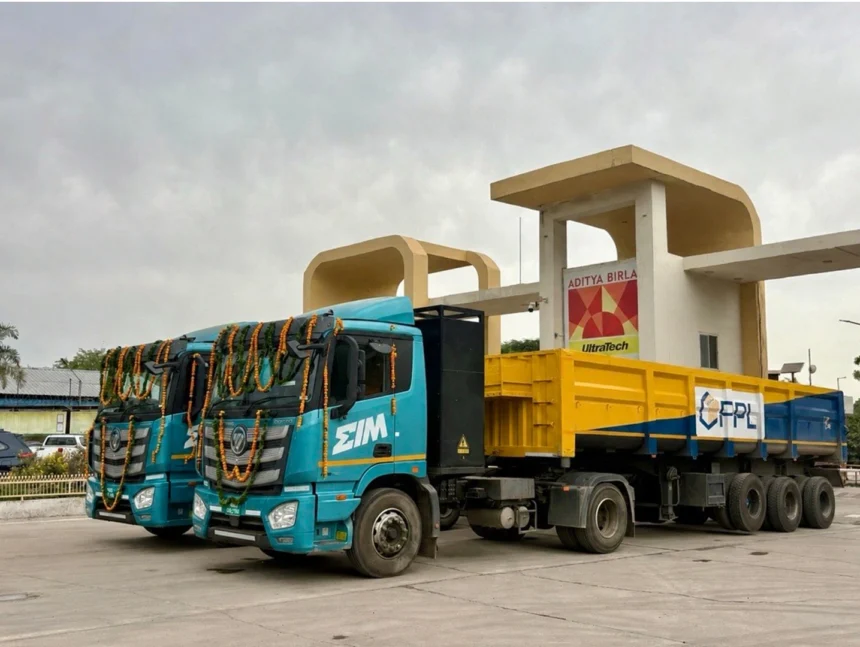
In a significant move towards low-carbon transportation, UltraTech Cement has deployed 45 electric heavy-duty trucks across northern India, marking one of the largest electric freight initiatives in the country’s cement industry. The deployment is expected to eliminate more than 8,900 tonnes of carbon dioxide (CO₂) emissions annually while reducing diesel consumption by approximately 2.9 million litres every year.
The initiative highlights the growing role of electric mobility in decarbonising industrial supply chains and reducing emissions from one of the most challenging sectors of the economy—heavy-duty freight transportation.
Why This Matters for Climate Action
While much of the conversation around decarbonisation focuses on renewable energy and industrial emissions, transportation remains a major contributor to global greenhouse gas emissions.
Heavy commercial vehicles account for a significant share of freight-related emissions due to their dependence on diesel fuel. In industries such as cement manufacturing, where raw materials and finished products must be transported over long distances, logistics can represent a substantial portion of the overall carbon footprint.
By replacing diesel-powered trucks with electric alternatives, UltraTech is directly addressing Scope 3 emissions within its value chain while supporting India’s broader clean transportation goals.
The annual reduction of 8,900 tonnes of CO₂ is equivalent to:
🌱 Removing thousands of fossil-fuel-powered vehicles from the road
🌱 Avoiding the combustion of nearly 2.9 million litres of diesel annually
🌱 Supporting cleaner air quality across multiple states
🌱 Reducing dependence on imported fossil fuels
As industries increasingly pursue net-zero commitments, decarbonising freight transport is emerging as a critical component of corporate climate strategies.
Electric Freight Network Spans Three States
The electric truck fleet has been deployed in partnership with Energy In Motion (EIM) and will transport clinker from UltraTech’s Kotputli Cement Works in Rajasthan to grinding facilities located in Dadri and Sikandarabad in the Delhi-NCR region.
The trucks will operate across Rajasthan, Haryana, and Uttar Pradesh, covering routes of approximately 250 kilometres while carrying loads of up to 55 tonnes.
The project demonstrates that electric heavy-duty vehicles are becoming increasingly viable for long-haul industrial logistics applications.
Strengthening Sustainable Logistics
The latest deployment forms part of UltraTech Cement’s broader strategy to build a cleaner and more resilient transportation network.
The company has steadily expanded its green mobility initiatives over the past several years:
- Introduced CNG trucks in 2021
- Added LNG-powered vehicles in 2022
- Began deploying electric trucks in 2024
As of FY26, UltraTech operates:
- 638 CNG trucks
- 32 LNG trucks
- 89 electric trucks
Its total fleet of sustainable transport vehicles now exceeds 750 units.
Industry Leadership in Low-Carbon Supply Chains
Commenting on the initiative, UltraTech Cement Managing Director K C Jhanwar stated that decarbonising logistics is as important as reducing emissions from manufacturing operations.
The company believes that transitioning long-haul freight transportation to electric mobility aligns with India’s ambitions to strengthen energy security, reduce fossil fuel dependence, and accelerate the transition to a cleaner economy.
A Growing Trend in Industrial Decarbonisation
The deployment reflects a broader shift across global industries as companies increasingly focus on reducing emissions throughout their entire value chains.
While cement manufacturing itself remains a hard-to-abate sector, innovations in logistics, renewable energy adoption, alternative fuels, and carbon reduction technologies are helping companies lower their overall environmental impact.
UltraTech’s latest initiative demonstrates how electrification of freight transport can contribute meaningfully to climate goals while creating a more sustainable and future-ready industrial ecosystem.
The ESG Impact
For ESG investors, policymakers, and sustainability leaders, the project serves as a practical example of how emissions reductions can be achieved beyond factory gates.
By tackling freight emissions at scale, UltraTech is helping advance:
✅ Climate Action
✅ Clean Transportation
✅ Industrial Decarbonisation
✅ Energy Security
✅ Sustainable Supply Chains
As India accelerates its journey towards net-zero ambitions, large-scale electric freight deployments such as this could become an increasingly important tool in reducing industrial carbon emissions and building a low-carbon economy.