
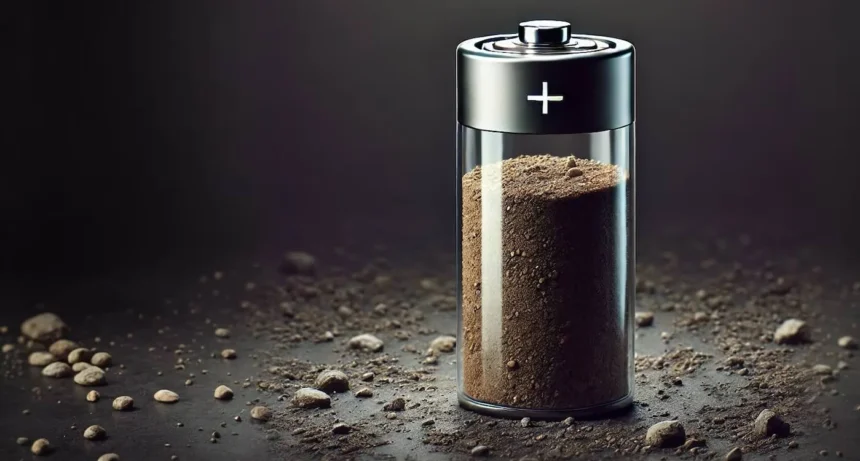
There is a strange kind of alchemy happening under a patch of grass in Somerset. No sunlight, no wind, no moving parts — just soil, a pair of buried electrodes, and billions of microorganisms going about their business. The company behind it, a British startup called Bactery, says that business can be turned into electricity, continuously, for decades, without anyone ever needing to dig it back up.
Bactery’s technology belongs to a category of devices known as soil microbial fuel cells. The premise sounds almost too simple to work: certain bacteria naturally found in soil — sometimes called exoelectrogens or electricigens — release electrons as a byproduct of breaking down organic matter. Capture those electrons with an electrode buried in the dirt, pair it with a second electrode exposed to air, and the soil itself becomes the electrolyte that completes the circuit. No fuel is added, no chemicals are consumed, and nothing needs replacing. The bacteria simply keep doing what bacteria do, and the device keeps drawing off the current.
From a Brazilian Schoolyard to a Bath Lab
The idea didn’t start as a battery company. Bactery’s founder and CEO, Jakub Dziegielowski, was a chemical engineering doctoral candidate at the University of Bath when he and a small team of researchers and students first tested the concept in the field — in a primary school in the fishing village of Icapuí, on Brazil’s semi-arid northeastern coast, the summer before the pandemic. The goal then was modest: power a water purifier using nothing but a nearby, distinctly unswimmable pond. It worked, if inefficiently.
What followed was years of refinement back in the UK. Early setups using simple graphite felt electrodes generated around 38 milliwatts per square meter. Later work in the Bath labs pushed that closer to 200 milliwatts per square meter — still a small amount of power, comparable to trickle-charging a phone or keeping a single LED lit, but a meaningful jump for a technology that essentially runs on dirt. By 2024, the research had been spun out into its own company, with Dziegielowski joined by fellow University of Bath academics Professor Mirella Di Lorenzo and Dr. Ben Metcalfe.

Already at Work on English Farms
Long before any residential rollout, Bactery has been building a track record in a less glamorous but more immediately practical setting: agriculture. Precision farming now relies on an estimated quarter-billion sensors worldwide — moisture probes, weather stations, irrigation valves — the vast majority powered by single-use batteries or solar setups that struggle under hedgerows and tree cover. Bactery’s pitch to farmers is that a buried soil cell can quietly replace both, producing enough energy in a year to roughly match ten AA batteries, about double what a typical wireless farm sensor needs.
That use case has already moved past the pilot stage. According to Fast Company, which named Bactery to its 2026 list of the most innovative companies in agriculture, the company has deployed units across roughly 50 farms in England and was preparing a commercial product launch. The company has drawn backing from SVG Ventures, the UK’s government-backed innovation agency UK Research and Innovation, and SOSV — the venture firm whose IndieBio program focuses on biology-driven startups — and is reportedly working on partnerships with agtech firms, energy providers, and government bodies interested in soil-based power as a clean-energy frontier.
A Crowded, Cautious Field
Bactery is not alone in trying to coax usable electricity out of dirt. Soil microbial fuel cells have circulated in academic and hobbyist circles for over a decade — the MudWatt kit, a school science project that lights a small LED from a tub of soil, is perhaps the best-known consumer version. But turning the concept into something that can offset a household’s electricity bill is a much larger leap, and outside researchers tend to frame the technology’s promise carefully.
Bruce Logan, an environmental engineer at Penn State who has written extensively on microbial fuel cells, has noted that the central challenge with this class of technology has always been economic: the power output is real, but modest, and the question is whether it can be produced cheaply enough at scale to matter. Korneel Rabaey, a biotechnology professor at the University of Ghent in Belgium, has pointed to a more immediate use case — low-power applications like environmental sensors, where even a small, steady current can be valuable precisely because so little is needed. Sheela Berchmans, formerly of India’s Central Electrochemical Research Institute, has suggested the technology may find its clearest near-term value in remote regions that lack reliable grid access at all, where hundreds of millions of people still have no dependable electricity supply.
That context matters for how to read Bactery’s residential ambitions. The company’s own roadmap, by its founder’s account, starts with agricultural sensors — a market where the bar for “useful power” is measured in milliwatts, not kilowatts — and only later extends toward bigger underground arrays that might genuinely dent a household power bill. Getting from today’s field-deployed units to the “4 watts per cubic meter” target Dziegielowski has described as the company’s end goal will likely take continued improvements in materials and microbial efficiency, the very thing Bactery says it is now focused on as it works to close the gap between lab and field performance.
What to Watch Next
For now, Bactery’s most concrete results sit in agriculture, where buried cells are already running on English farms and feeding into a venture-backed expansion. The leap to powering homes — a literal garden-as-power-plant — remains a stated ambition rather than a deployed product. Whether it gets there will likely depend on three things: how reliably the technology performs across different soil types and climates over many years, how far down the company can push the cost per unit as manufacturing scales, and whether utilities or installers are willing to integrate a genuinely new category of distributed generation alongside the solar panels and batteries already familiar to homeowners.
If Bactery can close that gap, the pitch is a compelling one: power that never needs sunlight, never runs out of fuel, and asks nothing of the person standing on top of it except, perhaps, to keep mowing the lawn.
Sources: Reuters; Bactery; University of Bath; IEEE Spectrum; Fast Company; SOSV.